From iOS Developer to AI Engineer: A Complete Career Transition Roadmap
Software engineers transitioning to AI should target LLM application engineering, not research — and lean into their existing strengths.
This article systematically breaks down the main AI role categories for software developers looking to make the switch — ML Engineer, AI Application Engineer, and Research Engineer — and argues that the AI application engineer path offers the lowest barrier and fastest-growing demand for those with an engineering background. The recommended learning path starts with Python and data fundamentals, then focuses on LLM application development (including RAG, Agent orchestration, and vector databases), driven by real-world projects and portfolio building. The core message: software engineers' systems design and engineering skills are still scarce in AI — position yourself as an "engineer who can wield AI," not a beginner starting from scratch.
The Opportunity for Software Developers to Transition into AI
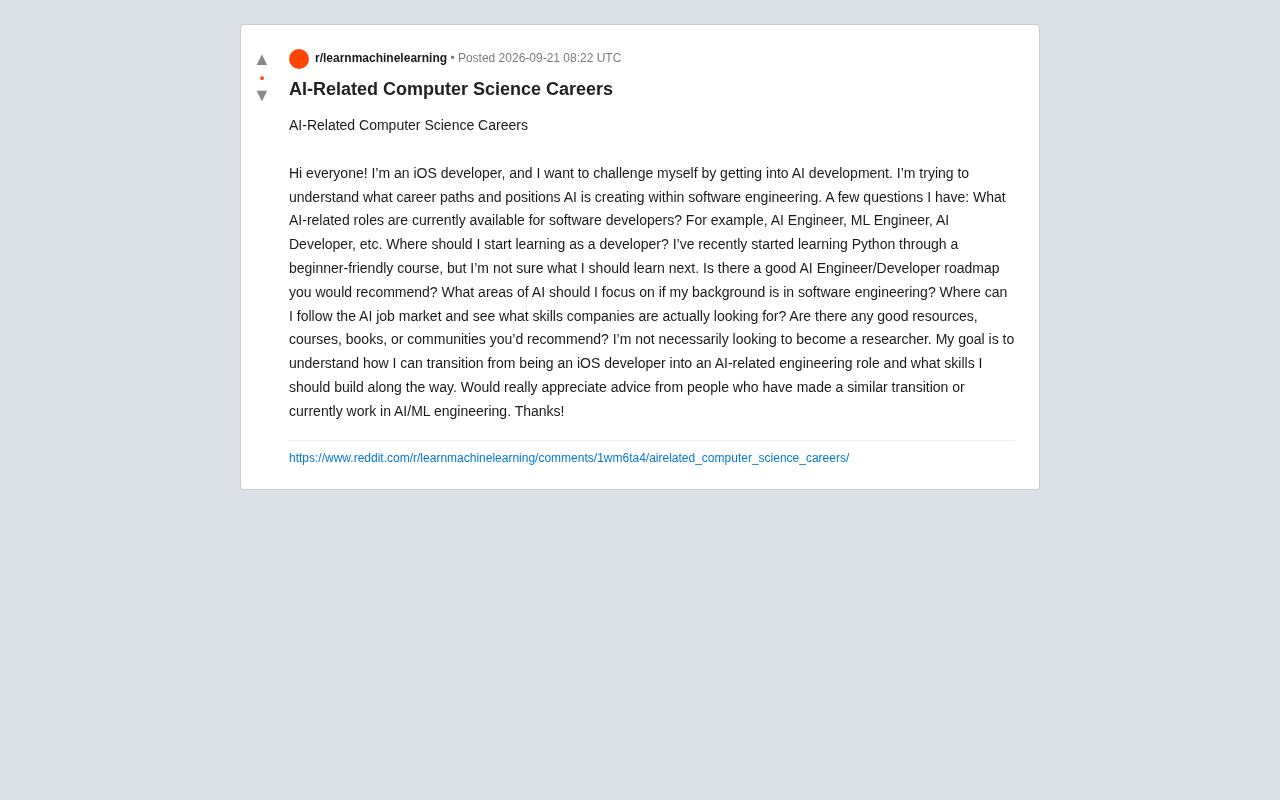
A Reddit post from an iOS developer captured a question many engineers are wrestling with: as a traditional software developer, how do you break into AI development? The poster had already started learning Python but felt lost about what to learn next, which roles were available, and how to track the AI job market. This question reflects a broader skill reckoning happening across the entire software industry.
For developers who already have engineering chops, transitioning to AI doesn't mean starting from scratch. In fact, the skills you've already built — systems design, code architecture, API integration — remain scarce and highly valued in AI engineering. The key is understanding what new roles AI has created and what those roles actually require.
What AI-Related Roles Actually Exist
Many people loosely use the term "AI engineer" as a catch-all, but in practice the market has quite distinct roles with very different background requirements.
ML Engineer (Machine Learning Engineer)
This is the AI role most closely related to traditional software engineering. ML Engineers are responsible for deploying models to production, managing data pipelines, model training workflows, and optimizing inference service performance. For iOS developers, this path has clear advantages — you're already familiar with engineering thinking, version control, and performance tuning. You mainly need to fill in the modeling knowledge on the machine learning side.
AI Engineer (AI Application Engineer)
With the rise of large language models, a new class of roles has emerged focused on "building products with AI capabilities." These engineers don't necessarily need to train models from scratch. Instead, they work around existing LLMs to build RAG (Retrieval-Augmented Generation) pipelines, Agent orchestration, prompt engineering, and API integrations. This is precisely the direction with the lowest barrier to entry and the fastest-growing market demand.
RAG (Retrieval-Augmented Generation) is a core architectural pattern in modern AI application engineering: before generating a response, the system retrieves relevant document chunks from an external knowledge base and provides them as context to the LLM, allowing the model to answer based on private or up-to-date data rather than relying solely on its trained parameters. Agent orchestration refers to using code or frameworks to coordinate multiple tool calls, subtask decomposition, and multi-step reasoning so that LLMs can handle more complex automated tasks — such as automatically browsing the web, executing code, or calling external APIs. Neither capability requires model training, but both demand that engineers deeply understand data flow design, context window management, and error handling — areas that map directly onto the systems design experience traditional software engineers already have.
ML Research / Research Engineer
This is a research-oriented role that typically requires a strong math background and the ability to reproduce research papers. The original Reddit poster explicitly said they didn't want to go into research, so this path can be set aside for now — but understanding its boundaries helps narrow focus.
A Learning Roadmap for Software Developers
For the core question of "what to learn after Python," here's a practical sequence to follow.
Build a Foundation in Data and Modeling
After Python, prioritize data processing libraries like NumPy and Pandas, then move into machine learning frameworks. Start with scikit-learn to understand the basic paradigms of supervised and unsupervised learning, then transition to PyTorch or TensorFlow for deep learning. Classic courses like Andrew Ng's Machine Learning and Deep Learning Specializations remain widely recognized starting points.
Focus on the LLM Application Layer
Given an engineering background and no desire to do research, the most efficient path is to go deep on LLM application development. Learn how to call APIs from OpenAI, Anthropic, and others; get comfortable with frameworks like LangChain or LlamaIndex; and understand how vector databases, embeddings, and RAG work. Skills at this layer can help you ship valuable AI products within months, quickly building up a portfolio.
Vector databases are the key infrastructure underpinning RAG systems. Unlike traditional relational databases that match on exact field values, vector databases store high-dimensional numerical vectors — the output of encoding text or images through an embedding model — and use Approximate Nearest Neighbor (ANN) algorithms to retrieve results by semantic similarity. Even if a query's wording differs from a document's, semantically similar content can still be retrieved. Popular vector databases include Pinecone, Weaviate, Chroma, and pgvector (a PostgreSQL extension). Embeddings essentially map discrete text into coordinate points in a continuous vector space, where semantically similar content sits closer together. Understanding this mechanism is critical for building search, recommendation, and Q&A AI products — and it's one of the core technical insights that separates AI application engineers from developers who just call an API.
Drive Learning Through Projects
For developers, the best way to learn is by building. Try integrating AI capabilities into iOS apps you're already familiar with — for example, building a locally running intelligent assistant, an image recognition feature, or a semantic search experience. Real projects demonstrate your transition far more convincingly than completing ten courses.
How to Track the AI Job Market and Skill Demands
The original post also asked where to track AI roles and real skill requirements. A few practical approaches:
Read job descriptions directly on hiring platforms for AI Engineer and ML Engineer roles — it's the most direct way to understand what companies actually need. Compile the skill keywords that appear repeatedly across multiple JDs and you'll have a practical learning checklist. Beyond that, the Hugging Face community, Papers with Code, and technical blogs by working AI engineers are all quality channels for staying technically sharp. Contributing to open source projects and joining relevant Discord or Reddit communities will also give you ground-level feedback from practitioners.
Transition Advice: Leverage — Don't Abandon — Your Engineering Strengths
For someone in the iOS developer's position, the most important mindset shift is this: don't think of yourself as an AI newcomer. Think of yourself as an "engineer who can wield AI." What the industry needs most right now isn't yet another algorithm researcher starting from zero — it's people who combine product engineering experience with the ability to harness AI capabilities.
The recommended action path: solidify Python and ML fundamentals → focus on breaking into LLM application development → build a portfolio of real projects → continuously close gaps by benchmarking against job requirements. Compared to pivoting into research, the AI application engineer path is far more accessible for existing software developers and offers a much shorter payback period.
Related articles

How Big Can Stars Really Get? The Physical Limits of the Largest Stars
Red supergiants are the largest stars by volume, with radii up to 2,000 times the Sun, engulfing the inner solar system. But there is no precise upper limit on stellar size—models predict up to 15,000 solar radii. The most massive blue stars are far smaller than red supergiants—biggest and heaviest are two different things.

Apple HomeView Smart Display Full Feature Breakdown: Wall-Mount or Desktop, $299
Apple launches HomeView, a $299 smart display with wall-mount and desktop options, 12MP camera for facial recognition, smart home control, music playback, and recipe step-by-step cooking. Full breakdown of watch faces, apps, privacy, and cooking integration.

Where Did the Promised New Studio Go? Craft Computing Answers After Five Years
Craft Computing's host responds to viewer questions: the new studio promised five years ago was shelved as construction costs soared from $30,000 to $75,000, and was replaced by a 168-square-foot garage conversion.