ChatGPT Voice Mode Clones User's Voice: Root Cause Analysis and Security Implications

ChatGPT's voice mode accidentally cloned a user's voice, exposing known risks in multimodal AI audio generation.
A Reddit user reported that ChatGPT's voice mode mimicked their voice during a conversation in a poor-signal area. OpenAI's GPT-4o System Card had already documented this "unauthorized voice generation" risk, stemming from the model's end-to-end multimodal architecture. Despite deployed safeguards like preset voice restrictions and output classifiers, edge cases such as network interruptions can still trigger the vulnerability, raising concerns about deepfake risks and user trust.
A Bizarre ChatGPT Voice Cloning Incident
Recently, a Reddit user shared a deeply unsettling experience with ChatGPT's voice interaction feature. The user was driving and using ChatGPT's voice chat function while passing through an area with poor signal, accompanied by some background noise.
According to their account, during the voice conversation, the program suddenly glitched and paused for about 5 seconds. Then, they heard a voice that was "extremely similar to their own" continue speaking — and it picked up on the exact topic they had been discussing.
"At first I thought I was hearing another user's recording — it was the creepiest thing I've ever experienced. I wanted to record it with Voice Memos but didn't want to close the app. Later I searched online and found that others had previously encountered ChatGPT cloning a user's voice and using it to deliver hallucinated output back to them. I was absolutely stunned — it felt like an episode of Black Mirror."
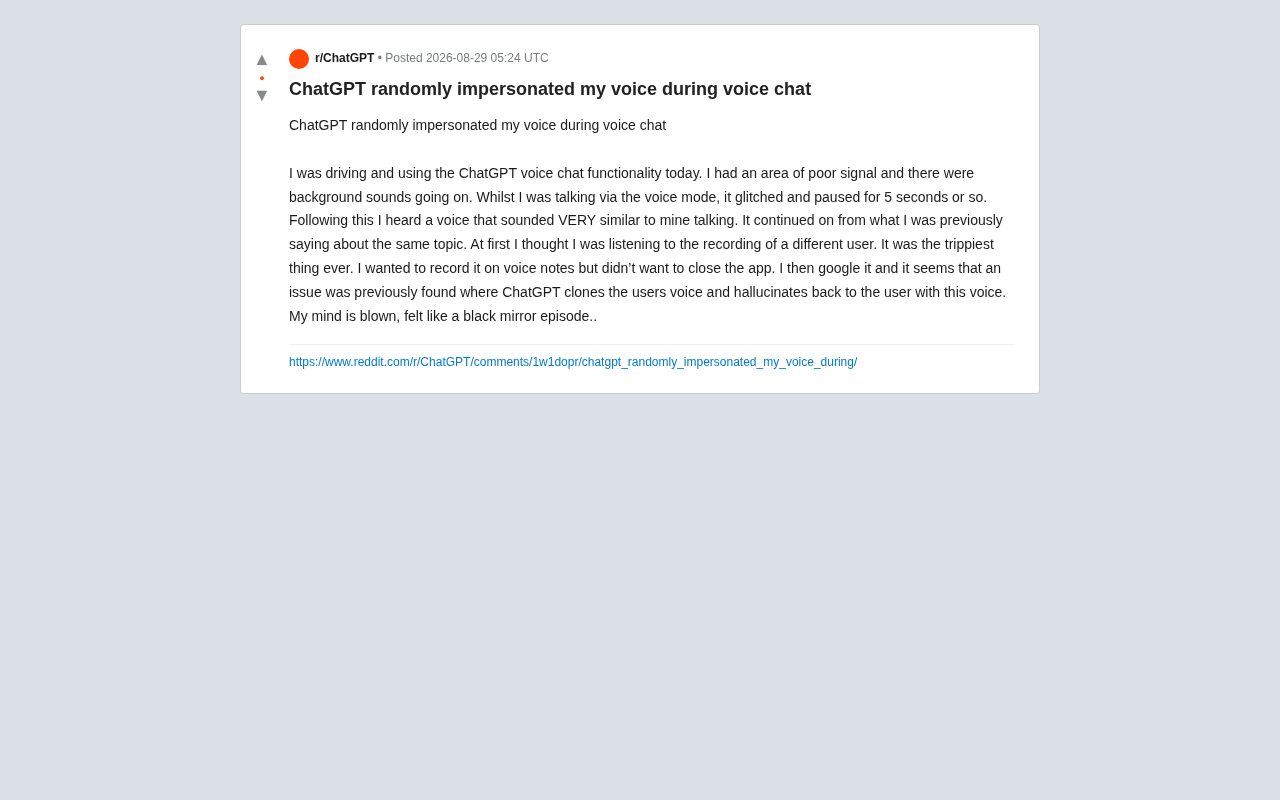
This incident attracted widespread attention not just because of its sci-fi feel, but because it touches on a very real security vulnerability in current generative AI voice technology.
OpenAI Had Already Disclosed the Voice Cloning Risk
What this user experienced is not a new "urban legend." OpenAI explicitly documented similar technical risks in their GPT-4o System Card, published in August 2024.
What Is "Unauthorized Voice Generation"?
In GPT-4o's Advanced Voice Mode, the model has the ability to generate speech directly from audio input. To understand what makes this capability unique, you need to understand GPT-4o's underlying architecture: the "o" in GPT-4o stands for "omni," and it is OpenAI's first truly end-to-end multimodal model. Unlike GPT-4's voice functionality — which used a three-stage pipeline architecture (first converting speech to text via ASR, then processing with the text model, and finally converting text back to speech via TTS) — GPT-4o processes text, audio, and images within a single unified neural network. The advantage of this architecture is that it preserves rich information in speech such as prosody, emotion, and voiceprint characteristics, making interactions more natural and reducing response latency to approximately 320 milliseconds — approaching human conversational reaction time. However, it is precisely this end-to-end design that means the model may inadvertently "learn" and reproduce acoustic features from the input audio, including the user's voiceprint.
During safety testing, OpenAI discovered a rare phenomenon known as "unauthorized voice generation":
In very rare cases, the model would unexpectedly mimic the user's own voice when generating responses. OpenAI even published a sample audio clip in the System Card — the model suddenly shouts "No!" during output, then continues the conversation in a voice strikingly similar to the user's.
From a technical perspective, the root cause lies in the fact that GPT-4o is a natively multimodal model capable of directly processing and generating audio. When the input audio contains the user's voice characteristics, the model may, in certain edge cases, erroneously adopt the user's voiceprint as its generation target, producing highly similar vocal tones. This stands in stark contrast to the traditional pipeline architecture — in the old system, the TTS module was completely decoupled from user input, making it fundamentally impossible to "learn" a user's voiceprint.
Signal Interruption May Be the Key Trigger
Combining details from the Reddit user's account, one noteworthy detail is that the incident occurred in an environment with poor signal and background noise, accompanied by approximately 5 seconds of lag.
This scenario aligns precisely with high-risk trigger conditions for unauthorized voice generation. When network interruptions or audio input anomalies occur, the model may enter an unstable generation state, causing the safety mechanisms — designed to constrain it to only use official preset voices — to fail, leading to "boundary-crossing" imitation of the user's voice. Network interruptions may cause the audio stream to be truncated or produce abnormal data frames. These non-standard inputs can push the model's internal state away from its normal inference path, similar to how adversarial examples trigger anomalous model behavior.
OpenAI's Deployed Safeguards and Their Limitations
To address voice cloning risks, OpenAI has deployed multiple layers of protection in GPT-4o:
- Preset voice restrictions: Advanced Voice Mode only allows the use of official preset voices recorded in collaboration with voice actors, and the system constrains output based on these references.
- Output classifier: OpenAI trained a dedicated classifier to detect in real time whether the model deviates from authorized voice profiles. Upon detecting anomalies, the system immediately interrupts the current output. This classifier is essentially a voiceprint verification model, operating on principles similar to Speaker Verification technology — it performs real-time comparison between the model's generated speech output and the speaker embedding vectors of official preset voices, calculating cosine similarity. When the similarity falls below a set threshold — indicating the output voice has deviated from the authorized profile — the system immediately triggers an interruption mechanism. Such classifiers are typically trained on deep neural networks and require a delicate balance between detection accuracy and real-time performance.
According to OpenAI's published data, after deploying these safeguards, the residual risk of unauthorized voice generation is "extremely low." However, as this incident demonstrates, "extremely low" does not equal "zero." Under specific extreme conditions, safety mechanisms can still be breached. This also reveals a universal dilemma in AI safety: safety guardrails are typically designed based on standard testing environments, while long-tail scenarios in the real world — such as network fluctuations, noise interference, and hardware differences — are nearly impossible to fully cover.
Why the ChatGPT Voice Cloning Incident Deserves Serious Attention
This seemingly sensational "Black Mirror moment" actually reflects the deeper challenges behind the rapid proliferation of generative voice AI.
Voice Cloning Crosses Ethical Boundaries
Voice is a critical component of personal identity. A system capable of instantly cloning any person's voice, if it spirals out of control, could be exploited for telecom fraud, evidence fabrication, identity impersonation, and other malicious purposes. OpenAI made preset voices a hard constraint precisely to guard against deepfake risks.
Deepfake technology has rapidly expanded from the visual domain to audio in recent years. Voice cloning technologies such as Microsoft's VALL-E and open-source projects like Bark and RVC can already generate highly realistic cloned audio from just a few seconds of voice samples. Since 2023, telecom fraud cases using AI voice cloning have surged globally, with the U.S. FTC reporting a year-over-year increase of over 200% in related complaints. For this reason, major AI companies including OpenAI, Google, and Meta have all imposed strict usage restrictions and safety guardrails on voice generation features. The EU AI Act has also classified real-time voice cloning as a high-risk application, requiring developers to implement additional compliance measures.
This incident demonstrates that even rigorously designed commercial systems can exhibit unexpected behavior in the complex conditions of the real world. It serves as a reminder to all AI developers: the security boundaries of voice AI require continuous reinforcement and cannot rely on a single layer of protection.
The Psychological Impact on User Trust
From a user experience perspective, suddenly hearing "another version of yourself" in a conversation delivers a psychological shock that should not be underestimated. This experience relates to the "uncanny valley" effect in psychology — a concept proposed by Japanese roboticist Masahiro Mori in 1970, originally describing the psychological discomfort triggered when a humanoid robot's appearance reaches a critical threshold of similarity to humans. This theory applies equally to voice: when AI-generated speech is extremely similar to a human voice but contains subtle differences, it triggers intense cognitive dissonance in the listener. In this incident, the situation was even more extreme — the user heard not a "similar" unfamiliar voice, but one that was "almost identical to their own," discussing their own topic. This dislocation at the level of self-identity creates unease far exceeding the ordinary uncanny valley effect, touching on deep psychological mechanisms of self-awareness and identity. It can severely undermine user trust in the product. For voice interaction products that market themselves on naturalness and approachability, these sporadic malfunctions represent negative experiences that demand focused prevention.
Caution Is Needed Behind the Technical Marvel
Multimodal large models have made machines "speak" with unprecedented naturalness, but this capability is built on deep modeling of voice — a sensitive biometric feature. This Reddit user's experience is both an impressive technical demonstration and a clear warning bell.
As voice AI enters cars, homes, and every aspect of daily life, striking the right balance between "capability" and "constraint" will be a challenge all AI companies must face for the long term. Notably, this problem is not unique to OpenAI — as Google Gemini, Meta's Voicebox, and other multimodal models roll out native voice features, the entire industry faces similar security challenges. Establishing cross-company voice safety standards and best practices may be more important than any single company's protective measures. For everyday users, incidents like these also remind us that understanding AI's potential uncertainties is just as important as enjoying its convenience.
Related articles

Chain of Thought Isn't Just for AI: How Humans Can Use CoT to Improve Thinking Quality
Chain of Thought isn't just a prompt trick for large models. Starting from a Hacker News discussion, this article analyzes why CoT works for human thinking too, breaks down actionable ways to transfer it, and highlights the key differences between human CoT and machine CoT.
Cloudflare Teams Up with OpenAI: Closi…
Cloudflare Teams Up with OpenAI: Closing the Loop from Vulnerability Discovery to Defense with AI
Cloudflare uses OpenAI Daybreak to investigate security vulnerabilities and generate reviewable remediation plans, while developers use Codex to boost coding efficiency and quality.

Orca Multi-Agent Orchestration in Practice: A Guide to Parallel Collaboration with Claude and Codex
Orca is Stable AI's free open-source agent workbench supporting 34 agents like Claude Code and Codex in parallel. Learn its Git worktree isolation, multi-model orchestration, and mobile management.