From LLM to Super Agent: A Complete Breakdown of Core Concepts in Large Model App Development

A full breakdown of LLM, RAG, Agent, MCP, and Skills — the core concepts behind modern AI app development.
This article traces how large model applications are built from the ground up — starting with the LLM's core nature (predicting the next token), then unpacking Prompt, Context, Memory, RAG, Function Calling, MCP, Agent, Skills, and SubAgent. The central argument: all these technologies address the same fundamental tension — LLMs are stateless, one-shot workers, while real tasks are continuous and require external data and multi-step tool use. An Agent is ultimately a "prompt wrapper," and its real value lies in the deterministic parts that don't need AI at all. Convenience supremacy drives Agents toward zero-config, out-of-the-box experiences — exactly what OpenClaw delivered.
Scrolling through videos and articles, you can't escape terms like OpenClaw, Skills, MCP, and Agent — but what exactly are they, and how do they work together? This article, based on a Bilibili creator's deep-dive on large model application development, untangles these seemingly scattered concepts in one go, helping you understand from the ground up how AI applications are built step by step.
The Foundation: LLM, Prompt, Context, and Memory
Before you can understand the impressive-sounding stuff like Agent and RAG, you need to get four foundational concepts straight — LLM, Prompt, Context, and Memory. Every complex technique that comes after is built on top of these.
Language models started out doing something remarkably simple: text completion. Feed it the beginning of a sentence, and it fills in the next word. But once model parameters and training data crossed a certain threshold, something clicked — the model could suddenly understand instructions, reason through problems, and even write code. Academics call this phenomenon "emergence," and the large models that emerge from it are what we call LLMs (Large Language Models).
The key is to stay clear-eyed about what an LLM fundamentally is: think of it as an extremely capable employee with one core constraint — it only works in single exchanges. Ask a question, get an answer, done. It won't proactively follow up. No matter how smart it seems, its underlying mechanism is still "predict the next token." Understanding this is the key to understanding everything that follows.
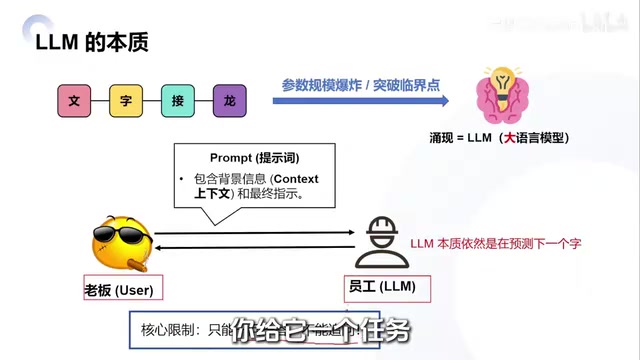
Given this "one-shot super employee," how do you get the most out of each interaction? The answer is to maximize the efficiency of every prompt. A well-crafted Prompt can be split into two parts: Context (background information for the task) and Instruction (the specific request). For example, "We're running a campaign targeting young users" is Context; "Write three ad slogans" is the Instruction. Separating these clearly tends to produce much better results.
Memory, at its core, isn't mysterious at all. Since an LLM "forgets" everything after each exchange, engineers came up with a workaround: pack the previous conversation history into the Context of the next prompt. The LLM then sees the full conversation history and can "pretend" to remember earlier exchanges. A more advanced approach has the LLM summarize the lengthy history into a few sentences before storing it as Memory, to conserve space.
A note on "Emergence" Emergence is worth unpacking a bit more, since it's central to understanding modern LLMs. Capabilities that are barely observable in small models — logical reasoning, analogy, code generation — suddenly appear once parameter counts cross a certain threshold, rather than improving smoothly as scale increases. This phenomenon was systematically documented in the 2022 Google Research paper Emergent Abilities of Large Language Models. Why emergence happens is still an open question in academia, but it's precisely what gave rise to useful models like GPT-3, GPT-4, and Claude — and it's the fundamental dividing line between LLMs and earlier statistical language models. Keeping this in mind helps explain why both early chatbots and modern LLMs are "predicting the next word," yet early chatbots fell apart under the slightest scrutiny while modern LLMs can handle complex multi-step reasoning.
Expanding Capabilities: Giving AI the Ability to Look Things Up and Take Action
LLMs have one glaring weakness — they're offline. Ask about today's weather or yesterday's stock price, and they'll either hallucinate an answer or tell you their knowledge has a cutoff date, because once training ends, the connection to the outside world is severed. The fix is to let them look things up, and there are two main approaches.
The first is Search: write a small program that queries a search engine on the LLM's behalf, then feed the results back in. The second is RAG (Retrieval-Augmented Generation): same logic, but searching your own documents or databases — a company's internal product manuals, customer service records, contract templates, and so on. Relevant passages are retrieved first, then stuffed into the Prompt. Either way, the core idea is the same: bring external information into the Context so the LLM can answer based on current data.
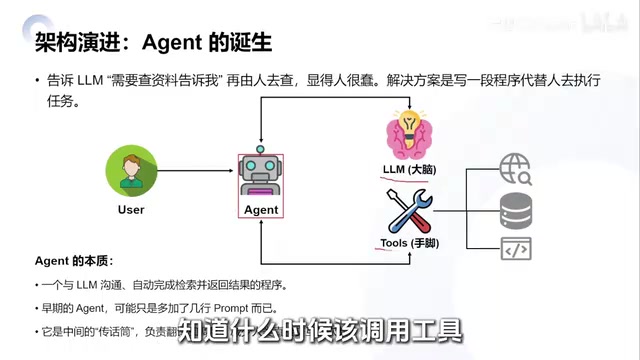
But Search and RAG still require manual triggering — too cumbersome. So developers built an intermediary program to run errands on the LLM's behalf: the Agent. Instead of talking directly to the LLM, the user hands things off to the Agent, which acts like a chief of staff — knowing when to let the LLM think and when to call a tool. The LLM handles the reasoning; Tools handle the execution; the Agent handles coordination. At its core, an Agent is an automated orchestrator that reduces the need for repeated human intervention.
Once tools are in play, a new problem emerges: communication can get chaotic. Here it helps to distinguish two concepts. Function Calling is the LLM's own built-in capability to output in a specific structured format (usually JSON) — think of it as an "API contract" between the LLM and the Agent, preventing misinterpretation of intent. MCP (Model Context Protocol), on the other hand, is a universal connection protocol — the "USB port for AI." It defines two core operations: a tools list (telling the Agent what tools are available) and a tools call (invoking a specific tool). As long as a tool developer builds an MCP-compliant server, any MCP-compatible application can plug right in without custom integration work.
In short: Function Calling is the standardized signal the LLM sends to the Agent; MCP is the standardized work order the Agent sends to the Tools. Both are needed to turn a fragmented system into a coordinated one.
A note on RAG and MCP
RAG's retrieval step typically relies on a vector database: documents are split into chunks, converted into high-dimensional numerical vectors by an embedding model, and stored. When a user asks a question, it's similarly converted into a vector, and semantically similar chunks are retrieved using methods like cosine similarity, then sent to the LLM along with the question. This means RAG retrieves content based on semantic similarity, not keyword matching — which works better for natural language questions. Its limitation: if the source documents are low quality, the chunking strategy is poor, or the question requires synthesizing information across multiple passages, the retrieved chunks may be insufficient for an accurate answer, and hallucination remains a risk.
MCP (Model Context Protocol) was proposed by Anthropic in late 2024, with the goal of becoming a universal standard for AI tool integration. Its core value is decoupling "tool description" and "tool invocation" from each application's proprietary implementation: tool developers implement a single MCP-compliant server, and any MCP-compatible client (Claude Desktop, Cursor, OpenClawAd, etc.) can discover and call it directly, with no per-platform adaptation needed. The analogy to USB-C holds up well — before MCP, every AI application was reinventing the wheel of "how to connect to tools."
Evolving Forms: From Workflow to Skills to SubAgent
As tasks grow more complex, how do you keep AI reliable and manageable? The central tension here is that regardless of the interface — CLI, IDE, desktop assistant — long workflows are notoriously unstable.
Consider asking AI to translate an English PDF into Chinese and save it as a Markdown file. This involves extraction, translation, formatting, and saving — multiple steps. If left entirely to an Agent's discretion, it might pick the wrong tool on step one, and will waste huge amounts of tokens re-reasoning through the entire workflow every time. Here's a key insight: extracting a PDF and saving a Markdown file are deterministic operations — a few fixed scripts will do. Only the translation step genuinely requires AI intelligence. The right approach is: fix what can be fixed, make intelligent what needs to be intelligent.

Three approaches emerged for locking down workflows: Pure code is most stable but completely inflexible. LangChain wraps prompts, memory, and tools into components you can chain together like LEGO — but you still need to code. Workflow (visual, low-code drag-and-drop) lowers the barrier dramatically, but hits a "combinatorial explosion" ceiling — as the number of input/output formats grows, the number of workflows you need to draw explodes.
This is where the recently popular Skills concept comes in. A Skill is a standardized, self-contained capability unit. When a user issues a task, the system loads the relevant Skill folder, which must include a Skill.md file recording core metadata (what it does, what inputs it needs, what constraints apply), plus optional executable scripts, reference documents, and static assets. The benefit: no matter who built the Skill, as long as it follows the structure, the Agent can read and invoke it — and Skills are modular and reusable. A Skill is essentially a fixed workflow and its necessary constraints packaged as a plugin, letting the Agent exercise intelligence within defined guardrails: the best of both flexibility and control.
Even with Skills, highly complex tasks run into "context explosion" — cramming everything into the main Agent's context window causes the model to lose track and lose focus. The solution is divide and conquer: enter SubAgent. The main Agent handles orchestration, breaking the large task into smaller ones and delegating to independent SubAgents. A SubAgent's purpose isn't to create a new brain — it's to create context partitioning, like opening multiple browser tabs that don't interfere with each other. The core goal is to ensure that a subtask's context doesn't pollute the main task's context, achieving information isolation.
A note on LangChain and context explosion
LangChain is one of the most widely used large model application development frameworks, open-sourced by Harrison Chase in late 2022. Its core contribution is an abstraction layer: LLM calls, prompt templates, memory management, tool invocation, and vector retrieval are all packaged as standardized components that can be chained together. LlamaIndex focuses more narrowly on RAG scenarios, offering richer document chunking, indexing, and retrieval strategies. The shared drawbacks: steep learning curve, frequent breaking changes, and over-abstraction that can make debugging painful. The "context explosion" problem is particularly acute when building long-horizon Agents with these frameworks: every LLM call stuffs the full history of prior tool call results into the context, token consumption accumulates rapidly, and eventually the model's attention degrades or the context window limit is hit. The SubAgent architecture fundamentally cuts off this accumulation by giving each subtask its own isolated context window.
The Ultimate Form: The Essence of Agent and the Supremacy of Convenience
Strip away all the technical layers, and what is an Agent at its core? The answer might surprise you — an Agent is essentially just a "prompt wrapper" sitting between us and the large model.

On one side, it automatically adds context, searches the web, queries knowledge bases, and reads Skill documentation — all to give the large model more background so it doesn't have to guess. On the other side, it offloads deterministic logic to conventional programs (OCR for PDFs, direct parsing for Word files). So an Agent isn't an all-knowing brain — it's a smart chief of staff that knows when to think for itself and when to call in a script. The key insight is this: an Agent is made up precisely of the parts that don't require intelligence. Its real value lies in all the places where you don't need to ask the large model anything.
From pure code to Workflow to Skills to pure Agent, there's a spectrum from "rigid and stable" to "flexible and adaptive." There's no perfect solution, only the most appropriate choice for the current stage. And the core force driving Agent evolution is convenience trumps everything — if users find it useful, the market will pay for it, even if the underlying code is a mess or it burns hundreds of dollars in tokens a day. Token costs are falling fast anyway.
The author proposes a "convenience supremacy theorem," drawing on the examples of Spring Boot and uv: neither is the most technically sophisticated option, but both are the easiest to use. No matter how elegant a technology is, if it makes a user click one extra button or memorize one extra command, it will be displaced.
This also explains why OpenClaw went viral. Under the hood, it's technically almost indistinguishable from Claude Code — but it got three things right: you don't need to open a complex IDE, you just issue commands inside a messaging app; it supports scheduled tasks, so it can proactively do work like a personal assistant; and it has visual Skill management, letting you add capabilities with one click like installing an app. These three things made ordinary users feel, for the first time, that this was "an agent that can actually do things for me."
This points to a bold prediction about the Agent's ultimate form: the future will bring packaged "super Agents" where MCP configuration, Skill scripts, and SubAgent orchestration are all hidden in the background. Users just say "help me arrange next week's business trip," and the rest is handled automatically — zero configuration, out-of-the-box, learning your preferences over time.
A Learning Roadmap
For those who want to learn this systematically, a phased roadmap was outlined: L0 — build Python fundamentals; L1 — develop an overall understanding of large models and master prompt engineering; L2 — learn RAG pipeline construction and tools like LangChain and LlamaIndex; L3 — master core Agent architecture from single-agent to multi-agent systems, task orchestration, and hands-on projects; L4 — advance to model fine-tuning and private deployment to build domain-specific vertical models. This path from concepts to implementation maps neatly onto the technical evolution laid out in this article.
Related articles

Gmod TTT: Boba's Winning Streak and Game Design Insights
An in-depth analysis of Gmod TTT's role system, creative items, and social gameplay mechanics, exploring the relationship between randomness design and game balance through Boba's winning streak phenomenon.

FlexBudget: Fair Comparison of KV Cache Eviction Strategies Under a Unified Compute Budget
AMD engineer proposes FlexBudget at PyTorch Conference: a training-free fair comparison method for KV cache eviction rules using fixed kernels and memory budgets, all in core PyTorch.
