From Micro-Behavior to System Intervention: Deconstructing an Obscure yet Highly Effective Platform-Based Research Paradigm

Granular investigation and operations yield remarkable results yet remain obscure—rooted in misaligned academic incentives, not methodological ineffectiveness.
Starting from a Reddit developer's confusion about a "granular investigation and operations" platform, the article proposes "research granularity" as an underappreciated dimension. It analyzes three obstacles to its rarity: the mismatch between platform construction costs and paper output, reproducibility tensions from engineering coupling, and privacy/ethical thresholds from individual-level data. Multi-source discussions cross-validate that the core contradiction is the imbalance between engineering investment and academic reward. The article notes "remarkable results" is only a single-source subjective description and advises practitioners to treat the platform as a research object, embed privacy and reproducibility design upfront, and proactively name the paradigm.
When "Granularity" Becomes the Dividing Line in Research
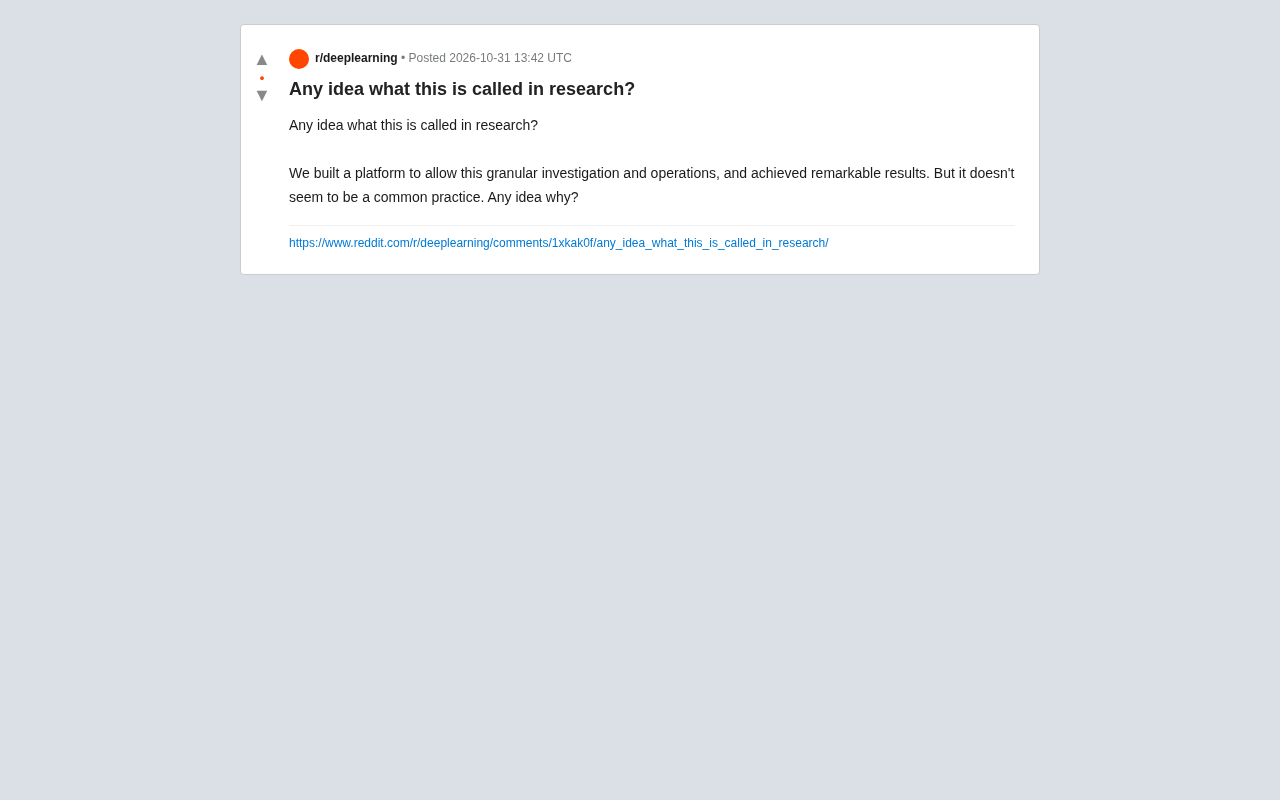
In a technical discussion forum on Reddit, a developer raised a thought-provoking question: their team built a platform for "granular investigation and operations" and claimed to have achieved remarkable results, but wondered why this approach is not common in research.
This actually touches on an underappreciated dimension in AI and data-driven research—research granularity. Most studies remain at the level of aggregate metrics, while a small number of teams choose to build platforms to observe and intervene down to extremely fine units. The latter's results are often striking, yet difficult to replicate and disseminate.
Granular Investigation: Building an Operable Bridge Between "Individual" and "System"
So-called granular investigation and operations essentially work at the smallest observable unit of a system. In AI products, for example, this might be a single user's interaction path or the output distribution of a single model call; in complex systems, it might be the state fluctuation of a particular node.
Unlike traditional research paradigms, this platform-based path does not start with theoretical hypotheses and then collect data. Instead, it first makes the system observable and intervenable, then seeks patterns during real operation. The "remarkable results" mentioned by the original poster likely stem precisely from this closed loop of "running, observing, and intervening simultaneously."
Such practices have several loosely corresponding names in academia: micro-behavior analysis, unit-level experimental platforms, fine-grained system intervention, operational research infrastructure. The lack of a unified term reflects its awkward position—its engineering character outweighs its theoretical character, making it hard to fit into existing disciplinary frameworks.
Observability originally refers to the ability to infer a system's internal state through logs, metrics, and distributed tracing, and has become standard practice in distributed systems operations. This article extends it to the research context, emphasizing that researchers must first make the behavior of the smallest units "visible" before meaningful questions can be posed. Unlike the traditional "hypothesis first, sampling later" approach, the observability-driven path embeds data collection into the system's operation itself, thus capturing anomalies and long-tail patterns masked by aggregate metrics. Intervenability goes further: not only observing but also applying controlled perturbations to individual units (such as changing the parameters of a model call or pushing different strategies to specific users), enabling quasi-experiments in real environments. Together they form the "observe—intervene—observe again" loop, which is precisely the technical foundation of the original text's "running, observing, and intervening simultaneously," and also explains why such platforms require substantial engineering effort yet cannot be replaced by ready-made datasets.
Why Is It Uncommon? Three Overlooked Obstacles
The original poster asked "why," and the answer lies in the structural preferences of the research ecosystem.
The Mismatch Between Construction Costs and Academic Output
The time cost of building a platform that supports granular investigation and operations is often several times that of running experiments with existing datasets. Yet the academic evaluation system rewards paper counts and citations, not infrastructure. Even when the platform is built, it is hard to convert directly into publishable output units—creating a negative incentive.
The Tension Between Reproducibility and "Black-Boxing"
Granular operations mean that a large amount of engineering detail is coupled into the work. Other researchers find it difficult to reproduce an experiment containing complex platform logic, which conflicts with the scientific community's requirement for reproducibility. The result: impressive outcomes that are hard to verify and inherit.
The replication crisis is a widely discussed issue in the scientific community in recent years: many published studies fail to yield the same results when independently reproduced, manifesting in psychology, medicine, and even machine learning. Replication in machine learning is particularly difficult because results often depend on data versions, random seeds, hardware, and hyperparameters that are not fully documented. Granular platform-based research couples more engineering logic into the experimental workflow; if the platform code, configuration, and runtime environment are not fully disclosed, external researchers can hardly reconstruct the same conditions. The academic community's responses include: submitting the platform itself as an "artifact" of the paper, adopting containerization and versioned data, and attaching executable reproduction scripts to papers. The "black-boxing" tension described in the original text is essentially that scientific norms demand transparency and verifiability, while complex infrastructure naturally tends toward encapsulation and concealment—the two must be reconciled through engineering discipline.
The Invisible Threshold of Data Privacy and Ethics
The more granular the approach, the closer the data gets to the individual level. In AI and user behavior research, this means higher privacy compliance costs and ethical review pressure. Many teams abandon this path at the conceptual stage.
The finer the smallest observable unit, the closer the data gets to personally identifiable information (PII). Under regulatory frameworks such as the EU's General Data Protection Regulation (GDPR), processing data of identifiable individuals requires a clear legal basis, purpose limitation, and the principle of data minimization, with additional constraints on cross-border transfers. Academic ethics review (IRB) typically requires informed consent, risk assessment, and data de-identification plans, while granular platforms often require continuous collection and real-time intervention, making it difficult to exhaust all purposes before project launch. Common mitigation measures in practice include: differential privacy, federated learning, aggregated analysis within controlled environments, and keeping individual-level data local while uploading only summary statistics. These mechanisms weaken the precision of granular observation, constituting the practical reason for "abandoning at the conceptual stage" mentioned in the original text.
Cross-Validation: Shared Judgments Across Multiple Sources
According to discussions by several technical analysts on Bilibili and YouTube, the core contradiction behind the marginalization of platform-based research infrastructure is the imbalance between "engineering investment" and "academic reward." This judgment cross-validates the original Reddit poster's confusion: it is not that the method is ineffective, but that the ecosystem does not reward it.
It should be noted that current discussions of this paradigm are mostly scattered experience sharing, lacking systematic methodological summaries. The "remarkable results" mentioned in the original post are a subjective description from a single source, without quantifiable metrics or controlled experiments; readers should treat it as a practical signal rather than a confirmed conclusion.
Implications for Practitioners
If your team is building or planning to build a similar platform, three points deserve upfront consideration: design documentation and interfaces with the platform itself as a publishable research object; embed privacy protection and reproducibility mechanisms early on; and proactively name and define this paradigm, because a method without a name can hardly enter academic dialogue.
Granular investigation and operations are not a master key, but they offer a differentiated path in scenarios where aggregate metrics fail. Their obscurity is more an ecosystem problem than a value problem.
One-line Summary
Granular investigation and operations yield remarkable results yet remain obscure—the root cause lies in misaligned academic incentives, not methodological ineffectiveness.
Paragraph Summary
Starting from a Reddit developer's confusion about a "granular investigation and operations" platform, the article proposes "research granularity" as an underappreciated dimension. The granular path observes and intervenes at the smallest observable units of a system, building an observable, intervenable platform first and then seeking patterns during operation; results are striking but lack a unified terminology. The author analyzes three obstacles to its rarity: the mismatch between platform construction costs and paper output, the reproducibility tension caused by engineering coupling, and the privacy and ethical thresholds brought by individual-level data. Multi-source discussions cross-validate that the core contradiction is the imbalance between engineering investment and academic reward. The article notes that "remarkable results" is only a subjective description from a single source, and suggests practitioners treat the platform as a research object, embed privacy and reproducibility design upfront, and proactively name the paradigm.
Related articles

Xmind 2027 Launches: Mind Mapping Evolves into an AI Thinking Partner
Xmind 2027 launches on Product Hunt as an "AI thinking partner." It adds Xmind Agent for research with local documents and mind maps, and connects mind map context to ChatGPT, Claude, and other AI workflows via MCP. This article analyzes its product logic, differentiation, and open questions.

Display 1.0: Build Docs and Apps with Any Agent
Display 1.0 launches on Product Hunt, letting any Agent create docs, prototypes, and apps in one workspace, organized via Spaces and Folders into a team knowledge base with flat pricing.

UnleashX: Hire AI Employees Like People and Turn Conversations into Deliverables
UnleashX launched on Product Hunt with a pitch to hire AI employees like people: choose a role, connect CRM and tools, set rules, execute workflows end to end, and involve humans only when needed. This article analyzes its positioning, configuration logic, and human-AI collaboration boundaries.