UnleashX: Hire AI Employees Like People and Turn Conversations into Deliverables

UnleashX sells "hiring AI employees" to let AI execute workflows end to end, ranking third on Product Hunt for the day.
On Product Hunt, UnleashX proposes the concept of hiring AI employees. Through three steps—choosing a role, connecting tools such as CRM, and setting rules—it lets AI execute workflows end to end, with humans intervening only when necessary. Its positioning differs from chat assistants by emphasizing execution and deliverables, turning AI configuration from an engineering task into a management task and lowering the enterprise adoption barrier. It received 118 votes, 31 comments, and ranked third for the day, showing the concept resonates, but execution depth and trust design remain to be verified.
On Product Hunt, a product called UnleashX makes a straightforward claim: let AI be "hired" like a real colleague and turn conversations directly into work outcomes. It received 118 votes and 31 comments, ranking third for the day. This positioning hits a pain point in current AI tools—most assistants stop at answering questions, while UnleashX tries to let AI take over the complete workflow.
The Positioning Gap: From "Chatting" to "Doing Work"
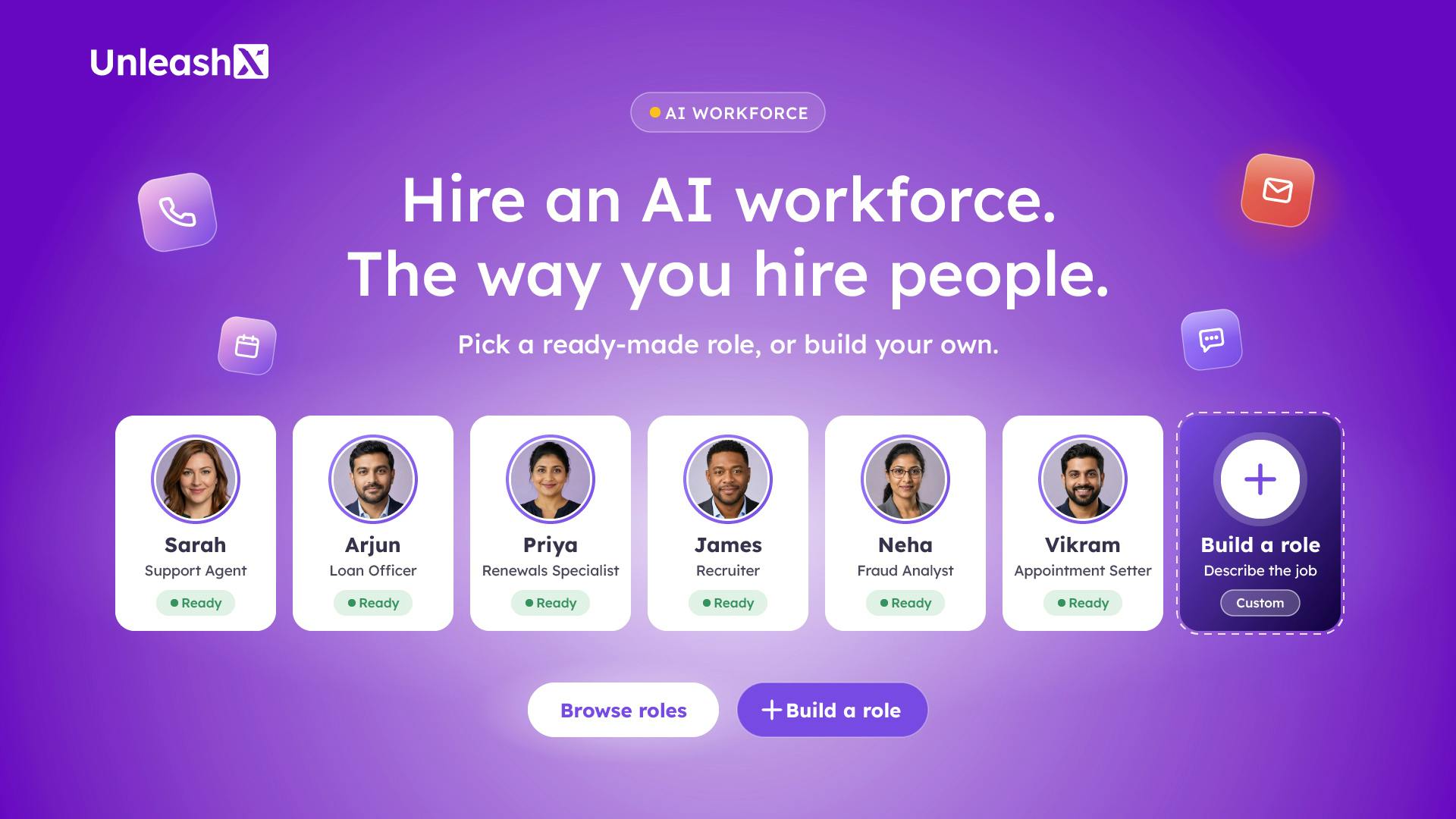
UnleashX's tagline is "AI workforce that turns conversations into outcomes." Its core logic is: users choose a role, connect CRM and existing tools, set rules, and then hand off the work. The AI employee executes the workflow end to end, bringing in humans only when necessary.
This is fundamentally different from common chatbots. Ordinary AI assistants wait for instructions and give suggestions, while UnleashX emphasizes execution—it is designed to take over processes, call external systems, and push tasks forward until completion. The phrasing "hire AI employees like people" on the product page suggests an organizational metaphor: AI is not a tool, but a configurable position.
This approach is not surprising in the Productivity category. The essence of enterprises buying software is buying capacity. If AI can be "hired" by role and directly held accountable for results, procurement decisions become closer to labor outsourcing rather than software subscriptions.
CRM (Customer Relationship Management) systems are core software used by enterprises to manage customer information, sales processes, and interaction records, such as Salesforce and HubSpot. In AI workflows, connecting to a CRM means AI can read customer data in real time, update sales stages, and automatically record communication content, thereby turning conversations into concrete business actions. For "AI employee" products, CRM integration is one of the key indicators of execution depth—whether it can securely read and write core enterprise data directly determines whether AI can truly take over the complete processes of roles such as sales and customer service.
How Role-Based Configuration Lowers the Barrier to Adoption
UnleashX's configuration path is very specific: choose a role, connect tools, set rules. These three steps correspond to common obstacles enterprises face when adopting AI—not knowing what to let AI do, data silos, and the lack of behavioral boundaries.
Role-based configuration means the product comes with job-level task templates, so users do not need to design prompts or workflows from scratch. Connecting CRM and tools solves data and operation permission issues, allowing AI to read business context and write results. Setting rules is the control layer, determining under what conditions AI acts and when it stops to find a human.
This design moves AI configuration from an "engineering task" to a "management task." For small and medium-sized enterprises without dedicated AI teams, this reduction in abstraction level may determine whether the product is usable more than model capability itself.
Prompt Engineering refers to the technique of carefully designing input instructions to guide large language models to produce expected results. Traditionally, to get AI to complete complex tasks, one needs to write multi-turn prompts and design chains of thought, which creates a high barrier for non-technical people. UnleashX replaces prompt engineering with "role + rules" configuration, essentially encapsulating underlying model interactions into a management interface, letting business users describe job responsibilities and boundary conditions in natural language while the product translates them into executable AI behavior. The value of this abstraction layer lies in turning AI deployment from a "project-based" effort requiring a dedicated algorithm team into a "management task" that business departments can operate independently.
The Boundary of Human-AI Collaboration: When Human Intervention Is Needed
UnleashX explicitly retains a human intervention mechanism, and when AI executes workflows it only asks a human to take over when needed. This is both risk control and part of the product positioning—it does not promise full automation, but places humans in the exception-handling position.
Judging from the heat of discussion in the product comment section, 31 comments indicate that early users have real concerns about boundary issues. End-to-end execution means AI will take actions that affect the business, and the design quality of rule setting and intervention timing directly determines whether users dare to hand over critical processes. This is also the common trust threshold faced by all "AI employee" products: demonstrating capability is easy, dividing responsibility is hard.
The "exception handling" mechanism in human-AI collaboration refers to AI proactively pausing and requesting human confirmation when it encounters low-confidence, rule-uncovered, or high-risk decisions during automated workflow execution. In "AI employee" products, the design quality of this mechanism is directly related to trust building: if intervention is too frequent, the automation value of AI is weakened; if intervention is insufficient, it may create business risk. Ideal boundary design needs to combine the granularity of the rule engine (such as amount thresholds, customer tiers, and operation types) with AI's self-assessment capability, so that human intervention is both safe and not a bottleneck. This is also one of the core challenges for current AI Agent products moving from demos to production environments.
Market Position and Signals Worth Watching
Ranking third with 118 votes is a mid-to-upper first-day performance on Product Hunt, not enough to prove product maturity, but it shows that the concept of "AI workforce" resonates. The Productivity track is crowded, and UnleashX's differentiation is not in the model, but in the delivery form—using an employment relationship as an analogy for AI deployment, and replacing prompt engineering with roles and rules.
What needs to be observed is the actual execution depth: which tools are connected, how long workflows can run, and how detailed the rule system is. These details determine whether it is just another AI wrapper or a true process execution layer. Public information currently remains at the positioning level, and whether the product can deliver on its promise of "turning into outcomes" depends on actual usage feedback from early users.
One-line Summary
UnleashX sells the idea of "hiring AI employees," letting AI execute workflows end to end and ranking third on Product Hunt for the day.
Paragraph Summary
On Product Hunt, UnleashX proposes the concept of "hiring AI employees." Through a three-step configuration of choosing a role, connecting tools such as CRM, and setting rules, it lets AI execute workflows end to end, with humans intervening only when necessary. Its positioning differs from chat assistants by emphasizing execution and result delivery, turning AI configuration from an engineering task into a management task and lowering the barrier to enterprise adoption. The product received 118 votes, 31 comments, and ranked third for the day, indicating that the "AI workforce" concept resonates, but actual execution depth and trust mechanism design still need verification.
Related articles

Altman Says Local Deployment Can't Beat Data Centers: The Open-Source AI Debate Reignites
Altman says local deployment of open-source models can't match centralized data-center computing. Bilibili creator Guashu Diluola breaks down the technical roadmap debate and China-US AI industry differences behind the remark, asking whether local deployment should really be abandoned.

MiniMax H3 Open-Source Workflow: Breathing-Skin Results Even on Low VRAM
This article introduces a MiniMax H3 dual-sampling workflow shared by a Bilibili creator, using fused models, a line-breaking LoRA, and low-VRAM nodes to fix greasy AI character faces and run on 12GB VRAM devices. Includes model pairing, dual-sampling logic, and parameter details.

On-Device LLM + ESP32: Build a DIY Calorie Reminder
A Bilibili creator open-sourced a calorie intake reminder: a phone app uses the open-source miniCPM model to locally recognize food photos and estimate calories, while an ESP32 mini screen syncs data and shows intake status with green/yellow/red rings — magnetically attachable to the fridge door for constant reminders.