From π0 to Practice: An Advanced Project Roadmap for VLA Learners

A structured project roadmap taking VLA learners from π0.5 inference to fine-tuning, experiments, and real robot deployment.
This article provides a progressive project roadmap for VLA learners who have completed basic π0.5 inference. It covers four phases: fine-tuning on custom tasks via OpenPI, conducting ablation experiments on action generation mechanisms like flow matching, transferring models to new simulation environments, and deploying to real robots. It also suggests open research directions including long-horizon task planning, data efficiency, and multi-model comparative studies.
Introduction: What to Do After You've Got π0.5 Running
In the field of Embodied AI, Vision-Language-Action models (VLA) are becoming one of the hottest research directions. VLA is a class of end-to-end models that unifies visual perception, natural language understanding, and robot action generation within a single architecture. Traditional robot control pipelines typically separate perception, planning, and control into independent modules, while VLA attempts to use a single large model to directly map from images and language instructions to continuous action spaces. This paradigm is inspired by the success of Large Language Models (LLMs)—if text can be processed with a unified Transformer architecture, then perhaps vision, language, and actions can also be fused within the same representation space.
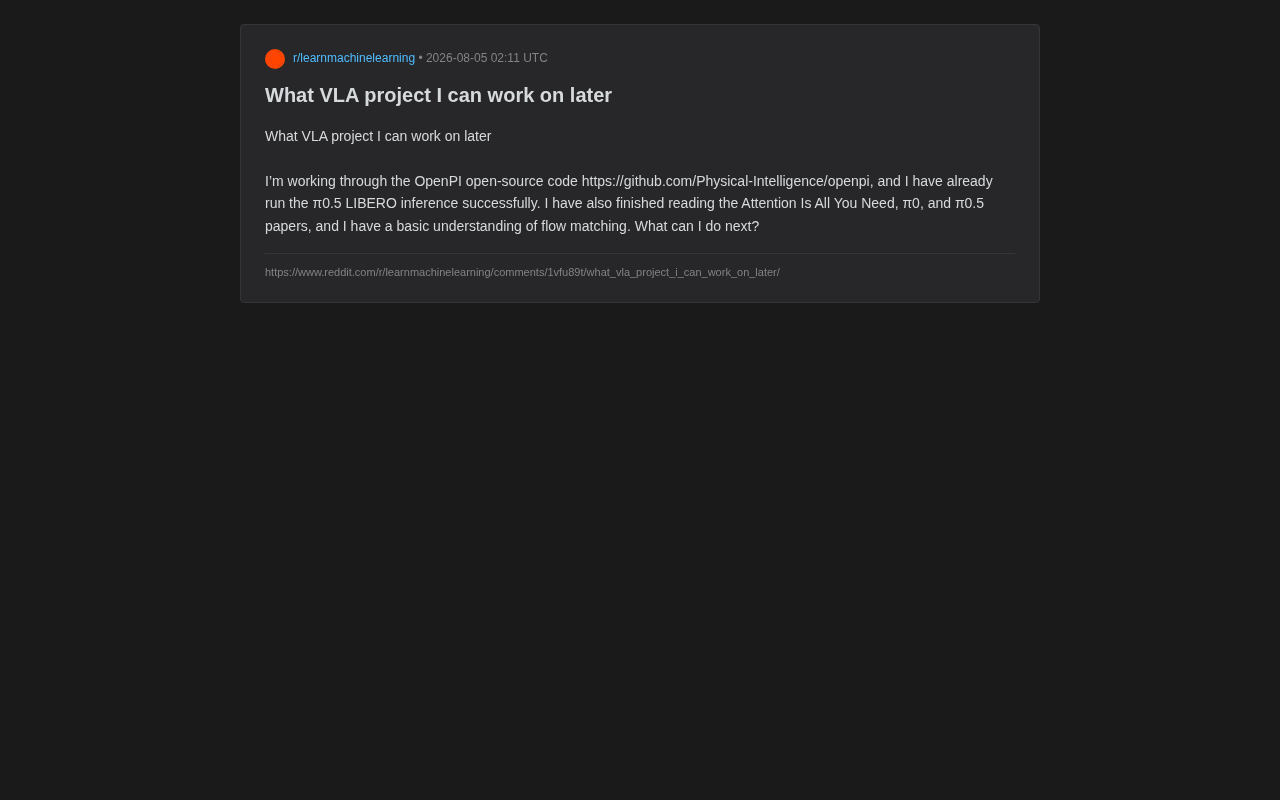
Recently, a developer shared their learning progress on Reddit and raised a question that many beginners encounter: Once I've gotten basic inference running and read the core papers, what project should I work on next?
This developer actually had a fairly solid starting point: they were studying the OpenPI codebase open-sourced by the Physical Intelligence team, had successfully run π0.5 inference on the LIBERO benchmark, and had read three key papers—"Attention Is All You Need," π0, and π0.5—with a basic understanding of flow matching.
Physical Intelligence (PI) is a robot AI startup founded in 2024 by top researchers from Google DeepMind and Stanford. π0 is their first general-purpose robot foundation model, with the core innovation of using flow matching as the action generation mechanism; π0.5 is an upgraded version that further enhances the model's generalization capability in open-world scenarios, introducing stronger language understanding and long-horizon reasoning abilities. OpenPI is PI's open-source code framework that allows researchers to fine-tune and deploy these models on their own data and tasks.
This question seems simple but actually touches on the critical gap between "understanding" and "building" for VLA learners. This article will outline a clear advanced project roadmap around this topic.
Understanding Your Current Technical Position
Before planning next steps, it's important to clarify what your current tech stack actually represents.
Foundations Already Mastered
Getting π0.5 LIBERO inference running means you can already: set up a VLA runtime environment, load pretrained weights, and understand the model's input/output format (visual observation + language instruction → action sequence). LIBERO is a robot manipulation benchmark suite developed by institutions including UT Austin, specifically designed to evaluate the generalization capabilities of robot policy learning. It includes multiple task suites: LIBERO-Spatial tests spatial relationship understanding, LIBERO-Object tests generalization to different objects, LIBERO-Goal tests goal generalization, and LIBERO-Long tests long-horizon task completion. Each suite provides standardized evaluation protocols for fairer comparisons between methods, making it one of the most commonly used benchmarks in the VLA field.
Having read the Transformer and π0/π0.5 papers means you understand the architectural skeleton of these models—a vision-language backbone (typically based on VLMs like PaliGemma) plus an action expert. PaliGemma is a vision-language model developed by Google DeepMind that combines a SigLIP vision encoder with the Gemma language model, concatenating visual tokens and text tokens before feeding them into the language model for unified processing, achieving deep fusion of vision and language. In the VLA architecture, PaliGemma is responsible for understanding scene images and task instructions, with its high-level semantic features then passed to the downstream action expert module to generate specific robot control actions.
Key Insight: Inference ≠ Training ≠ Deployment
Many learners tend to linger in the satisfaction of "getting inference working," but the real capability gap lies in: whether you can modify the model, fine-tune it, and make it work on new tasks. As the core mechanism for generating continuous actions in the π0 series, understanding flow matching's mathematical principles is only the first step—being able to debug it in code and observe its convergence behavior is the true watershed.
Flow matching is a generative model training method proposed and refined by teams including Meta Research during 2022-2023. Compared to diffusion models, flow matching directly learns deterministic ordinary differential equation (ODE) paths from noise distributions to data distributions, training neural networks to fit the vector field from standard Gaussian noise to target data. During inference, samples can be generated from noise by numerically integrating the learned vector field (e.g., using Euler's method). Its advantages include more stable training, faster inference, and controllable generation quality. In π0, flow matching is used to generate continuous robot action sequences, enabling the model to output smooth, high-quality motion trajectories.
VLA Advanced Project Roadmap: From Fine-Tuning to Deployment
Based on your current foundation, you can plan the following project categories in order of increasing difficulty.
Phase 1: From Inference to Fine-Tuning
The most natural next step is fine-tuning π0.5 on custom tasks. OpenPI provides fine-tuning interfaces. Here are recommended starting directions:
- LIBERO sub-task fine-tuning: Select a task suite from LIBERO (such as LIBERO-Object or LIBERO-Spatial), try fine-tuning the model with a small number of demonstrations, and observe changes in success rate. This helps you understand the relationship between data scale, training steps, and performance.
- Data format conversion: Convert your own recorded or collected robot demonstration data into the format required by OpenPI (typically LeRobot or RLDS format). LeRobot is an open-source robot learning framework developed by Hugging Face that provides a standardized data format for storing robot demonstration data; RLDS is a format based on TensorFlow Datasets developed by Google, used in large-scale datasets like Open X-Embodiment. Both formats structure robot interaction data into a hierarchical organization of episodes and steps. Data format conversion is a critical threshold in VLA practice because different robots have different sensor configurations, action space dimensions, and coordinate system definitions—unified formatting is the foundation for cross-embodiment transfer learning. This step may seem tedious but is an essential gateway for all VLA hands-on projects, and the place where pitfalls are most common.
Phase 2: Deep Experiments on Action Generation Mechanisms
Since you already understand flow matching, consider running some controlled experiments to deepen your understanding:
- Replace the action generation head: Try replacing flow matching with other action generation methods, such as discretized autoregressive prediction (as in RT-2) or Diffusion Policy. Diffusion Policy was proposed by Cheng Chi et al. from Columbia University in 2023, applying denoising diffusion models to action generation by iteratively denoising from Gaussian noise to produce action sequences, with the advantage of modeling multimodal action distributions. RT-2's discretized autoregressive approach discretizes the continuous action space into tokens and predicts them step by step like generating text. The trade-offs differ: autoregressive methods are simple to implement but action precision is limited by discretization granularity; Diffusion Policy has strong expressive power but slow inference (typically requiring 50-100 denoising steps); flow matching achieves a good balance between precision and speed (typically requiring only 10-20 integration steps). Comparing different approaches in terms of inference speed and action smoothness will help you build a comprehensive understanding of action generation methods.
- Inference step ablation experiments: Flow matching requires multi-step integration during inference—how does reducing the number of steps affect action quality and real-time performance? This is a small experiment with both engineering value and the potential to produce interesting conclusions.
Phase 3: Deploying to Real-World Scenarios
If conditions allow, the most valuable project is connecting to real or simulated robots:
- Simulation environment transfer: Deploy π0.5 to other simulation platforms such as ManiSkill, RoboSuite, or Isaac Sim to test the model's generalization ability. ManiSkill is a GPU-parallelized robot manipulation simulation environment supporting large-scale parallel data collection; RoboSuite is a robot learning benchmark framework based on MuJoCo; Isaac Sim is an industrial-grade simulation platform from NVIDIA supporting ray-tracing level rendering. Cross-simulation transfer is challenging because different platforms differ in rendering styles (colors, textures, lighting), physics parameters (friction coefficients, contact models), and camera configurations. This "visual distribution shift" is an important test of VLA model generalization—a model trained only in a specific rendering environment often cannot directly transfer to another platform.
- Real robot deployment: If you have access to robotic arm hardware (such as ALOHA, UR5, xArm, etc.), try deploying the model to a physical robot, handling real-world challenges like latency, calibration, and control frequency. ALOHA is the bimanual teleoperation system from the Stanford Mobile ALOHA project, based on low-cost ViperX robot arms; UR5 is an industrial collaborative robot arm from Universal Robots; xArm is a research robot arm from UFactory. Deploying VLA models to real robots presents multiple engineering challenges: model inference typically requires 50-200ms while robot control demands 10-50ms response times, requiring action chunking or interpolation strategies to bridge the gap; there are also issues like hand-eye calibration and safety mechanisms to solve. This type of experience is rarely discussed in detail in papers but is the critical knowledge for actually making models "do work"—extremely scarce and valuable in the embodied intelligence field.
Going Further: From Reproduction to Research Innovation
For learners who aspire to make contributions in research, consider the following more challenging topics.
Exploring Open Research Questions in VLA
- Long-horizon tasks and language grounding: π0.5 itself emphasizes open-world generalization. You can try constructing complex tasks requiring multi-step reasoning to test the model's ability to decompose high-level language instructions into action sequences. This involves hierarchical decision-making—how to decompose abstract instructions like "clean up the table" into specific action sequences like "pick up cup → move to sink → put down → pick up plate → ..." is one of the core challenges currently facing VLA models.
- Data efficiency research: One of the core pain points in the VLA field is the high cost of data. Research how to achieve comparable performance with fewer demonstrations—for example, combining data augmentation, sim-to-real transfer, or self-supervised pretraining. The core idea of sim-to-real transfer is to generate large amounts of cheap data in simulation for pretraining, then fine-tune with a small amount of real data to bridge the visual and physical domain gap between the two domains.
- Multi-model comparative studies: Systematically compare OpenPI with other open-source VLAs (such as OpenVLA, reproductions of the RT series) to form your own technical judgment. Representative works include Google's RT-2 (which discretizes actions into tokens for autoregressive generation), UC Berkeley's OpenVLA (an open-source VLA based on the Llama architecture), among others. They differ in architecture design, training data, and action representation methods—systematic comparison helps understand the impact of different design decisions.
Building a Portfolio and Contributing to Open Source
Regardless of which direction you choose, it's recommended to document your experimental process and conclusions in the form of blog posts, GitHub repositories, or technical reports. VLA is a rapidly evolving field with an active community—sharing publicly not only generates feedback but also serves as an effective entry point into the research community or industry.
Conclusion
From getting π0.5 inference running to independently completing a VLA project, there are several gates in between: data processing, fine-tuning training, mechanism experimentation, and real robot deployment. For this Reddit developer and all learners at a similar stage, the best next step is not reading more papers, but choosing a specific task and getting hands-on—modifying the model, running it, and breaking it.
Embodied intelligence is still in its early stages. Open-source projects like OpenPI have lowered the barrier to entry, but the real moat always lies in the engineering intuition and debugging experience accumulated through hands-on practice. Committing to a project you can invest several weeks in will yield more substantial growth than superficial exploration across many topics.
Related articles

Chain of Thought Isn't Just for AI: How Humans Can Use CoT to Improve Thinking Quality
Chain of Thought isn't just a prompt trick for large models. Starting from a Hacker News discussion, this article analyzes why CoT works for human thinking too, breaks down actionable ways to transfer it, and highlights the key differences between human CoT and machine CoT.
Cloudflare Teams Up with OpenAI: Closi…
Cloudflare Teams Up with OpenAI: Closing the Loop from Vulnerability Discovery to Defense with AI
Cloudflare uses OpenAI Daybreak to investigate security vulnerabilities and generate reviewable remediation plans, while developers use Codex to boost coding efficiency and quality.

Orca Multi-Agent Orchestration in Practice: A Guide to Parallel Collaboration with Claude and Codex
Orca is Stable AI's free open-source agent workbench supporting 34 agents like Claude Code and Codex in parallel. Learn its Git worktree isolation, multi-model orchestration, and mobile management.