From Prompt to OPC: How a Hands-On AI Course Takes You from Beginner to 'One-Person Company'
Bilibili course *AI + OPC Tutorial* offers a systematic seven-day path from zero foundation to a one-person company.
This article introduces the Bilibili course *AI + OPC (One-Person Company) Tutorial*, which addresses the common dilemma of installing AI tools but not using them well. It designs a four-stage learning path: basics teaches task description to avoid rework, advanced covers skills, connectors, resource libraries, and automation, practical applies to work scenarios, and extension explains the OPC one-person company model. The course emphasizes low thresholds, packaged materials, official certification, and real cases, attempting to connect the complete chain from tool use to monetization. The article also notes that any 'seven-day quick success' promise carries marketing flavor; the effect depends on course structure, case reusability, and learners' willingness to practice. It is suitable for beginners or professionals stuck at the tool configuration stage.
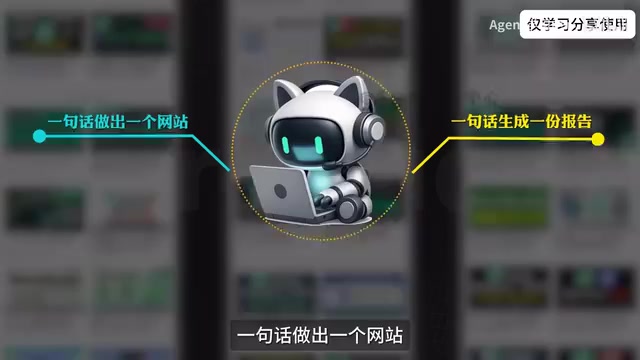
In recent months, the AI world has been flooded with "one-sentence" capabilities: generate a report in one sentence, build a website in one sentence, even run an entire solution in one sentence. What follows is a more practical question: many people install the tools but only know how to do simple Q&A. How should a task be described to avoid rework? How do you install skills? How do you connect connectors? Online materials are scattered, and piecing them together yourself is time-consuming and laborious. A course on Bilibili titled AI + OPC (One-Person Company) Tutorial attempts to systematically solve these problems and proposes an ambitious path—from basic operations to monetization, from beginner to "one-person company" in seven days.
Course Design: Four Stages, a Path from Tools to Business
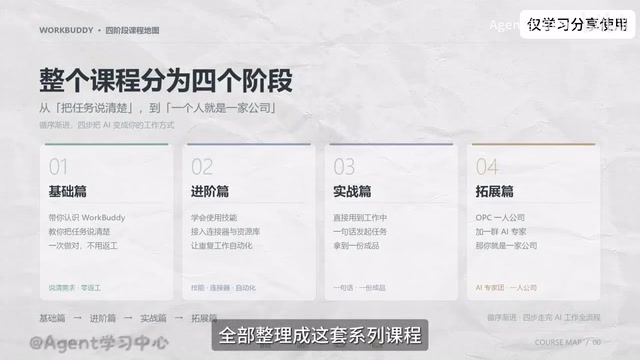
This course is not a simple list of features; it is broken down into four progressive stages, covering the complete chain from "knowing how to use" to "being able to sell":
- Basics: Get to know the AI tool (called WalkBody in the course). The core goal is to "describe tasks clearly and avoid rework."
- Advanced: Learn skills, connectors, an inspiration resource library, and automation.
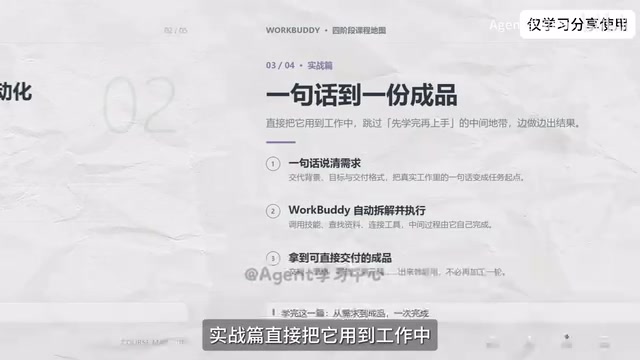
- Practical: Apply directly to work, achieving "from one sentence to one deliverable" (i.e., from instruction to output delivery).
- Extension: OPC one-person company—equip one person with a team of AI experts, giving individuals company-level productivity.
A detail worth noting: the course emphasizes that "you don't need to know AI, and you don't need to write code." All materials are provided as a package, and you just follow the stages step by step. This low-threshold design targets the many ordinary users who are attracted to AI tools but lack a systematic approach.
Automation in AI workflows refers to using preset rules or trigger conditions to let AI tools automatically execute repetitive tasks, reducing manual intervention. The advanced section includes automation, meaning students will learn how to combine skills and connectors into reusable processes—for example, automatically generating weekly reports, automatically scraping and analyzing data, or automatically replying to customer inquiries. Automation is the bridge between "single-point tool use" and "systematic productivity," and it is also a prerequisite for the OPC one-person company to achieve scalable delivery. Mastering automation requires understanding basic logic such as triggers, actions, and conditional judgments, but no coding is needed—this is exactly the value of a low-threshold course.
Core Pain Points: Why Can't You Use AI Well Even After Installing It?
The course opens by pointing directly at a common dilemma: unclear task descriptions lead to repeated rework. This is actually the first hurdle in putting AI applications into practice. Most tutorials only teach "how to ask" but not "how to break down a business process into steps AI can execute." This course makes "describe tasks clearly" the core of the basics section, showing that the author realizes: prompts are only the surface; task structuring is the key to efficiency.
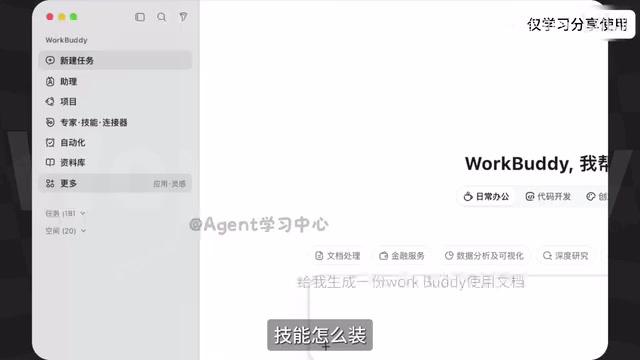
Another pain point is stitching together the toolchain. How to install skills and how to connect connectors are often scattered and technical in official documentation. The course uses an approach of "three months of organizing official docs + certification exam points + daily office scenarios" to try to integrate scattered knowledge into an actionable path.
Prompt Engineering refers to the method of designing and optimizing the instructions input to AI models to guide them toward more accurate and expected outputs. It is not just about "how to ask"; it also involves techniques such as task decomposition, context setting, and output format constraints. The article emphasizes that "prompts are only the surface; task structuring is the key to efficiency" precisely because good prompt engineering needs to be built on clear task logic. For example, breaking a complex task into multiple subtasks and providing clear input/output examples for each subtask is often more effective than simply piling on modifiers. Mastering prompt engineering can significantly reduce repeated rework, but it cannot replace understanding the business itself—which is why the course makes "describe tasks clearly" the core of the basics section.
Connector, in the context of AI tools, usually refers to integration components that allow AI models to access external data sources or call third-party services. For example, connectors can let AI read enterprise databases, call calendar APIs, or interact with CRM systems, thereby embedding AI capabilities into actual workflows. The article mentions that "how to connect connectors" is a common pain point because official documentation is often technical, involving steps such as API key management, permission configuration, and data format mapping. The course includes connectors in the advanced section, intending to help users cross the gap from "single conversation" to "system integration," which is also the infrastructure for automation and the OPC model.
OPC One-Person Company: Leveraging Individual Productivity
The "OPC (One-Person Company)" in the extension section is the most distinctive part of the entire course. Its logic is straightforward: one person + a group of AI experts = a company. This is not a new concept, but with the significant improvement in AI tool capabilities, individuals can indeed use AI to complete marketing, product, operations, and other tasks that previously required team collaboration.
The course does not stop at the conceptual level; it treats OPC as part of the "monetization path" and connects it with the practical section's "from one sentence to one deliverable." This means it attempts to answer a key question: after learning the tools, how do you turn them into income?
AI Agent refers to an AI system that can perceive the environment, make autonomous decisions, and execute actions to achieve goals. Unlike single-turn Q&A, an Agent can plan task steps, call tools (such as search, calculation, APIs), and execute iteratively. The "group of AI experts" in the article is essentially multiple Agents with different specialties working together. The OPC model relies on Agent technology, allowing individuals to dispatch multiple AI roles like managing a team, each responsible for marketing, product, operations, and other areas. Understanding an Agent's planning, tool use, and memory mechanisms helps evaluate the feasibility and boundaries of OPC—for example, complex decisions still require human oversight, and the quality of Agent output depends on the granularity of task decomposition and tool configuration.
Certification and Monetization: Value Anchors Beyond the Course
In addition to skills themselves, the course also highlights two value anchors: one is an official certification certificate—after completing the course, you can take the exam directly; the other is real case studies—using cases to illustrate monetization paths. For people who want to change careers or improve workplace competitiveness, certification provides a certain credible endorsement; case studies reduce the confusion of "learning but not knowing what to do with it."
What needs to be viewed rationally is that any promise of "from beginner to master in seven days" carries marketing flavor. What truly determines the effect is whether the course content is structured enough, whether the cases are reusable, and whether learners are willing to practice hands-on. Judging from its four-stage design and "all materials packaged" approach, this course is at least complete in its teaching framework.
Who Is It For?
This course is more suitable for three types of people: beginners attracted to AI tools but lacking a systematic approach, professionals who want to integrate AI into their daily workflows but are stuck on tool configuration, and individual entrepreneurs who want to explore the "one-person company" model. If you can already skillfully orchestrate complex task flows, the basics section may be redundant, but the advanced section's connectors and automation and the extension section's OPC ideas are still worth referencing.
The threshold for AI tools is lowering, but the threshold for turning tools into productivity has not disappeared. Systematic learning, task-structured thinking, and a complete path from tools to monetization are what this course really aims to convey.
One-line Summary
Bilibili course AI + OPC Tutorial proposes a systematic path from zero foundation to a one-person company in seven days.
Paragraph Summary
This article introduces the Bilibili course AI + OPC (One-Person Company) Tutorial, which addresses the common dilemma of "installing AI tools but not using them well" with a four-stage learning path: basics teaches task description to avoid rework, advanced covers skills, connectors, resource libraries, and automation, practical applies to work scenarios, and extension explains the OPC one-person company model. The course emphasizes low thresholds and packaged materials, and offers official certification and real cases, attempting to connect the complete chain from tool use to monetization. The article also notes that any "seven-day quick success" promise carries marketing flavor, and the effect depends on course structure, case reusability, and learners' willingness to practice. It is suitable for beginners or professionals stuck at the tool configuration stage.
Related articles

Watching Movies in the Terminal: Building an SSH Streaming Service with Codex Multi-Agent Workflow
A creator uses Codex multi-agent workflow to build an SSH-accessible streaming service in the terminal, with planning, cloud async dev, AI-drawn scenes, and synced live channels.

AI Face Licensing: A New Micro-Drama Trend or a Hollywood Trap?
Actors are licensing their faces to micro-drama startups for AI digital doubles to perform. Popular in China, the model raises concerns in Hollywood over lost control and diluted bargaining power.

Amazon's First Digital Photo Frame Is 50% Off for Black Friday: Is the Alexa Frame Worth Buying?
Amazon's first digital photo frame, the Alexa Photo Frame, is nearly 50% off for Black Friday, with prices starting at $114. We analyze why this new product dropped in price just one month after launch, its positioning, who it's for, and buying advice.