From Prototype to Real Product: Two Indie Developers on the Path to Commercialization

Two hackathon winners share how to cross the gap from prototype to real product.
This article covers an online meetup themed "You built it. Now what?" featuring two developers who turned hackathon projects into real products: Austin Eckman (Crafting Table, Designathon runner-up) and Andy Liu (HuHuu, dual winner at the Replit x ElevenLabs hackathon). While AI tools have lowered the barrier to building prototypes, crossing to a product with real users and revenue remains hard — involving user acquisition, ongoing maintenance, and business model validation. The true scarcity has shifted from "can build" to product refinement and commercial execution.
From "I Built It" to "Now What?"
For many indie developers and AI enthusiasts, getting a prototype up and running is rarely the finish line — it's where the real challenge begins. An online meetup centered around the theme "You built it. Now what?" brought together two developers who have successfully taken their prototypes to real products and businesses, sharing their journey from hackathon projects to sustainable products.
This theme cuts right to the heart of a common pain point in AI application development today: with AI coding tools and low-code platforms, going from idea to working demo has never been faster. But crossing the gap from demo to a product with real users and revenue remains a formidable challenge.
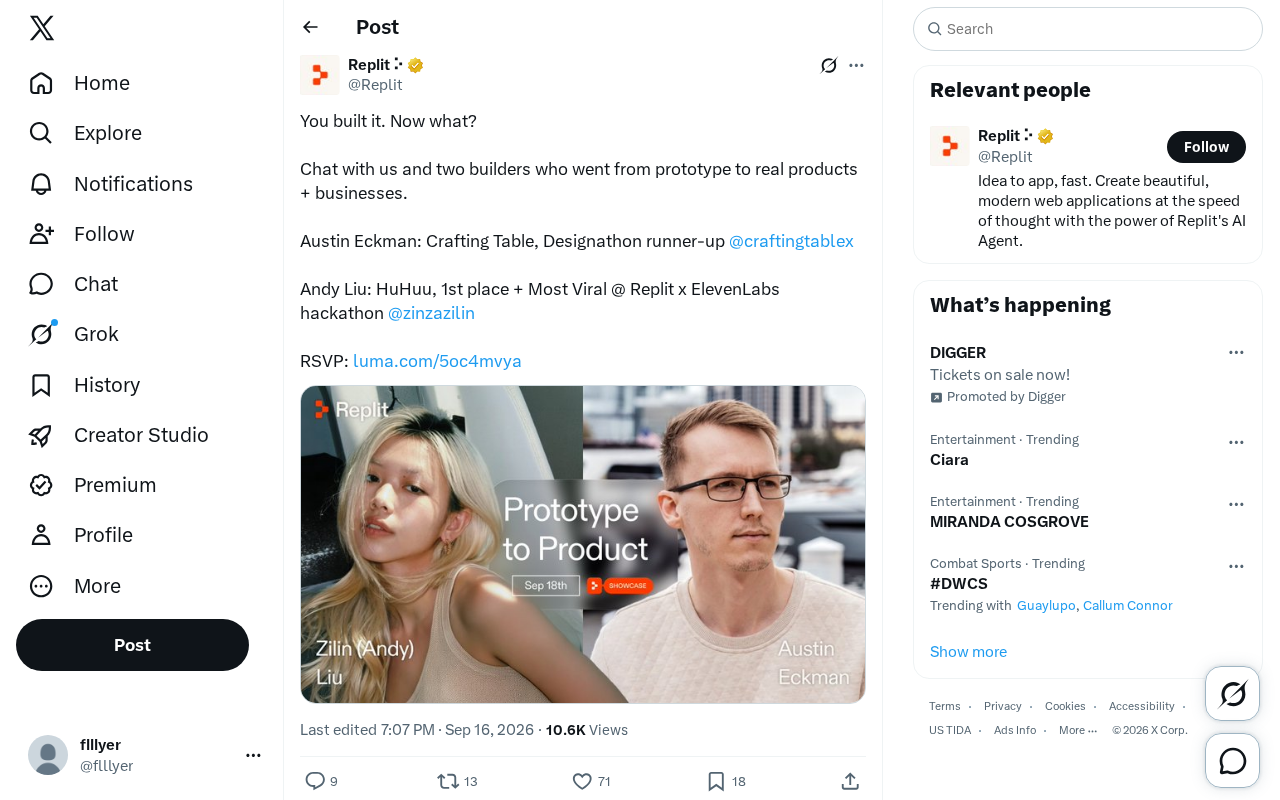
The Two Guests and Their Projects
Both speakers at this event are creators who recently stood out in hackathons and designathons.
Austin Eckman and Crafting Table
Austin Eckman (@craftingtablex) presented Crafting Table, which won runner-up at a Designathon. Designathons challenge participants to go from concept to interactive product within a tight timeframe, and placing second signals strong recognition for both execution quality and creativity.
Andy Liu and HuHuu
Andy Liu (@zinzazilin) had an even more impressive showing — his project HuHuu took both first place and the Most Viral award at the joint hackathon hosted by Replit and ElevenLabs. Replit is an online collaborative coding platform, while ElevenLabs is a leading AI voice synthesis company. Their combined hackathon naturally attracted a wave of creative projects blending voice capabilities with rapid development. Winning both the technical judges' top prize and the viral potential category means HuHuu demonstrated solid execution alongside the kind of user appeal that drives organic growth.
ElevenLabs is currently one of the top companies in AI voice synthesis, known for its highly realistic voice cloning and multilingual speech generation — widely used in podcast production, audiobooks, and game voice acting. Replit is a browser-based cloud IDE supporting dozens of programming languages, allowing developers to write, run, and deploy code without a local environment, making it one of the go-to tools for rapid prototyping at hackathons. By co-hosting a hackathon, these two companies effectively handed participants a complete "build fast + voice interaction" tech stack, encouraging developers to explore voice-driven AI applications in an extremely compressed timeframe.
Why "After the Prototype" Is the Critical Question
Hackathons and designathons are great at producing jaw-dropping demos — but these projects often face a harsh reality after the competition ends: how to find real users, how to validate willingness to pay, and how to keep iterating without a deadline driving you forward.
Going from prototype to product means clearing more than just technical hurdles. The bigger leaps are in product thinking and business validation:
- User acquisition: The audience for a demo is the judging panel; the audience for a product is the market — and their needs follow entirely different logic.
- Ongoing maintenance: A competition entry can be a one-off; a product must handle real-world reliability, costs, and user feedback.
- Business model: Turning "fun" into "something people will pay for" — or a sustainable business — is the hardest step of all.
The value these two speakers bring is precisely that they have already walked, or are walking, this path — offering first-hand, battle-tested perspectives rather than pure theory.
The hackathon economy has been further amplified by the recent AI wave: sponsors provide API credits and compute, participants channel their creativity in intense 24–72 hour sprints, but the vast majority of projects go dormant within two weeks of the event. This phenomenon is sometimes called the "demo trap" in startup circles — products get over-optimized to impress judges, but lack the resilience to handle diverse real users and long-term retention. Product-Market Fit (PMF) is the core benchmark for whether a prototype can become a real product — it means a product precisely meets the genuine needs of a large enough market, typically measured through user retention, organic referrals, and paid conversion rates. The distance between a hackathon win and PMF is far greater than writing code that runs.
What This Means for Creators in the AI Era
Today's AI tools have dramatically reduced the cost of "making things," enabling more people than ever to produce prototypes quickly. That also means the ability to simply "build something" is no longer scarce — the real scarcity has shifted to product refinement, user understanding, and commercial execution.
For developers watching this conversation, the questions worth paying attention to include: How did these award-winning projects hold onto their first users after the competition? How did the creators decide which feedback was worth acting on? What shifted in mindset and workflow when moving from a personal project to a real business? These are lessons that any builder sitting on a prototype — stuck at the "now what?" stage — will find worth exploring.
Interested readers can sign up through the RSVP link shared by the organizers to ask both practitioners questions directly.
Note: This article is based on pre-event announcements. Actual content shared may vary from what is described here.
Related articles

Chain of Thought Isn't Just for AI: How Humans Can Use CoT to Improve Thinking Quality
Chain of Thought isn't just a prompt trick for large models. Starting from a Hacker News discussion, this article analyzes why CoT works for human thinking too, breaks down actionable ways to transfer it, and highlights the key differences between human CoT and machine CoT.
Cloudflare Teams Up with OpenAI: Closi…
Cloudflare Teams Up with OpenAI: Closing the Loop from Vulnerability Discovery to Defense with AI
Cloudflare uses OpenAI Daybreak to investigate security vulnerabilities and generate reviewable remediation plans, while developers use Codex to boost coding efficiency and quality.

Orca Multi-Agent Orchestration in Practice: A Guide to Parallel Collaboration with Claude and Codex
Orca is Stable AI's free open-source agent workbench supporting 34 agents like Claude Code and Codex in parallel. Learn its Git worktree isolation, multi-model orchestration, and mobile management.