From Research Projects to Open Source Ecosystem: Academic PyTorch Projects Head to PyTorchCon

PyTorchCon NA calls on academic researchers to bring their PyTorch projects into the open source ecosystem.
Many of the most valuable tools in the PyTorch ecosystem were born in university labs and research institutions. PyTorchCon NA has issued a dedicated call for academic submissions, aiming to give these projects a platform and help them transition from closed lab prototypes to open source contributions. Open-sourcing academic work benefits researchers through real-world feedback and benefits the PyTorch ecosystem through fresh technical input. The article advises academic developers to prioritize clear documentation, reproducible experiments, and defined use cases — and to treat conferences like PyTorchCon NA as a key opportunity to bridge the gap between research prototype and open source tool.
Academic Research: A Core Source of the PyTorch Ecosystem
Some of the most interesting work built with PyTorch originates in universities, research labs, student groups, and academic institutions. A new model architecture, a library created to support a specific research direction, a deep dive into underlying mechanisms — these contributions often take root in academic settings before growing into widely used tools within the open source community.
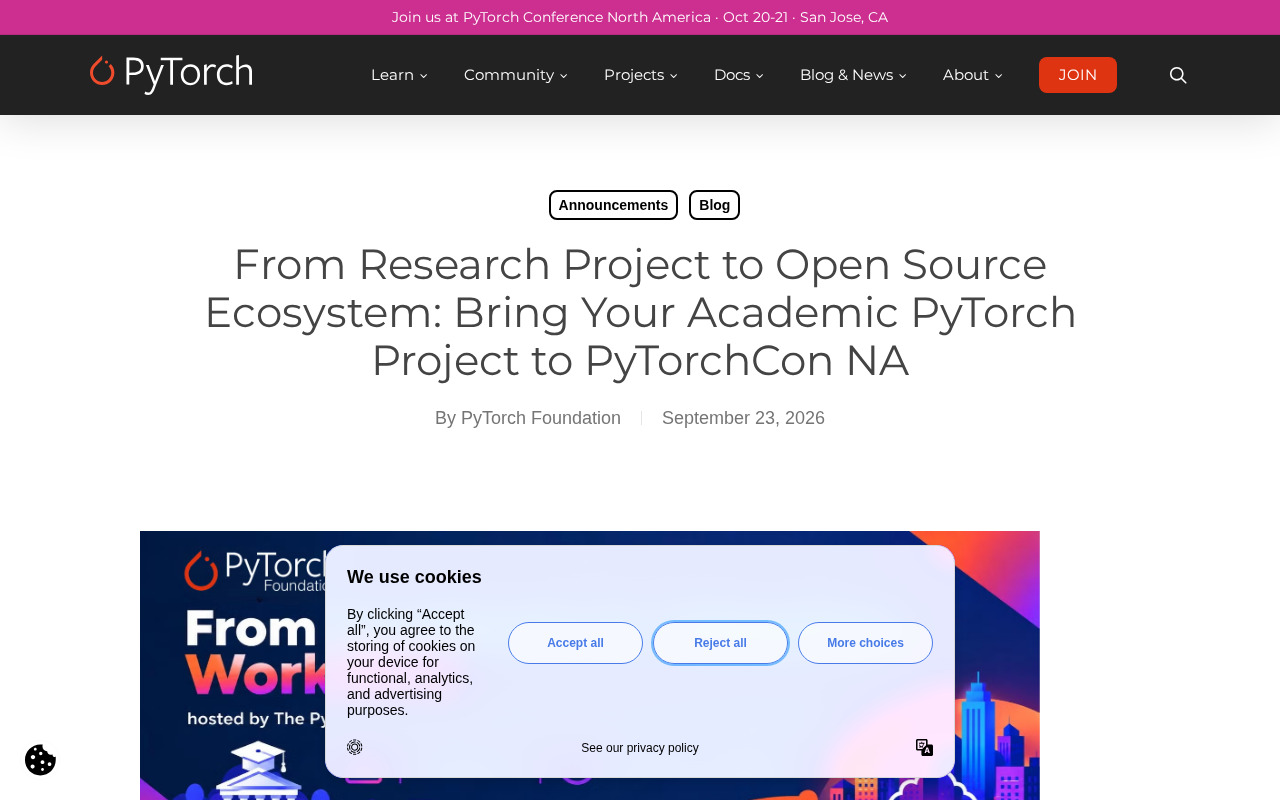
This recent initiative from the PyTorch team aims to bring these scattered academic contributions into the PyTorchCon NA conference. For developers in universities and research institutions, it's an opportunity to take a lab prototype and introduce it to a much broader ecosystem.
Why Academic Projects Deserve Greater Visibility
The trajectory of academic projects differs markedly from that of industry projects. Academic work typically begins with a concrete research question: the need for a new network architecture, a more efficient training method, or a tooling library tailored to a specific discipline. These projects are rarely built with "productization" in mind from the start — yet they often contain the most original ideas.
Open-sourcing these projects and bringing them to the community creates value in both directions. Researchers get real-world validation and feedback that accelerates iteration; meanwhile, the PyTorch ecosystem gains fresh technical input, forming a virtuous cycle between research and engineering. Trace the origins of many widely relied-upon open source libraries today, and you'll find an academic starting point.
PyTorchCon NA: What It Offers and Why It Matters
As a major gathering of the PyTorch community in North America, PyTorchCon NA provides a platform for developers, researchers, and engineering teams to present and exchange ideas. By issuing a dedicated call for academic submissions, the conference is signaling its intent to give cutting-edge research greater visibility alongside industry-focused topics.
For academic teams, participating in an event like this is more than just a showcase — it's a critical step in transforming a "research project" into a genuine part of the open source ecosystem. At the conference, a project can connect with potential contributors, users, and ecosystem maintainers, gaining the momentum needed for sustained growth. This shift from closed research to open collaboration often determines whether a project can go the distance.
PyTorchCon NA (North America) is the flagship North American technical conference hosted by the PyTorch Foundation, typically featuring keynotes, technical talks, poster sessions, and workshops. After Meta donated PyTorch to the Linux Foundation in 2022 and the PyTorch Foundation was established, events like this have become important nodes connecting industry and academia. Unlike engineering-focused summits, the academic track emphasizes early-stage sharing of new methods, architectures, and tools, with relatively flexible submission requirements — even prototype-stage projects are welcome. For researchers, this kind of presentation complements paper publication: papers address the trust problem of peer review, while conference talks solve the problem of community visibility and reaching potential collaborators.
Advice for Academic Developers
If you have a PyTorch-based research project — whether it's a new model architecture or a supporting toolkit — it's worth considering bringing it to the community. Open-sourcing doesn't mean having everything polished first; early-stage versions can still attract like-minded collaborators. Clear documentation, reproducible experiments, and well-defined use cases will make it much easier for the ecosystem to adopt your work.
The gap between a research prototype and an open source ecosystem component isn't just about making code public — it also involves community building, collaboration structures, and long-term maintenance. Platforms like PyTorchCon NA offer a concrete opportunity to shorten that path.
Reproducibility in machine learning research is a challenge that gets repeated emphasis yet remains difficult to achieve in practice. It means more than just providing training code — it includes fixing random seeds, fully documenting hardware and software environments (e.g., CUDA versions, dependency versions), providing pretrained weights, and supplying runnable scripts that align with reported results in the paper. In recent years, platforms like Papers With Code and reproducibility statement requirements at top venues such as NeurIPS and ICML have been gradually pushing this standard forward in academia. For projects aiming to enter the open source ecosystem, reproducibility is the first step in building community trust — experiments that users can actually run are what convert into real stars, issues, and contributions.
Related articles

Chain of Thought Isn't Just for AI: How Humans Can Use CoT to Improve Thinking Quality
Chain of Thought isn't just a prompt trick for large models. Starting from a Hacker News discussion, this article analyzes why CoT works for human thinking too, breaks down actionable ways to transfer it, and highlights the key differences between human CoT and machine CoT.
Cloudflare Teams Up with OpenAI: Closi…
Cloudflare Teams Up with OpenAI: Closing the Loop from Vulnerability Discovery to Defense with AI
Cloudflare uses OpenAI Daybreak to investigate security vulnerabilities and generate reviewable remediation plans, while developers use Codex to boost coding efficiency and quality.

Orca Multi-Agent Orchestration in Practice: A Guide to Parallel Collaboration with Claude and Codex
Orca is Stable AI's free open-source agent workbench supporting 34 agents like Claude Code and Codex in parallel. Learn its Git worktree isolation, multi-model orchestration, and mobile management.