From Rust to Zig: A Developer's Honest First Impressions

A Rust developer tries Zig: less cognitive overhead, but memory safety is now your responsibility.
This article is based on a viral Hacker News post documenting a seasoned Rust developer's first experience with Zig. Rust trades a steep learning curve for compile-time memory safety via ownership and the borrow checker; Zig returns that responsibility to the developer, using defer, error unions, and comptime as a modern safety net. The author's standout impression is dramatically reduced cognitive load — especially comptime, which unifies Rust's generics, macros, and trait system into one elegant mechanism. Community reactions were polarized: Zig fans valued simplicity and predictability, while Rust advocates stressed the long-term value of safety guarantees in large-scale projects. The conclusion is pragmatic: both languages suit different contexts, and the choice is ultimately about trade-offs.
From Rust to Zig: A Developer's Honest First Impressions
For many systems programmers, Rust and Zig are two of the most talked-about languages in recent years. Both target the traditional territory of C/C++, but their design philosophies couldn't be more different. A blog post that earned 200 points and sparked 241 comments on Hacker News documents one Rust developer's firsthand experience switching to Zig — and reignited the community debate over the trade-offs between the two languages.
Note: This article is based on the original blog post and the accompanying Hacker News discussion. Some views reflect the author's personal experience and are shared for reference.
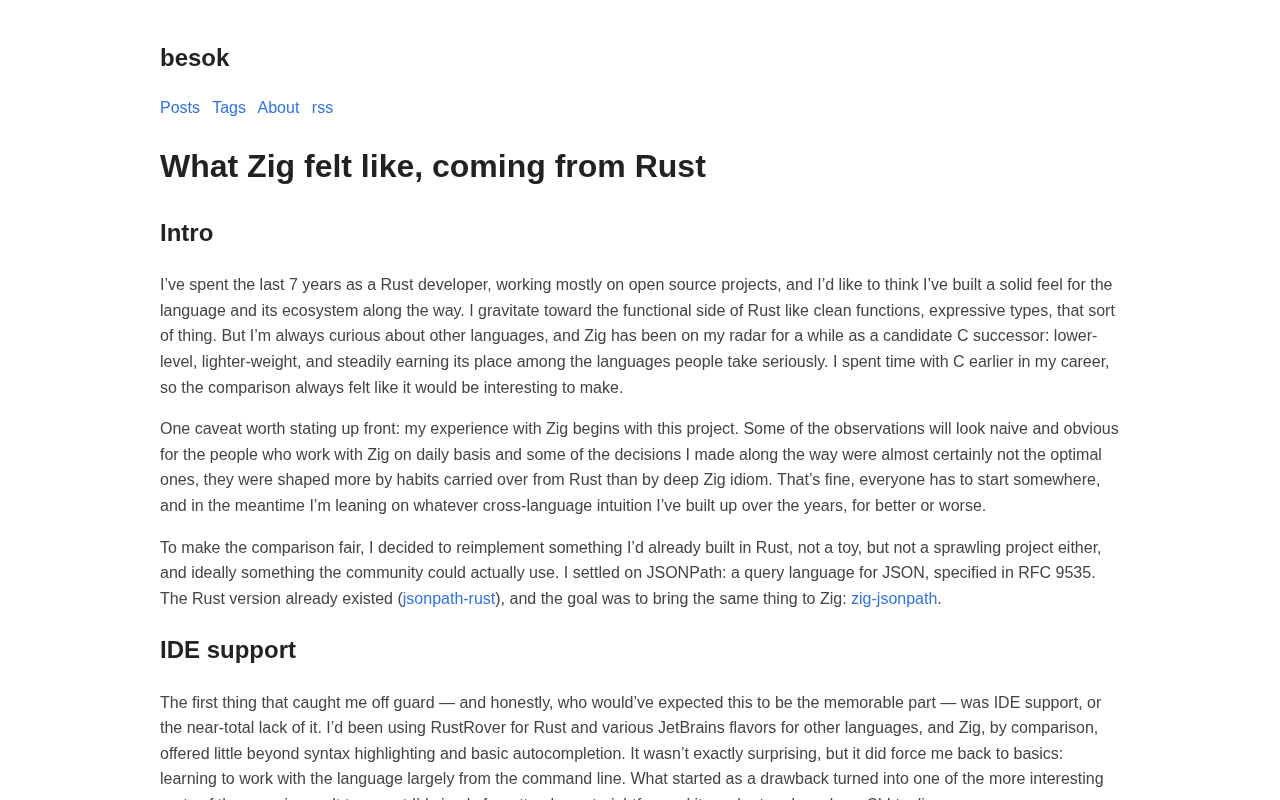
The Design Divergence Between Rust and Zig
Rust's core selling point is memory safety — through ownership, the borrow checker, and lifetimes, it eliminates data races and dangling pointers at compile time. The cost is a steep learning curve and a relatively complex type system.
Zig takes a different path. It has no borrow checker and doesn't pursue compile-time enforced memory safety. Instead, it emphasizes simplicity, explicitness, and complete control over the underlying system. Zig's creed is "no hidden control flow, no hidden memory allocations" — the developer always knows exactly what each line of code is doing.
This divergence produces a distinctly different "feel" between the two languages. Developers moving from Rust to Zig often go through a mental shift from "constrained by the compiler" to "taking on the responsibility yourself."
Rust's ownership system is essentially a set of compile-time static analysis rules: each value can have only one "owner" at any given moment, and when the owner goes out of scope, the value is automatically destroyed. The borrow checker tracks how "references" are used on top of this, ensuring that immutable and mutable references cannot coexist, fundamentally eliminating data races. Lifetime annotations extend this mechanism, telling the compiler about the relationships between how long different references stay alive. Together, these three form the foundation of Rust's "no GC but memory-safe" guarantee — and are also the primary source of its steep learning curve. Zig's explicit allocator-passing pattern comes from a different design decision: by requiring callers to pass in a memory allocator, Zig keeps the source of all memory visible in the code at all times, avoiding the unpredictability of global implicit allocation — but at the cost of putting correctness entirely in the programmer's hands.
The "Lightness" of Zig Through a Rust Lens
One of the author's central impressions is a sense of ease when working with Zig. In Rust, a lot of time goes toward fighting the borrow checker, reasoning about lifetime annotations, and choosing between smart pointers like Rc, RefCell, and Arc. In Zig, that cognitive overhead is dramatically reduced.
Zig hands memory management back to the developer: you explicitly pass allocators around and manually decide when to allocate and free. This might seem like a regression to C-style programming, but Zig provides a more modern safety net than C through defer, error union types, and memory leak detection during testing.
For developers accustomed to Rust's strict constraints, this "freedom" is both a relief and a risk. You no longer have the compiler catching you if you fall, but you also don't have to restructure entire data layouts just to satisfy the type system.
comptime: Zig's Killer Feature
One feature that came up repeatedly in the discussion is Zig's comptime (compile-time computation). It allows ordinary Zig code to run at compile time, enabling generics, code generation, and metaprogramming — all without needing a separate macro system or trait hierarchy like Rust's.
Many developers coming from Rust feel that comptime replaces Rust's generics, macros, and trait bounds with a single, unified, intuitive mechanism. This "one syntax to solve many problems" approach is a direct expression of Zig's philosophy of simplicity.
The way comptime works: any value or parameter marked as comptime is evaluated by the compiler at compile time, and the result is embedded directly into the generated code. This means generic functions are effectively "ordinary functions that accept types as comptime parameters," and types themselves are first-class values in Zig. By contrast, Rust's generics rely on monomorphization and trait bound constraints, while the macro system — including declarative macro_rules! and procedural proc macros — is a separate code generation mechanism outside the type system. This separation is powerful, but adds cognitive layers. comptime unifies all these scenarios into "ordinary Zig code that runs at compile time." Developers only need to learn one set of syntax to cover conditional compilation, generic containers, code generation, and more — which is why many who try it describe the moment of understanding as an "aha" experience.
Zig's defer statement, borrowed from Go, lets you declare cleanup logic (like freeing memory or closing file handles) right after acquiring a resource; the actual execution is deferred until the current scope exits. This solves the classic C pitfall of resource leaks caused by multiple return paths. Error union types (written as !T) are Zig's error handling mechanism: a function's return value can be either a normal value of type T or an error value, and the caller must handle it explicitly or the compiler will error — similar in effect to Rust's Result<T, E>, but with lighter syntax. Additionally, Zig's testing framework has a built-in std.testing.allocator that checks for memory leaks after each test and reports them, making it low-cost to catch leaks during development. These mechanisms together form the concrete foundation of Zig's positioning as "safer than C, but more free than Rust."
The Divide in Community Discussion
The 241 comments reflected deeply polarized views, revealing the genuine tensions within the systems programming community.
Those in favor of Zig argued that Rust's complexity is overkill for many use cases; that Zig's explicit memory management actually makes code more predictable and readable; that comptime is more elegant than Rust's macros; and that compile speed and C interoperability are clear advantages.
Those sticking with Rust emphasized that abandoning compile-time memory safety is a major compromise. In large team projects with long maintenance cycles, Rust's safety guarantees are enormously valuable. No matter how modern the manual memory management, it can't definitively prevent issues like use-after-free at compile time.
A more pragmatic contingent pointed out that the two aren't in zero-sum competition — they suit different scenarios. Rust fits projects with extreme safety requirements and large teams; Zig fits situations demanding ultimate control, rapid iteration, and deep integration with the C ecosystem.
There's No Universal Answer in Language Choice
"Language A vs. Language B" articles like this continue to generate heat precisely because choosing a programming language is never a purely technical question — it's about trade-offs.
Rust trades complexity for safety; Zig trades responsibility for simplicity. Which is better depends on your project constraints, team capabilities, and personal preferences. The value of the original post isn't in delivering a verdict, but in honestly documenting the psychological shift — the surprises and the friction — of an experienced Rust developer encountering Zig for the first time.
For developers currently evaluating systems programming languages, this kind of firsthand comparison is more useful than an abstract feature checklist. The best approach is to try both in a real project and let actual coding experience guide the decision.
Related articles

Chain of Thought Isn't Just for AI: How Humans Can Use CoT to Improve Thinking Quality
Chain of Thought isn't just a prompt trick for large models. Starting from a Hacker News discussion, this article analyzes why CoT works for human thinking too, breaks down actionable ways to transfer it, and highlights the key differences between human CoT and machine CoT.
Cloudflare Teams Up with OpenAI: Closi…
Cloudflare Teams Up with OpenAI: Closing the Loop from Vulnerability Discovery to Defense with AI
Cloudflare uses OpenAI Daybreak to investigate security vulnerabilities and generate reviewable remediation plans, while developers use Codex to boost coding efficiency and quality.

Orca Multi-Agent Orchestration in Practice: A Guide to Parallel Collaboration with Claude and Codex
Orca is Stable AI's free open-source agent workbench supporting 34 agents like Claude Code and Codex in parallel. Learn its Git worktree isolation, multi-model orchestration, and mobile management.