From Vibe Coding to AI-Engineered Programming: A Comprehensive Guide to Three Practical Modes
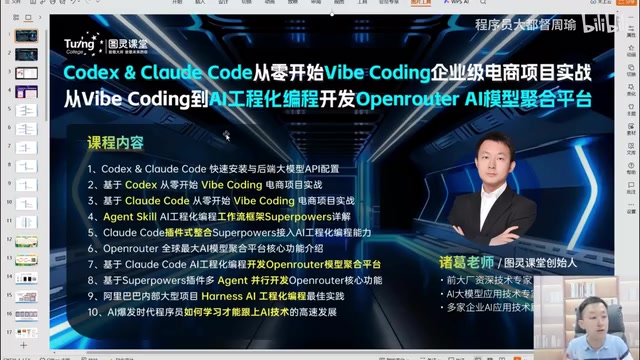
From toy demos to enterprise systems: mastering the three modes of AI programming with Claude Code and Codex
This guide breaks down AI programming into three distinct modes: Vibe Coding for quick prototypes, Plan Mode for structured development, and AI-engineered programming using tools like SuperPower for enterprise-grade systems. It compares Claude Code and Codex, provides practical model selection advice for domestic markets (GLM, DeepSeek), and explains why engineering methodology—not just tool usage—is the real competitive advantage in the AI era.
From Vibe Coding to AI Engineering: The Real Divide in AI Programming
With the maturation of tools like Claude Code and Codex, "writing code with natural language" has moved from concept to reality. But a repeatedly debated question remains: can AI programming truly replace real software engineering? The answer isn't a simple "yes" or "no"—it depends on how you use it.
This article, based on a teaching curriculum centered on hands-on practice with both Claude Code and Codex, breaks down the three levels of AI programming—from the most basic Vibe Coding, to Plan Mode, to genuine AI-engineered programming—and provides actionable pathways grounded in the current reality of domestic and international model selection.
What Is Vibe Coding, and Where Are Its Limits?
Vibe Coding is a concept from the international community. The core idea: you, as product owner or developer, clearly describe the requirements in your mind, and AI programming tools write remarkably polished code for you. What used to require programmers to implement line by line can now be turned into a working demo in minutes by AI.
This concept was first introduced by Andrej Karpathy (OpenAI co-founder and former Tesla AI Director) in early 2025. He described a radically new way of programming: developers immerse themselves completely in the "vibe," relying on intuition and natural language dialogue with AI, rarely reading or reviewing the generated code themselves. This concept quickly sparked debate because it fundamentally challenges the traditional software engineering axiom that "developers must fully understand every line of code." The rise of Vibe Coding is closely tied to breakthroughs in code generation by large language models (LLMs)—when model code completion accuracy improved from under 30% in early days to over 70% in certain scenarios today, "building products without writing code" shifted from theory to reality.
But Vibe Coding has a clear ceiling:
"After you get into Vibe Coding, as your project grows larger and more complex, you'll find you can't keep going."
Three reasons:
- Questionable code quality: AI-generated code can be a "spaghetti mess," difficult to maintain and iterate on;
- Bug fixing becomes an endless loop: Once problems arise in production, non-technical people can't effectively direct AI to locate and fix issues, often making things worse;
- Can't handle complex scenarios: Vibe Coding only covers small tool-type projects; enterprise-grade architectures like high concurrency, distributed systems, and microservices are completely beyond its capabilities.
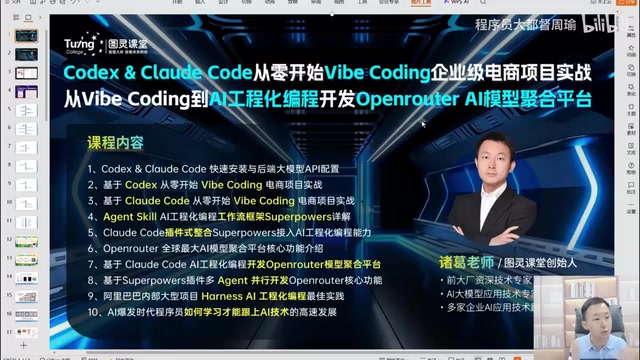
Early on, some non-programmer bloggers claimed to have "replaced programmers with AI," but a closer look at their projects—overseas small websites, Pomodoro timers, fill light gadgets—reveals functionality that can often be generated by AI in just a few sentences. Between these projects and real enterprise systems lies a vast engineering chasm. Enterprise systems mean handling data consistency, transaction management, permission control, multi-tenancy isolation, canary deployments, monitoring and alerting—a series of complex engineering problems that can't be solved by a single natural language description to AI.
Three Progressive Modes of AI Programming Capability
For developers at different levels, here's a recommended "three-stage" training method: do each project three times, once in each mode, to intuitively experience the differences in capability boundaries.
Mode One: Vibe Coding for Rapid Demos
The most basic approach, suitable for beginners. Open a folder, describe your requirements to Claude Code or Codex, and within minutes you'll have a runnable e-commerce demo. The value of this step is building "muscle memory" and understanding the basic interaction patterns of AI programming tools.
Mode Two: Plan Mode
Both Claude Code and Codex have built-in plan modes. Rather than generating code directly, plan mode has the AI first outline development steps and break down tasks before implementing them step by step. This way, even if the requirements themselves are still simple, the resulting project structure will be clearer and more controllable, suitable for slightly more complex scenarios.
The essence of plan mode is applying Chain-of-Thought reasoning to software development workflows. In direct generation mode, LLMs attempt to output complete code all at once, which works for simple tasks but tends to suffer from context loss and logical inconsistencies when facing complex requirements. Plan mode forces the model to first perform Task Decomposition, breaking a large requirement into multiple atomic subtasks, each with clear inputs, outputs, and acceptance criteria, then executing them step by step according to dependencies. This essentially simulates how human software engineers work—first conducting technical design reviews, then developing module by module. Claude Code's plan mode also allows user intervention and correction at each step, forming a human-AI collaborative iteration loop that significantly reduces the risk of AI "going off track."
Mode Three: AI-Engineered Programming (Enterprise Development)
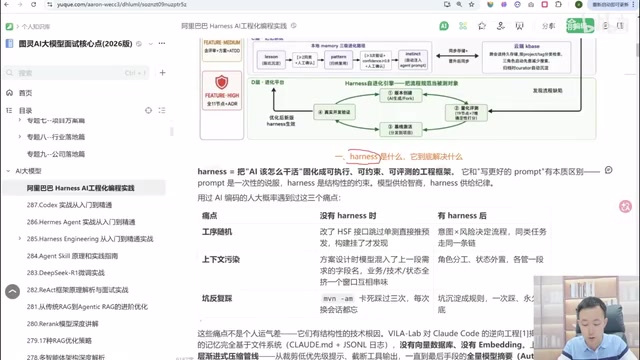
This is the most critical of the three modes. The core representative is a plugin for Claude Code called SuperPower (similar approaches include Spec Kit and other SDD spec-driven development tools).
SuperPower is essentially a complete set of AI-engineered programming Skills, containing dozens of Skills that cover the entire lifecycle of enterprise projects:
- Requirements analysis and architecture design
- Code implementation and code review
- Testing, deployment, and production rollout—the full workflow
SDD (Spec-Driven Development), which SuperPower represents, is one of the core methodologies of AI-engineered programming. Its central idea: before AI generates code, first define system architecture constraints, interface contracts, coding standards, and testing criteria using structured specification documents (Specs). These spec documents themselves serve as "system prompts" for the AI, ensuring it doesn't deviate from engineering standards throughout the development process. This approach solves the biggest pain point of pure Vibe Coding—lack of consistency and maintainability. Each Skill is actually a carefully designed prompt template combined with engineering workflow orchestration logic, covering the complete DevOps lifecycle from requirements analysis to deployment.
Notably, leading Chinese tech companies (like Alibaba) are internally promoting an AI-engineered programming system called "Hanis," aiming for a self-contained and self-evolving development process. Such enterprise-level AI programming systems aim not only to have AI write code, but also to automatically perform code review, automatically generate unit tests, automatically detect security vulnerabilities, automatically deploy to test environments and verify functional correctness. Further "self-evolution" means the system can learn from feedback across development iterations, continuously optimizing its code generation strategies. This aligns with the same generation of product thinking as Google's internal Gemini Code Assist and Microsoft's GitHub Copilot Workspace, but emphasizes deeper integration with enterprises' existing CI/CD pipelines, code repository standards, and security compliance systems. This shows that AI programming deployment on the enterprise side has long been more than just "dialogue-to-code"—it's a systematic engineering methodology.
AI Programming Model Selection: The True Core Behind the Tools
An often-overlooked but critically important point: the core competitiveness of AI programming tools comes first from the underlying large model.
"The core of AI programming is still its model—the backend model ranks first."
Differences in programming capabilities across large models stem from differences in training data, model architecture, and post-training alignment strategies. Common benchmarks for evaluating programming models include HumanEval (testing function-level code generation), MBPP (testing basic programming ability), and SWE-bench (testing real GitHub issue resolution capability). SWE-bench is particularly important because it measures not whether a model can write a sorting function, but whether it can understand a real large open-source project codebase, locate bugs, and submit correct fix patches—this is the real scenario of engineering programming.
Claude Code and Codex: Currently the Two Strongest AI Programming Tools
The two tools widely recognized as having the strongest AI programming capabilities are Claude Code and Codex:
- Claude Code: Considered the most-used AI programming tool among professional programmers, it has a highly mature internal AI-engineered programming system with extensive optimizations for professional programming. The Claude model series (developed by Anthropic) excels at programming tasks, partly because it employs unique training methods including RLHF (Reinforcement Learning from Human Feedback) and Constitutional AI, making the model more focused on safety and logical rigor when generating code. Developers interested in learning more should read Claude Code's source code—you'll find it's an implementation of an entire engineering system, including context management, tool invocation orchestration, error recovery mechanisms, and more. These designs themselves represent best practices in AI-engineered programming.
- Codex: Originally a code-specific model fine-tuned by OpenAI from GPT-3, and the early backend for GitHub Copilot. Today's Codex has evolved into an independent product based on the latest GPT models, supporting asynchronous execution of long-running tasks, with capabilities rapidly catching up to Claude Code. A major feature of Codex is its sandboxed execution environment, which can safely run and test generated code in the cloud, achieving a "write-and-verify" closed loop.
Additionally, domestic options like CodeBuddy, ByteDance's CodeTree, and Cursor (a VS Code fork) are all viable choices. Cursor especially deserves mention—by deeply embedding AI capabilities into the IDE editing experience (like Tab smart completion, inline editing, multi-file coordinated modifications), it has innovated extensively on developer experience and is currently one of the fastest-growing AI programming tools.
Domestic Model Selection: Practical Considerations and Testing Rankings
Because Claude (Anthropic) faces issues like easy account bans and network environment restrictions, actual development often requires connecting domestic models as backends for Claude Code. This involves an important technical concept: tools like Claude Code support replacing backend models via OpenAI API-compatible interfaces—developers only need to modify the API endpoint and key configuration to switch to different model providers. Based on actual testing feedback, the ranking of mainstream domestic large models is roughly:
| Model | Characteristics |
|---|---|
| GLM (Zhipu) | First tier, best overall experience, based on GLM-4 series models, outstanding balanced performance in code understanding and generation |
| DeepSeekAd | Best cost-performance ratio, cheap and capable, its DeepSeek-Coder series performs excellently across multiple code benchmarks, uses MoE (Mixture of Experts) architecture to effectively control inference costs |
| Kimi, MiniMax, MiMo (Xiaomi) | Each has unique features, all usable for daily development, with Kimi notable for ultra-long context windows, suitable for handling large codebases |
| Tongyi, Tencent Hunyuan | Major tech company products, guaranteed stability, with comprehensive enterprise-grade SLA and compliance certifications |
This reminds developers: when choosing AI programming solutions, tools and models can be decoupled—flexibly combining them based on your network environment, budget, and stability needs is the more pragmatic approach right now.
The Business Models Actually Making Money in AI
Understanding the commercial logic behind AI programming helps developers see industry direction clearly.
Take OpenRouter as an example—it's the world's largest AI model aggregation platform, connecting nearly all mainstream models and offering considerable free quotas. Such platforms architecturally belong to the "AI middleware" or "AI gateway" layer, encapsulating services from dozens of model providers including OpenAI, Anthropic, Google, Meta, Mistral, and domestic providers like Zhipu and DeepSeek through a unified API interface, allowing developers to switch between different models with a single API integration. This model resembles early cloud computing CDN aggregation platforms or payment aggregation gateways, with core value in reducing developers' integration costs and vendor lock-in risks. Some platforms further optimize cost structures through intelligent routing (automatically selecting the most cost-effective model based on request type).
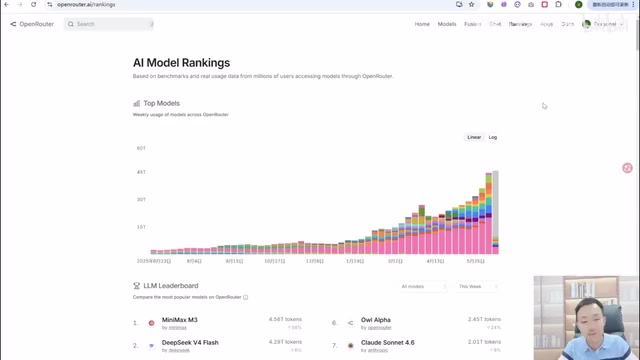
Consumer-facing AI applications (like Doubao, Yuanbao) are mostly burning cash at a loss, while those truly making money are upstream in the value chain:
- Selling compute/hardware: Memory, chips, semiconductors—stock prices soaring. Take Nvidia for example: its data center GPUs (like H100, B200) are in short supply, with demand for AI training and inference growing exponentially
- Selling tokens: Major companies like Zhipu and Tencent provide external API services, billing by input/output token count—a business model with diminishing marginal costs. Model training is a one-time massive investment, while the marginal cost per inference is relatively low
- Aggregation platforms/wrapper sites: Buying cheap tokens and reselling them—some teams of just a dozen people generate annual revenues of one or two hundred million yuan selling tokens
The lesson for developers: AI programming capability isn't just technology—it's leverage for capturing the AI infrastructure dividend.
Conclusion: Engineering Mindset Is the Core Competitive Advantage That Survives Cycles
For traditional engineers (especially backend) looking to transition into AI application development, there's an optimistic but pragmatic signal: large model development isn't mysterious, and backend experience in system design, API development, and engineering are all strong advantages. Backend engineers have natural advantages when transitioning to AI application development—deploying AI applications is essentially a systems engineering problem: designing highly available inference service architectures, implementing streaming response interfaces (SSE/WebSocket), managing context window and conversation history storage, handling asynchronous task queues (like long-text generation), implementing vector database integration in RAG (Retrieval-Augmented Generation—a technique that lets AI generate more accurate answers based on external knowledge bases) pipelines, and building comprehensive monitoring and logging systems. These capabilities highly overlap with microservice architecture design, message queues, caching strategies, and database optimization in traditional backend development. What developers mainly need to learn additionally is Prompt Engineering, model API invocation standards, and using AI application development frameworks like LangChain/LlamaIndex. Migrate these capabilities over, supplement with AI tool usage, and within a few months you can produce demonstrable projects.
The real divide isn't whether you can use Claude Code or Codex, but whether you're stuck at toy-level demos with Vibe Coding or have mastered AI-engineered programming—a methodology for enterprise-grade complex systems. Tools will continuously iterate, but the engineering mindset is the core competitive advantage that survives cycles.
Key Takeaways
- Vibe Coding is effective for rapid prototyping but hits a ceiling with complex, maintainable enterprise systems
- Plan Mode bridges the gap between quick demos and structured development through task decomposition
- AI-engineered programming (via tools like SuperPower/Spec Kit) enables enterprise-grade development with proper architecture, testing, and deployment workflows
- Model selection matters more than tool choice: Claude and Codex lead globally; domestically, GLM and DeepSeek offer strong alternatives
- Tools and models can be decoupled: use Claude Code with domestic model backends for flexibility
- Real money in AI is made upstream: compute/hardware, token sales, and aggregation platforms—not consumer apps
- Backend engineers have natural advantages in AI application development due to transferable systems engineering skills
- Engineering mindset over tool proficiency: systematic thinking about architecture, testing, and deployment survives tool evolution
Related articles

iPhone Duo vs Z Fold 8: Which Foldable Nails Cover Screen and Form Factor Experience Better?
Based on a YouTube comparison, we analyze the iPhone Duo vs Samsung Z Fold 8 in cover screen ratio, one-handed grip, pocketability, app adaptation, multi-posture use, and keyboard input.

Why Tech Media Always Gets Accused of "Shilling"? The Verge Editor-in-Chief Responds to Bias Allegations
After The Verge's Duo review drew accusations of bias, Editor-in-Chief Nilay Patel responds: no paid reviews, no brand deals, editorial independent of sales, and details the ethics policy.

Claude Code 3x Speedup: Thanks to 1997's GZip Technology
Claude Code achieves 3x faster local sessions and 2.8x faster cloud sessions by enabling GZip compression. This article analyzes how this classic technology optimizes message transmission efficiency in AI coding tools and what it means for developers.