From Web Developer to AI Engineer: A Pragmatic Career Transition Roadmap

A three-layer roadmap for web developers to transition from prompt engineering to real AI engineering.
Based on a real Reddit case, this article outlines a pragmatic career transition path for web developers moving into AI engineering. It covers three layers: solidifying math and PyTorch foundations, deeply understanding Transformer architecture through resources like Karpathy's nanoGPT and Hugging Face courses, and specializing in areas like LoRA fine-tuning or Agent architecture design.
From "Prompt Engineer" to a Real AI Engineer
In a Reddit tech community, a web developer with several years of experience posed a highly representative question. He currently wears two hats at his company—web development and AI development—having built RAG (Retrieval-Augmented Generation) systems and chatbots, and dabbled in Agent development. But he openly admitted that he wants to move beyond "glorified prompt engineering" toward a more hardcore, technically deep AI career path.
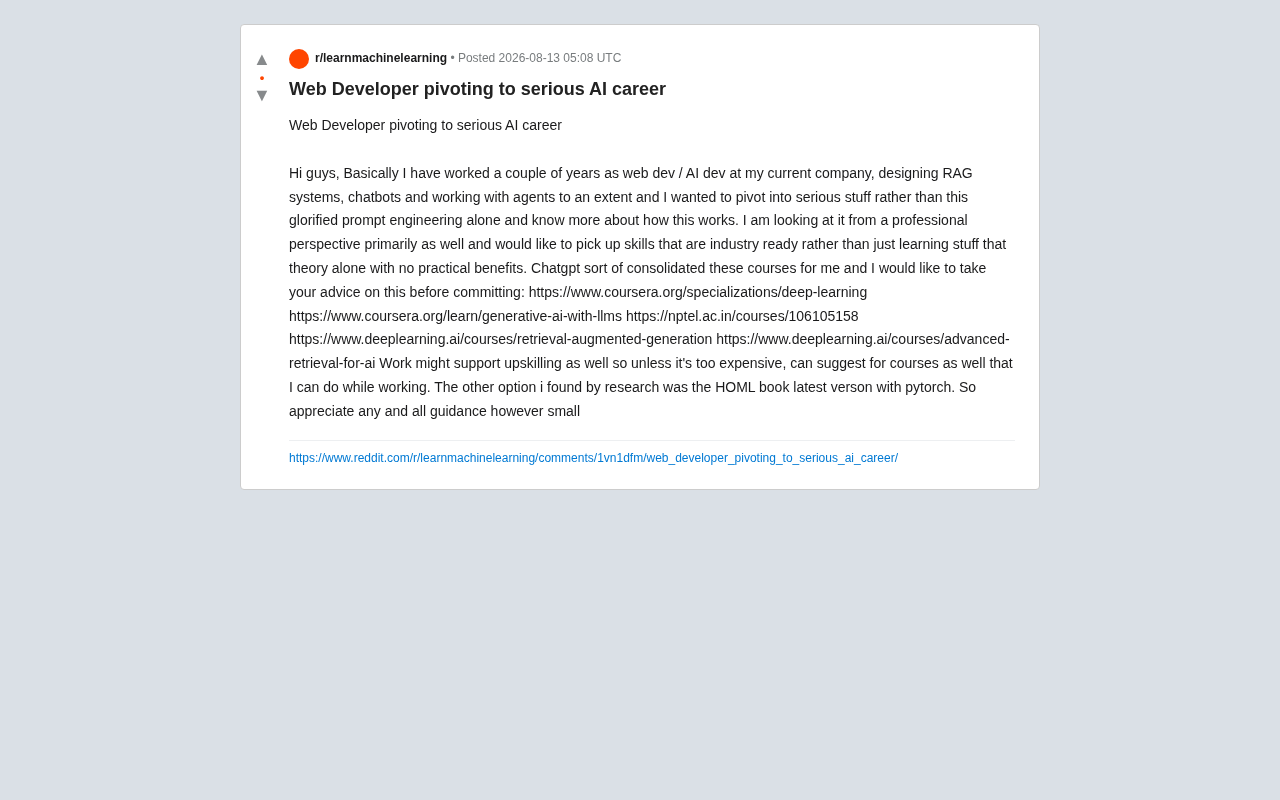
This is an incredibly relatable aspiration. As LLM APIs have become widely accessible, a large portion of "AI application development" has effectively devolved into calling APIs and writing prompts. Many developers find themselves trapped in a peculiar anxiety: they're technically working on AI projects, but they know very little about the underlying principles. Take away the off-the-shelf frameworks and APIs, and they're lost. This developer made it clear that he wants "industry-ready" practical skills—not pure theory with no real-world payoff. That's the mindset of a mature practitioner.
What RAG Systems Actually Do
To understand the gap between this developer's current capabilities and his growth goals, we first need to clarify what RAG systems actually involve. RAG is an architectural paradigm proposed by Meta AI's research team in 2020. Its core idea is to combine the generative capabilities of large language models with the retrieval capabilities of external knowledge bases. Traditional LLMs can only rely on parameterized knowledge learned during training when answering questions, leading to knowledge cutoff limitations and hallucination problems. RAG addresses this by retrieving relevant passages from an external document store before generating an answer, injecting those passages as context into the prompt so the model generates responses grounded in real documents. A typical RAG system involves three core components: document chunking and vectorization (typically using embedding models to convert text into high-dimensional vectors), vector retrieval (finding the most relevant document chunks via similarity search in a vector database), and context-augmented generation (feeding the retrieved results along with the user's question into the LLM). Popular vector databases in the industry include Pinecone, Weaviate, Chroma, and Milvus.
The Agent development he's been exposed to is also one of the hottest areas in LLM applications today. Unlike simple chatbots, AI Agents possess autonomous planning, tool-calling, and multi-step reasoning capabilities. Their core architecture typically includes: a large language model serving as the "brain," a set of callable external tools (such as search engines, code executors, and database query interfaces), and a memory system (short-term working memory and long-term persistent memory). The key technical challenges for Agents lie in task decomposition (breaking complex goals into executable sub-steps) and reflection mechanisms (evaluating intermediate results and dynamically adjusting strategies). Representative frameworks include LangChain's Agent module, AutoGPT, CrewAI, and others. However, much of current Agent development still operates at the level of orchestrating LLM calls through prompt templates, with relatively shallow understanding of the underlying reasoning mechanisms—which is precisely the bottleneck this developer wants to break through.
His Self-Curated AI Learning Path
With ChatGPT's help, the developer had already compiled a preliminary list of course resources, including:
- Andrew Ng's Deep Learning Specialization (Coursera)
- Generative AI with LLMs (Coursera)
- NPTEL's Deep Learning course (India's national online education platform)
- Retrieval Augmented Generation (DeepLearning.AI)
- Advanced Retrieval for AI (DeepLearning.AI)
He also considered an alternative path: reading the classic textbook Hands-On Machine Learning (HOML), whose latest edition has rewritten all code examples in PyTorch.
Strengths and Blind Spots of This Course List
In terms of selection quality, this list is quite solid. Andrew Ng's Deep Learning Specialization is a universally recognized introductory classic that helps learners build intuition around core concepts like neural networks, backpropagation, CNNs, and RNNs. The DeepLearning.AI short courses on RAG align perfectly with his existing work experience, offering a quick way to fill theoretical gaps.
However, the list has notable blind spots. It's heavily concentrated on the "application layer" and "deep learning fundamentals" while missing critical stepping stones to more advanced AI engineering capabilities—such as in-depth deconstruction of the Transformer architecture, hands-on engineering practice in model training and fine-tuning, and solid mathematical and programming foundations. If the goal is to evolve from an API consumer to a model builder, these courses alone won't be enough.
A More Complete AI Engineer Transition Roadmap
Given this developer's background (existing hands-on experience with RAG and Agents), a more sensible progression should be structured in three layers.
Layer 1: Solidify Math and Programming Foundations
For someone with existing engineering skills, there's no need to start from scratch—but two gaps must be filled: basic intuition for linear algebra and probability/statistics, and hands-on proficiency with PyTorch. The latest edition of Hands-On Machine Learning is an excellent choice here. It strikes a balance between theory and code, making it better suited for developers with programming backgrounds to systematically organize their knowledge than pure video courses. The key recommendation is to run every code example in the book yourself, rather than just reading through them.
Layer 2: Deeply Understand Transformers and LLM Principles
This is the critical gateway for leaping from "prompt engineer" to AI engineer. The Transformer is a revolutionary architecture proposed by Google's team in the 2017 paper Attention Is All You Need, which completely replaced the RNNs and LSTMs that had previously dominated NLP. Its core innovation is the self-attention mechanism, which allows the model to "attend to" all other positions in a sequence when processing each position, thereby capturing long-range dependencies. Specifically, self-attention works by transforming the input into three sets of vectors—Query, Key, and Value—and computing an attention weight matrix. Multi-Head Attention runs this process in parallel multiple times, enabling the model to extract information from different representation subspaces. Positional Encoding addresses the Transformer's inherent lack of sequence position awareness. Modern large language models like the GPT series use a decoder-only architecture, while BERT uses an encoder-only architecture, and T5 uses a full encoder-decoder structure. Deeply understanding the differences among these variants is a key step in moving from API consumer to model builder.
Andrej Karpathy's "build GPT from scratch" series ("Let's build GPT" and "nanoGPT") comes highly recommended—it's widely regarded as the best free resource for truly understanding LLM internals. Karpathy, a former Tesla AI Director and founding member of OpenAI, starts his video series from a blank Python file and progressively builds a complete GPT model, covering tokenizer implementation, self-attention mechanism coding, feedforward network construction, residual connections, layer normalization, and the full training loop. nanoGPT is his open-source minimalist GPT implementation—roughly 600 lines of code—that can train a small language model capable of generating coherent text on a single GPU. This "build from scratch" learning approach is so highly regarded in the industry because it forces learners to understand the mathematical principles and design decisions behind every line of code, rather than staying at the level of calling high-level APIs. After completing this exercise, learners typically develop deep intuition about gradient flow, loss function design, learning rate scheduling, and why specific architectural choices work.
Additionally, Hugging Face's official course should be included in the learning plan—it serves as the bridge between theory and industrial practice. Hugging Face has become the de facto open-source infrastructure platform in AI, holding a position analogous to GitHub in software development. Its core products include: the Transformers library (providing a unified API interface for tens of thousands of pretrained models, supporting PyTorch, TensorFlow, and JAX), the Datasets library (standardized dataset loading and processing tools), Model Hub (a platform hosting over 700,000 open-source models), and Spaces (a model demo deployment platform). For AI engineers, the official Hugging Face course doesn't just teach tool usage—more importantly, it covers the complete workflow for industrial-grade model applications: from model selection, tokenizer configuration, and fine-tuning (integrating techniques like PEFT and LoRA), to model evaluation and deployment. Mastering the Hugging Face ecosystem is a critical bridge connecting academic research with industrial deployment, and one of the most commonly required skills for AI engineer positions today.
Layer 3: Engineering Practice and Specialization
With the first two layers as a foundation, going back to study advanced RAG and Agent courses will yield an entirely different experience—you'll understand the principles behind every component, not just copy-paste from tutorials. At this point, you can choose a specialization based on your interests: model fine-tuning (LoRA, QLoRA), model deployment and inference optimization, or Agent system architecture design.
Among these, LoRA and QLoRA are the most mainstream parameter-efficient fine-tuning methods and deserve special attention. LoRA (Low-Rank Adaptation), proposed by Microsoft in 2021, solves the massive computational resource requirements of full-parameter fine-tuning for large models. Its core idea is based on an important hypothesis: when a model adapts to downstream tasks, the change matrix of its weights exhibits low-rank properties. Therefore, instead of directly modifying the original large weight matrix W, LoRA decomposes the weight update into the product of two small matrices A and B (ΔW = A×B), where the rank of A and B is far smaller than the dimensions of the original matrix. For example, a 4096×4096 weight matrix, through rank-16 decomposition, reduces trainable parameters from approximately 16 million to around 130,000—a reduction of two orders of magnitude. QLoRA takes this even further by introducing 4-bit quantization (NormalFloat4 data type) to store the frozen base model weights, combined with double quantization and paged optimizers, making it possible to fine-tune 65B-parameter models on a single consumer-grade GPU (e.g., 24GB VRAM). These two techniques have dramatically lowered the barrier for individual developers and small-to-medium businesses to participate in large model fine-tuning.
Practical Advice for All Developers Looking to Transition into AI
This Reddit user's situation represents a shared anxiety among a large number of web developers and backend engineers today. Based on his case, several universal recommendations are worth emphasizing.
First, leverage your existing engineering strengths. He already has hands-on experience with RAG and Agents—something many pure theory learners lack. Transitioning isn't about starting over; it's about adding theoretical depth to your existing engineering capabilities.
Second, stick to the "write the code yourself" principle. He repeatedly emphasized that he doesn't want to learn "pure theory"—and he's absolutely right. The litmus test for whether a course is worth your time is whether it requires you to implement things hands-on. Understanding something and actually building it are two entirely different worlds.
Third, fully leverage your company's learning support. He mentioned that his company might support skill development. This is a severely underestimated resource—paid courses, cloud GPU credits, and even internal project practice opportunities should all be actively pursued. Honing your skills on real business problems is far more valuable than completing ten courses.
Fourth, validate learning outcomes through projects. After learning the fundamentals, the best way to consolidate knowledge is to build a complete end-to-end project: from data processing and model fine-tuning to deployment. A project like this serves both as proof of learning and as the most compelling evidence when job hunting.
Conclusion
Transitioning from web development to serious AI engineering is fundamentally a cognitive upgrade—from "using tools" to "understanding and creating tools." This Reddit developer's course list is a decent starting point, but the real keys are: filling the gaps in math and training engineering, deeply understanding Transformer principles, and consistently practicing hands-on. In an era where LLM APIs have lowered the barrier to AI development, those who take the time to understand what's happening under the hood will be the ones with a true technical moat.
Related articles

Python 3.15 New Feature: Is the sentinel Type Better Than None?
Python 3.15 adds the sentinel type, using named unique sentinel objects to replace None and bare object(), resolving confusion among missing values, explicit emptiness, and invalid input while avoiding type hint failures.

Deep Learning's Three Architectures and the Universal Approximation Theorem: A Complete Guide to MLPs, CNNs, and Transformers
Explaining the inductive bias differences among MLP, CNN, and Transformer, the existence meaning of the Universal Approximation Theorem (UAT), and the role of Taylor expansion in approximation analysis, while clearing up common misconceptions.

GitLab Emergency Patch Release: Analysis of Critical Security Fixes
GitLab releases critical patch 19.5.1, sparking 355 points of discussion on Hacker News. This article analyzes the background, upgrade steps for self-hosted instances, and verification points to help DevOps teams respond quickly to security updates.