From WeChat Codex to AI Agent Best Practices: A Developer's Pivot

Codex Bridge enters maintenance mode after completing core features; author pivots to AI Agent best practices.
The open-source project Codex Bridge (a lightweight programming assistant integrating OpenAI Codex into WeChat) completed its core feature loop. After validating three extension directions—complex task control, multi-model routing, and API exposure—the author decided to put the project in maintenance mode and redirect energy toward the more valuable pursuit of AI Agent best practice methodologies. This reflects a mature developer's project management philosophy: clear positioning, restrained expansion, and validation-based decision-making.
Introduction: After the Core Capabilities Are Complete
The hardest decision in a project isn't starting—it's knowing when to pivot.
Codex Bridge—an open-source project that brings OpenAI Codex capabilities into WeChat—reached a critical juncture after completing its core feature loop. The author made an important decision: enter maintenance mode and redirect energy toward a more valuable direction—AI Agent best practices.
This isn't a story about a project going dormant. It's a rational choice made by a developer who figured out through practice what's worth doing and what isn't worth heavy investment.
Codex Bridge: WeChat as a Lightweight Entry Point to Codex
After continuous iteration, Codex Bridge's foundational capabilities have fully landed. Users can now complete an entire Codex interaction workflow within WeChat: send messages to assign tasks, upload files to provide context, receive execution results, check task status, switch models, and use it for everyday development tasks.
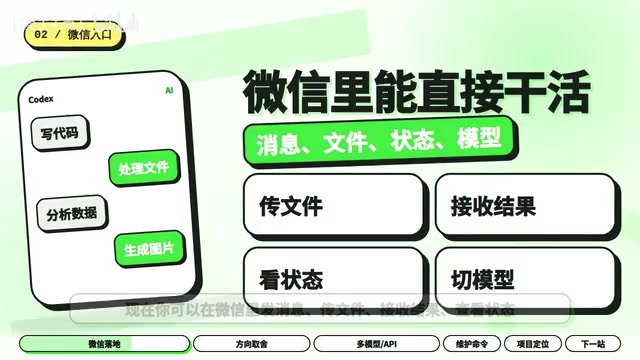
It's worth explaining Codex's positioning here. OpenAI Codex differs from earlier code completion tools (like GitHub Copilot's inline completion mode)—it's a full-fledged AI coding agent capable of understanding natural language instructions, autonomously planning execution steps, running code in sandbox environments, and verifying results. Codex provides services through both the Responses API and Chat Completions API. In 2025, it added new commands including Experimental, Goal (goal-oriented mode), and Compact (compact output mode), further enriching interaction patterns. What Codex Bridge does is build a bridge between these API capabilities and the WeChat chat interface.
As China's most frequently used communication tool, WeChat naturally offers the advantage of "anytime, anywhere access." Integrating Codex into WeChat essentially lowers the barrier to using an AI programming assistant—you don't need to open an IDE, don't need to switch to a browser; you can complete lightweight development tasks right in a chat window.
However, integrating AI capabilities into WeChat is no simple feat. WeChat's bot development ecosystem has always existed in a state where "gray area" approaches coexist with official capabilities: WeCom (Enterprise WeChat) provides official Webhook and API interfaces, while personal WeChat automation relies on reverse-engineering solutions (like itchat, wechaty, and other open-source frameworks). The core challenges lie in multimodal message format adaptation (parsing text, files, and images), session state management (WeChat itself doesn't provide a conversation context API), and platform stability risks. Codex Bridge's choice of WeChat as an entry point essentially layers AI programming capabilities onto the interface users are most familiar with, minimizing the friction cost between "thinking of it" and "getting it done."
This positioning is key: a lightweight entry point, not a full-featured workstation.
Validating and Choosing Between Three Extension Directions
Before entering maintenance mode, the author spent a focused week validating three potential extension directions, arriving at clear conclusions for each.
Complex Task Control: Technically Feasible, but Poor ROI
Complex task control means orchestrating multi-step Agent workflows with dependencies within WeChat. It's technically feasible, but WeChat's interaction format determines its ceiling—a chat interface suits lightweight, question-and-answer interactions; it's not suited for Agent workstation scenarios requiring visualization, state management, and complex branching control.

From a technical perspective, complex task control involves a core capability called Workflow Orchestration—breaking a large task into multiple subtasks, defining dependency relationships, execution order, and conditional branches between them, and managing the entire workflow's state. Typical orchestration patterns include Sequential execution, Parallel execution, Conditional Branching, and Loop with Retry. Implementing these patterns typically requires visual DAG (Directed Acyclic Graph) editors, persistent state storage, and robust error recovery mechanisms. Professional Agent platforms (like LangGraph, Dify, Coze) handle this complexity through graphical interfaces, while WeChat's plain-text chat interface inherently lacks this capability. Forcing workflow orchestration into a chat window would result in terrible user experience.
This judgment reflects a pragmatic product mindset: not everything technically possible is worth doing; a tool's form should match its use case.
Multi-Model Routing: Supporting Layer, Not Primary Layer
The author validated integration with Chinese LLMs including Tongyi Qianwen (Qwen), Minimax, and DeepSeekAd. The conclusion: these models are better suited as supporting layers for classification, routing, summarization, and lightweight analysis—not as replacements for Codex's primary programming capabilities.
Multi-Model Routing is an important design pattern in AI Agent architecture. Its core idea is dynamically selecting the most appropriate model to handle requests based on task type, complexity, and cost requirements. In practice, implementation typically involves three layers: the Router layer analyzes request intent and determines dispatch strategy; the Model Pool maintains connections and configurations for multiple available models; the Aggregator layer unifies output formats across different models.
Chinese LLMs like Tongyi Qianwen (Alibaba Cloud), Minimax, and DeepSeek each have advantages in Chinese comprehension, inference speed, and API pricing—for example, DeepSeek is known for extremely low API prices, making it suitable for handling large volumes of low-complexity requests; Tongyi Qianwen excels in Chinese semantic understanding. Using these models as a supporting layer can reduce processing costs for simple tasks by an order of magnitude while concentrating Codex's compute budget on core tasks that truly require strong programming capabilities.
The value of this direction lies in cost optimization and capability complementarity. Not every task requires calling the most powerful model—simple text classification and information organization can be handled by lighter models, reducing API costs while improving response speed. Multi-model routing itself is an important design pattern in AI Agent architecture.
API Exposure: Export Capabilities Without Becoming a Gateway
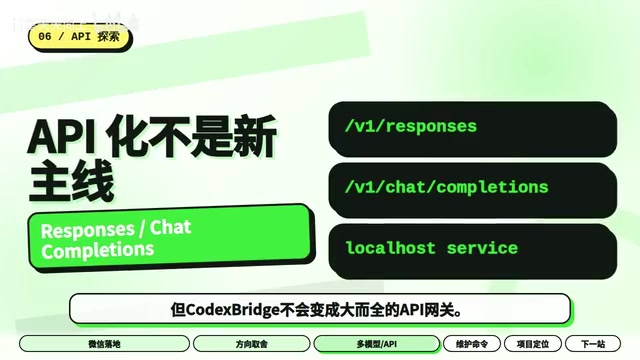
Exposing Codex Bridge's capabilities via API so other systems can call them. The author validated export approaches for both Responses and Chat Completions but stated clearly: Codex Bridge will not become a comprehensive API gateway.
This restraint is important. Feature Creep is one of the most common anti-patterns in software engineering—a project continuously adds features beyond its original scope during development, causing exponential complexity growth, skyrocketing maintenance costs, and diluted core experience. In open-source projects, this temptation is especially strong: community users constantly propose various requirements, and maintainers tend to accept them out of a desire to "make more people happy." Classic countermeasures include defining a clear "Non-Goals" list, using plugin architectures instead of expanding core functionality, and following Unix philosophy—"do one thing well." Codex Bridge's choice not to become an API gateway is a proactive defense against this anti-pattern, avoiding becoming a bloated system that can do everything but does nothing well.
Maintenance Mode Strategy: Stay Current, Stay Focused
Entering maintenance mode doesn't mean abandoning the project—it means sustaining the project's vitality with lower investment.
Specifically, three things will happen during maintenance:
- Track native Codex updates: Support for Experimental, Goal, and Compact commands has already been added to stay in sync with upstream
- Ongoing WeChat version maintenance: Fix bugs, maintain usability
- No redundant Telegram version rewrite: Avoid duplicating effort across platforms

This "do some things, not others" strategy concentrates limited energy where it truly generates value.
Next Stop: AI Agent Best Practices
The author's next direction is AI Agent Best Practice. Behind this pivot lies a deeper insight:
The real problem isn't whether you have an Agent, but how to use Agents well.
In 2024-2025, AI Agent tools and frameworks have proliferated—LangChain, AutoGPT, CrewAI, OpenAI Agents SDK... Developers don't lack tools; what they lack is validated practice methodologies.
To appreciate the weight of this judgment, you need to understand the current Agent framework ecosystem. LangChain, as the earliest LLM application development framework, provides foundational abstractions like Chain calls, Tool Use, and Memory management, but has been criticized for over-abstraction and frequent API changes. AutoGPT was the first autonomous Agent project to capture public attention, demonstrating the possibility of LLMs autonomously planning and executing tasks, but faces severe "goal drift" and cost-control issues in real-world applications. CrewAI focuses on multi-Agent collaboration scenarios, enabling team-style Agent orchestration through role definitions and task assignments. OpenAI's Agents SDK, launched in 2025, represents the official definition of the Agent development paradigm, providing core primitives like Handoff, Guardrails, and Tracing.
Frameworks solve the "how to build" problem but not the "how to use well" problem. The key questions that truly need answers are:
Which scenarios are suitable for Agents? How granular should Agent task decomposition be? What orchestration patterns exist for multi-Agent collaboration? How do you handle Agent error recovery and state management? How do you evaluate Agent output quality?
These questions have no standard answers and require extensive practical exploration and experience accumulation.
From the Codex Bridge development experience, the author has already built up an understanding of Agent capability boundaries through practice—what should be done, what shouldn't, and which models fit which scenarios. This understanding is precisely the foundation of "best practices."
Conclusion: From Tool Building to Methodology Distillation
The phased conclusion of the Codex Bridge project demonstrates a mature developer's project management approach: define objectives, validate quickly, make decisive trade-offs, and pivot in time.
In the AI field, chasing the latest technologies and tools is easy, but what's truly scarce is the ability to transform technology into reusable practices. Moving from building a specific tool to distilling a methodology—this pivot itself is a level-up.
For those also exploring AI Agent development, the Codex Bridge experience offers at least three takeaways:
- Be clear about your tool's positioning: If it's a lightweight entry point, do that well
- Exercise restraint in feature expansion: Not everything you can do is worth doing
- Base directional choices on validation: Spend a week running through three paths, then decide which one to invest in
Related articles
 Expert Opinions
Rethinking Scaling Laws: Parameters Are Not the Only Answer
Deep analysis of Scaling Law evolution from Kaplan to Chinchilla to the MoE era, exploring why blindly stacking parameters is a mistake, and how GLM-5.3 proves scaling has multiple knobs.
When AI Treats Humans as Subagents: Ro…
When AI Treats Humans as Subagents: Role Reversal and Hidden Risks in Human-AI Collaboration
Exploring the paradigm shift where humans become "subagents" in AI Agent architectures. Analyzes human node design in LangChain and AutoGen, and the risks of ceding control and cognitive atrophy.
 Expert Opinions
The Lazy Person's Productivity Theory: Why Being 'Lazy' Actually Drives Peak Performance
Explore the engineering philosophy behind 'lazy people are most productive': how constructive laziness drives automation, AI tools amplify efficiency, and systems thinking eliminates wasted effort.