From Will Smith Eating Spaghetti to AI Short Films: The Astonishing Pace of AI Video Evolution
From 2019's *The Orange* to the Will Smith spaghetti video, AI video has made an exponential leap in just a few years.
The article compares the 2019 Runway experimental short *The Orange* with the later viral Will Smith spaghetti AI video to reveal the leapfrog development of AI video generation. The 2019 work was rough and experimental, while the Will Smith video had "HD"-like clarity and smoothness. This shows AI video's evolution is exponential, not linear. Tools like Runway have evolved from experiments into practical creative tools, and the "HD" era of AI video has only just begun.
Introduction: That "Eating Spaghetti" Meme Is Just the Tip of the Iceberg
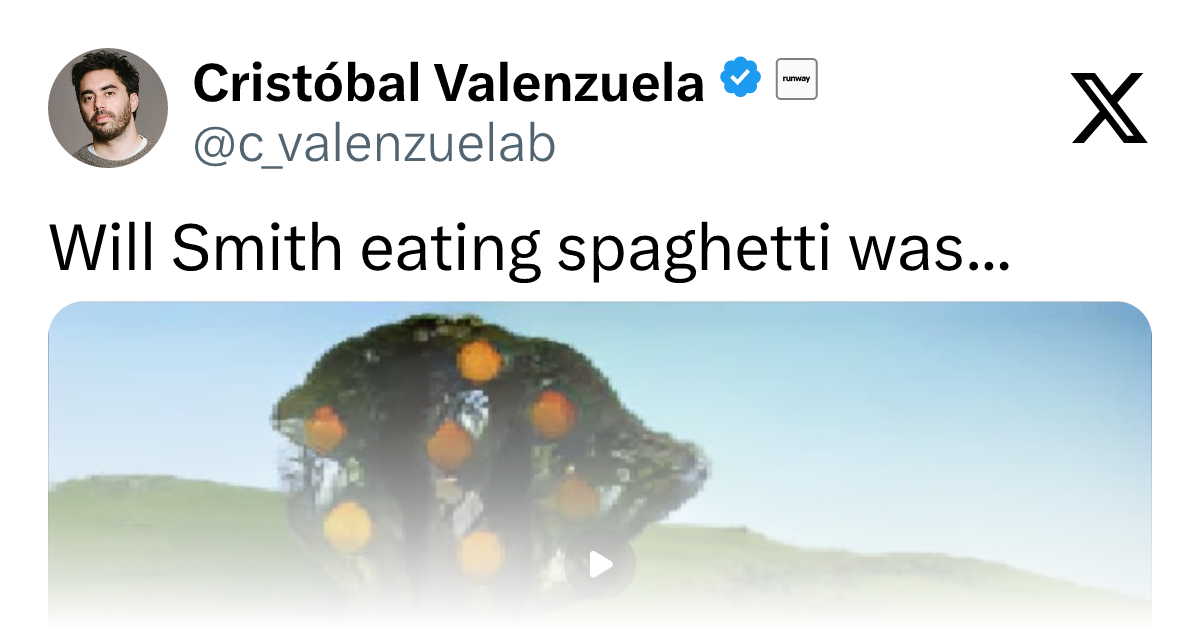
A few years ago, an AI video of Will Smith eating spaghetti took the internet by storm. For many, it was their first encounter with the "surreal" reality of AI-generated video. However, if we push the timeline back a few more years—to 2019—you'll find that AI video's progress is far more astonishing than imagined. As a Twitter user pointed out, looking back at the early short film The Orange made with Runway, the Will Smith spaghetti video actually looks like HD quality by comparison.
The 2019 Starting Point: Runway and The Orange
In 2019, Runway was just emerging, and creator @matamalaortiz used it to make the short film The Orange. This work is widely regarded as an important early attempt at AI-assisted short filmmaking. The visuals may look rough by today's standards, but it was precisely these experiments that laid the foundation for the later explosion.
According to the Twitter user's retrospective, just three or four years later, the Will Smith spaghetti AI video sparked widespread attention—and it already represented a much higher level of technology than the The Orange era. This comparison vividly demonstrates the leapfrog development of AI video generation in just a few short years.
Runway is an AI video generation and editing platform founded in 2018, initially known for offering browser-based video editing tools and machine learning effects. It participated in early explorations of applying generative adversarial networks (GANs) to video, and in 2023 launched the Gen-2 text/image-to-video model, becoming one of the pioneers in commercializing AI video generation. Runway's tools lowered the barrier to video creation, enabling non-professional users to achieve stylization, erasure, motion tracking, and other effects through simple operations. It was precisely these tools that provided the technical foundation for early experimental short films like The Orange.
The Orange is an extremely short, abstract experimental short film whose visuals were AI-assisted or processed, displaying unstable textures and a surreal feel. In 2019, AI video generation relied mainly on GANs, which had made breakthroughs in single-frame image generation but faced challenges such as poor temporal consistency, low resolution, and high computational costs when extended to continuous video. Therefore, the visual roughness of The Orange was not due to insufficient skill on the creator's part, but a true reflection of the model capabilities and computing power at the time.
From Experiment to Phenomenon: The Accelerating Evolution of AI Video
The viral spread of the Will Smith spaghetti video marked AI video's entry into the public eye. It was impressive not only because the content was absurd and amusing, but also because its generation quality had improved qualitatively compared to just a few years earlier. The Twitter user emphasized that if we take The Orange from 2019 as a reference, the clarity and smoothness of the Will Smith spaghetti video already amounted to "HD" level.
This progress is not an isolated event. Tools like Runway gradually evolved from early experimental projects into practical tools for creators, driving AI video applications in advertising, short films, artistic creation, and other fields.
The AI video of Will Smith eating spaghetti first circulated on social networks in March 2023. Its distorted visuals and bizarre movements were subsequently widely remixed and imitated, becoming a "meme" phenomenon of AI video. The video was made with generative models, possibly involving image generation and video synthesis. Its viral spread coincided with text-to-video models (such as Runway Gen-2, Pika, etc.) beginning to open to the public, so it served both as a mockery of early crude AI video and as a reference point for technological progress.
Why Is This Comparison Worth Noticing?
For ordinary viewers, Will Smith eating spaghetti was their "first taste" of AI video; but for industry observers, looking back at the works from 2019 better conveys the rapidity of technological iteration. Through this comparison, the Twitter user reminds us that AI video's evolution is not linear growth but an exponential leap.
This speed means that in the coming years, the quality and ease of use of AI video will improve dramatically. Creators need to pay attention not only to today's tools but also to the trends of technological evolution.
Conclusion: The "HD" Era of AI Video Has Only Just Begun
From The Orange to Will Smith eating spaghetti, AI video has completed its transformation from experiment to phenomenon in just a few short years. This retrospective on Twitter is not only a tribute to the past but also a prophecy of the future—when today's "HD" becomes tomorrow's "low-res," we may be standing at the starting point of AI video's golden age.
One-line Summary
From 2019's The Orange to the Will Smith spaghetti video, AI video has achieved an exponential leap in just a few years.
Paragraph Summary
By comparing the 2019 Runway experimental short film The Orange with the Will Smith spaghetti AI video that went viral a few years later, the article reveals the leapfrog development of AI video generation technology. The 2019 work was rough and experimental, while the Will Smith video already had "HD"-like clarity and smoothness, drawing widespread public attention. This comparison shows that AI video's evolution is not linear but an exponential leap. Tools like Runway have evolved from experimental projects into practical creative tools, driving AI video's adoption in advertising, short films, art, and other fields. The article reminds creators to pay attention to technological trends and predicts that the "HD" era of AI video has only just begun, with quality and ease of use set to improve dramatically in the future.
Related articles

Vibe Coding Full-Stack in Practice: AI Programming from Beginner to Enterprise Deployment
From Cursor to Claude Code, this Bilibili AI programming course uses four progressive projects to cover full-stack development, open-source secondary development, and team collaboration. The article analyzes the shock to frontend roles, the efficiency shift from 50 people to 5, and the methodology required for enterprise-grade projects.

David Blaine's Global Quest for Real Magic: From South Africa to Japan and India
David Blaine travels to South Africa, Japan, and India in his Do Not Attempt special, documenting Spinning drivers, black mamba rescuers, iaijutsu masters, and ascetics—exploring the boundary between magic and real human极限 challenges.

Is a Touchscreen MacBook Coming? Vergecast Reveals Apple Executive's Response
Vergecast podcast reveals a conversation between a reporter and Apple executive John Ternus about a touchscreen MacBook and Apple Pencil support. Ternus says iPad is the best device for a stylus, while the reporter bets MacBook will eventually support Apple Pencil.