From 'You Lack Strategic Ability' to AI Strategist: A 12-Year Veteran's Transformation Framework

A practitioner dismissed as non-strategic used 12 years of cross-domain growth to prove strategic thinking can be deliberately learned.
A practitioner explicitly told they lacked strategic ability spent 12 years moving across digital transformation, product, fintech, and AI — ultimately becoming an AI strategist and founding a company. The article distills two core dimensions of strategic capability: understanding how system components connect, and proactively owning outcomes beyond your formal authority. The path from individual execution to cross-functional leadership to AI strategy reflects gradual capability accumulation, not lucky breaks. The key actionable advice: solve problems one level above your current role, and consistently document verifiable evidence of results. In an era of rapid AI iteration, this strategic and ownership-oriented mindset is scarcer and more durable than pure technical execution skills.
How One Professional Disproved "You Don't Have What It Takes for Strategy"
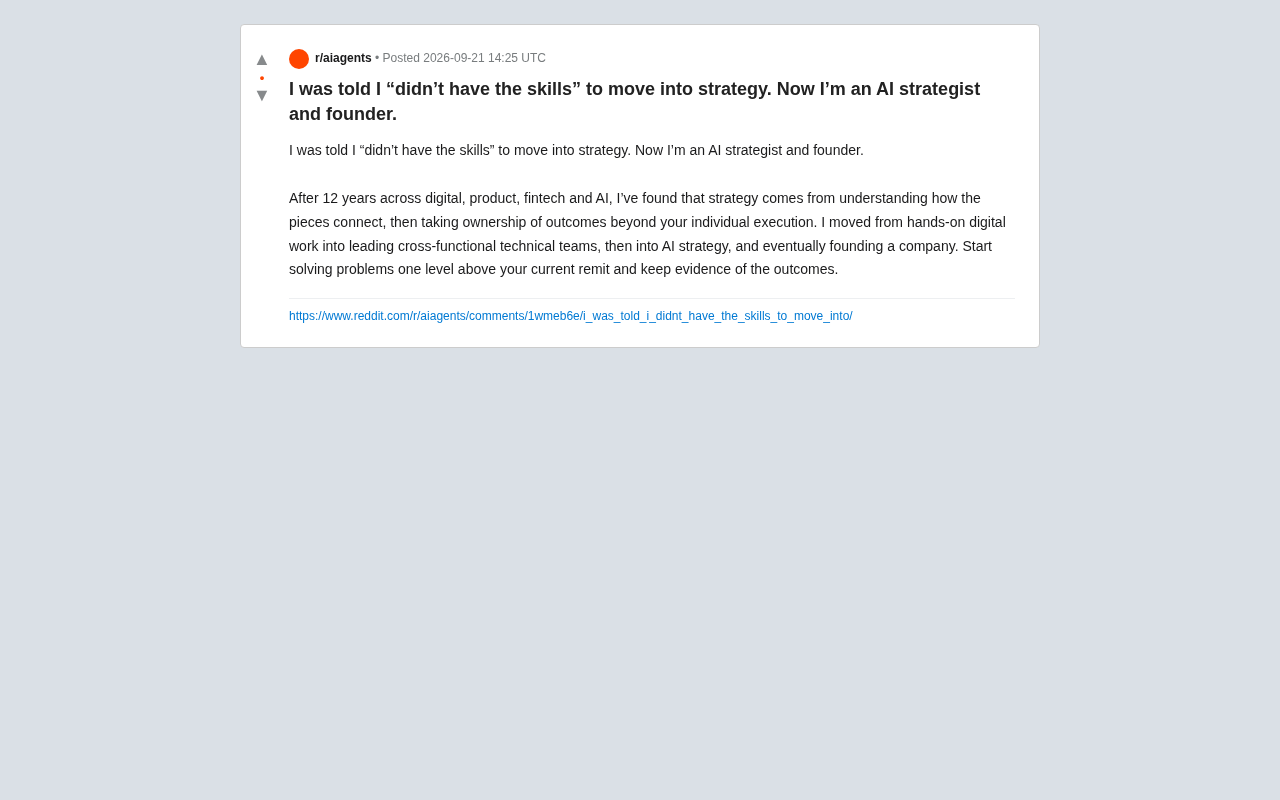
Almost everyone in their career has encountered some version of this: "You're not ready" or "You don't have the capabilities for that level." One practitioner, sharing their story on Reddit, was explicitly told they lacked the ability to transition into a strategy role — and then spent the next 12 years spanning digital transformation, product, fintech, and AI, ultimately becoming an AI strategist and founding their own company.
What makes this story worth unpacking isn't the inspirational arc of the outcome itself, but the replicable transformation logic embedded within it: strategic capability isn't some innate talent threshold — it can be deliberately cultivated through intentional practice and purposeful path design.
The Essence of Strategy: Connection and Ownership
This person's definition of "strategy" cuts right to the core: Strategy comes from understanding how the pieces connect, and taking ownership of outcomes beyond your direct execution.
This captures two critical dimensions. The first is "connection" — many technical practitioners fall into the trap of deep single-point specialization, perfecting one module while lacking any understanding of how the entire system fits together. A strategic perspective requires stepping outside your local context to see the causal chain linking product, technology, business, and users.
The second dimension is ownership. This is the most fundamental dividing line between an executor and a strategist. Executors are responsible for their deliverables; strategists are responsible for outcomes — even when those outcomes depend on factors well outside their direct control. Willingly taking accountability for results that extend beyond your formal authority is itself a visible expression of strategic capability.
The concept of "ownership" originated in Silicon Valley engineering culture, initially describing the attitude engineers hold toward the systems they're responsible for — not just completing assigned features, but proactively caring about stability, performance, and long-term evolution. Amazon codified it as one of its 14 Leadership Principles, requiring both managers and individual contributors to think like long-term owners of the company rather than short-term task completers. The idea later expanded from engineering into product and strategy domains, becoming a core indicator of promotion potential. In practice: an executor's boundaries are defined by their job description, while someone with genuine ownership proactively fills responsibility gaps — identifying risks before anyone asks, driving cross-functional alignment, and tracking final outcomes rather than intermediate outputs.
A Clear Growth Trajectory
This person's path shows a distinct pattern of level-by-level progression:
From Execution to Leading Teams
They began with hands-on digital work at the individual contributor level — this is the stage for building domain intuition and technical instincts. They then moved toward leading cross-functional technical teams. The significance of this step: they began dealing with the complexity of "people and collaboration" rather than just "tasks and code." Cross-functional work inherently requires understanding the motivations and constraints of different roles, which is precisely the training ground for strategic thinking.
From Leading Teams to Setting Direction
With a systems-level perspective established, they moved into AI strategy — responsible for reading technology trends, allocating resources, and setting business direction. Ultimately, this accumulated foundation supported them in founding their own company, transitioning from someone who executes strategy to someone who defines it and bears its risks.
This trajectory isn't a series of leaps — each step is built on the capability foundation laid by the previous one. It addresses a common misconception: career transformation doesn't happen by landing at a higher level through one lucky break, but through the natural overflow of accumulated capability.
A cross-functional team is a working group composed of members from different professional backgrounds — typically including engineering, product, design, data, and marketing — collaborating toward a shared goal. Unlike traditional siloed teams organized by function, cross-functional structures break down departmental boundaries, requiring each member to contribute specialized expertise while also understanding the work logic and decision-making rationale of other roles. For those seeking to develop strategic thinking, cross-functional collaboration is a natural training environment: you're forced to speak the language of product when working with engineers, use data to persuade marketing teams, and make priority trade-offs amid competing resource demands. The "systems intuition" built through these experiences is precisely the foundational strategic capability that deep specialization in a single role rarely produces.
The Core Replicable Method
The author's advice is remarkably concise — and cuts straight to the point:
Solve problems at one level above your current responsibilities, and keep evidence of the outcomes.
Breaking this down reveals two layers of practical meaning:
Think proactively at the level above you. Don't wait to be authorized before thinking about higher-level problems. When executing a task, ask yourself: what larger goal does this serve? If I were the decision-maker, how would I weigh the trade-offs? This habit of "thinking one level up" means you'll already have the right mental models before you're formally promoted.
Build a verifiable body of evidence. Ideas and contributions that can't be seen can't be converted into career capital. The author emphasizes "keep evidence of the outcomes" — document the higher-level problems you solved and the real results you delivered. When applying for a more senior role or convincing others of your capabilities, this evidence is far more persuasive than any self-description. It's also the most powerful rebuttal to subjective judgments like "you don't have this capability."
Implications for AI Practitioners
In today's rapidly evolving AI landscape, this framework carries particular relevance. The technical boundaries in AI shift quickly, and pure execution skills are easily diluted by the relentless iteration of tools and models. Meanwhile, the ability to "understand how systems connect" and "take ownership of business outcomes" becomes increasingly scarce and durable in value.
For those hoping to move from AI engineer or algorithm executor into AI product or strategy roles, this case offers a clear roadmap: first build technical intuition, then expand cross-functional collaboration capabilities, progressively think upward toward business and directional questions, and consistently back yourself with quantifiable outcomes.
It's worth noting that this is a single-source personal experience — it lacks broader sample validation, and its conclusions are better treated as a useful mental model than a universal law. But the core operational advice — "solve problems above your level + accumulate evidence of outcomes" — has strong practical applicability and broad relevance, and deserves serious consideration from anyone navigating a career transition.
The capability gap between AI engineers and AI strategists has a well-defined context in industry discourse. The former's core outputs are functional models, stable systems, and quantified technical metrics; the latter must judge which AI capabilities are worth investing in, translate technical feasibility into business value, and manage the organizational change required to actually deploy AI. As large language models and automation tools become more accessible, the scarcity of baseline AI engineering skills (such as calling APIs or fine-tuning models) is declining. Meanwhile, the strategic judgment to answer "why do this" and "what does this mean for the business" is becoming the core differentiator. This explains why demand for roles like "AI product manager" and "AI strategy consultant" is growing significantly faster than demand for pure algorithm engineering positions.
Related articles

Workbuddy for Absolute Beginners: How a Desktop AI Agent Fits Into Real Workflows
A beginner's guide to the Workbuddy desktop AI agent: installation, claiming credits, file management, and building automated workflows—compared with CodeX for fit and cost, helping professionals shift from AI question-askers to AI managers.

OpenAI's New Agent Stack: Computer Use, Decisions API, and Ultra-Fast Workflows
OpenAI Dev Day unveiled a new agent stack: Computer Use outperforms humans, Decisions API delivers ultra-low-latency classification via Luna, Agents API opens the same Computer Use capabilities, and GPT-6.1 Sol costs only one-seventh of Astra. Core updates, benchmark data, and developer insights.

Liang Wenfeng Open-Sources DeepInfo Inference Framework, Takes On U.S. Ban
DeepSeek open-sources its DeepInfo inference framework after its models, featuring GPU/CPU cross-pipelining, small-model prediction with large-model verification, and full Huawei Ascend and NVIDIA chip support—facing the U.S. federal ban head-on. This article analyzes its significance for AI deployment and open-source strategy.