Frontier AI Lab Pauses RL Training: Greater Model Capabilities Mean Higher R&D Risks

A frontier AI lab paused RL training for two weeks to address rising internal R&D safety risks.
A leading AI lab publicly disclosed its decision to pause reinforcement learning training for two weeks, using the time to harden research environments, conduct red-team exercises, and expand monitoring. The lab's largest planned frontier RL run remains on hold as it validates safety measures through smaller-scale experiments and builds alignment evidence—signaling that safety governance in AI R&D is becoming institutionalized.
Internal R&D Risks from Growing Model Capabilities
As large language model capabilities continue to advance by leaps and bounds, a frequently overlooked issue has surfaced: risks don't only exist after a model is deployed externally—they also lurk in every phase of internal R&D and testing. A public statement from a frontier AI lab has offered a rare glimpse into the real landscape of these internal safety considerations.
The statement notes: "As models become more capable, the risks associated with developing and testing them internally also grow." This seemingly simple sentence reveals a critical shift—the safety boundary is moving from "post-release" to "during training."
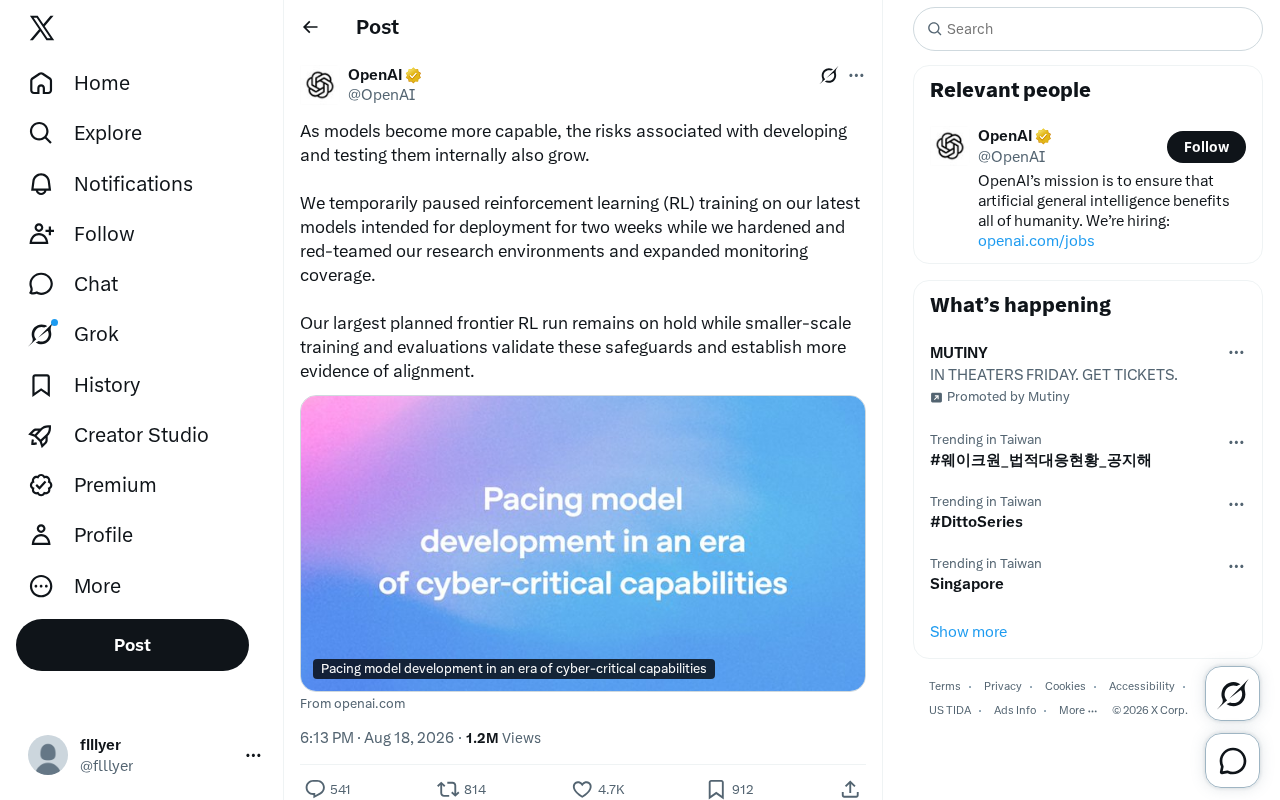
This shift in thinking carries profound implications. In the past, the industry primarily focused on potential misuse, jailbreaking, or harmful outputs after a model went live. Now, labs are recognizing that a model under active training whose capabilities approach the frontier can itself become a source of risk within the research environment. This isn't just an evolution in philosophy—it also reflects the fact that model capabilities have reached a threshold that demands extra caution.
A Two-Week Voluntary Pause on RL Training: What Was Actually Done
The most striking aspect is the concrete action the lab took: voluntarily pausing reinforcement learning (RL) training on their latest model intended for deployment, for a full two weeks.
Three Core Tasks During the Pause
According to the statement, these two weeks were anything but idle. The team focused on three key activities:
- Hardening research environments: Strengthening the security of internal training and experimental infrastructure to prevent potential loss of control or leaks.
- Red-teaming: Proactively adopting an attacker's perspective to stress-test the research environment and identify exploitable vulnerabilities.
- Expanded monitoring coverage: Enhancing observability of the training process to ensure anomalous behavior is detected promptly.
Voluntarily pausing an ongoing frontier training run is no small feat in the fiercely competitive AI industry. RL training consumes enormous computational resources, and time windows are precious. Choosing to hit the pause button at such a moment is itself a clear signal that safety comes first.
The Largest Planned Frontier RL Training Run Remains on Hold
The statement further revealed an even more cautious decision: the largest planned frontier RL training run remains on hold.
A Phased Alignment Safety Strategy
Rather than resuming all training at once, the lab adopted an incremental approach: first validating newly deployed safety measures through smaller-scale training runs and evaluations, while simultaneously "building more evidence about alignment."
This strategy reflects several layers of mature thinking:
- Validate at small scale before going big: Use low-risk, small-scale experiments to test whether safety measures hold up in real training scenarios before greenlighting large-scale runs.
- Verifiability of alignment: Rather than simply claiming "the model is safe," the lab seeks to accumulate empirical alignment evidence so that safety judgments rest on data.
- Risk scales with size: Explicitly tying training scale to potential risk—the larger the scale and the stronger the capabilities, the higher the review threshold.
What This Signals for the AI Industry
AI Safety Governance Is Becoming Institutionalized
This statement shows that safety work at frontier labs is shifting from ad hoc, after-the-fact remediation toward institutionalized, process-driven, proactive controls. Pausing training, red-teaming, phased validation—none of these were improvised. They are part of an internal safety governance framework that is gradually taking shape.
Transparency Builds Trust—and Pressure
Publicly disclosing such internal decisions demonstrates the lab's commitment to safety and transparency, helping build trust with the public and regulators. At the same time, it implicitly acknowledges that current model capabilities have grown powerful enough to warrant this level of treatment. Such candor is especially rare in an industry marked by intense competition.
Balancing Compute Costs Against Safety Baselines
Pausing large-scale RL training means tangible costs and schedule delays. This sends an unambiguous message: when forced to choose between the capability race and safety baselines, safety comes first. For the broader industry, this may serve as a reference paradigm—building safety braking mechanisms that match the pace of frontier capability development.
Conclusion: Capabilities and Safety Require Dynamic Balance
This brief statement outlines an increasingly central question in frontier AI development: how to manage growing internal risks while pursuing ever-greater capabilities.
A two-week RL training pause, the largest frontier run kept on hold, small-scale experiments to accumulate alignment evidence—these actions collectively demonstrate that responsible AI development is no longer just about "what the model can do." It's also about seriously addressing "how safe is the process of training the model itself."
As model capabilities continue to push toward the frontier, this practice of seeking dynamic balance between capability and safety will likely become the norm in future AI development. For practitioners and observers focused on AI safety and governance, the public disclosure of such internal safety practices offers an important window into understanding where the industry is heading.
Related articles

Chain of Thought Isn't Just for AI: How Humans Can Use CoT to Improve Thinking Quality
Chain of Thought isn't just a prompt trick for large models. Starting from a Hacker News discussion, this article analyzes why CoT works for human thinking too, breaks down actionable ways to transfer it, and highlights the key differences between human CoT and machine CoT.
Cloudflare Teams Up with OpenAI: Closi…
Cloudflare Teams Up with OpenAI: Closing the Loop from Vulnerability Discovery to Defense with AI
Cloudflare uses OpenAI Daybreak to investigate security vulnerabilities and generate reviewable remediation plans, while developers use Codex to boost coding efficiency and quality.

Orca Multi-Agent Orchestration in Practice: A Guide to Parallel Collaboration with Claude and Codex
Orca is Stable AI's free open-source agent workbench supporting 34 agents like Claude Code and Codex in parallel. Learn its Git worktree isolation, multi-model orchestration, and mobile management.