Frontier Multimodal Models as General Visual Reasoners: A Medical Image Alignment Evaluation Benchmark

Frontier MLLMs hit an inflection point on medical image alignment — GPT-6 tops 85% accuracy across nearly all tested settings.
This arXiv paper uses medical image alignment assessment as a testbed to systematically evaluate the general visual reasoning capabilities of frontier MLLMs. By varying prompting strategies and image-presentation methods, researchers compared frontier general-purpose models, locally fine-tuned MLLMs, and task-specific CNNs. The headline finding: frontier MLLMs have reached an inflection point — GPT-6 exceeds 85% accuracy across nearly all settings, while models from just months earlier barely beat random guessing in some configurations. Fine-tuned local models can match frontier performance on trained tasks but degrade sharply on unseen settings. The study suggests frontier models could become universal QC mechanisms across heterogeneous imaging pipelines, though 85% accuracy still falls short of clinical deployment thresholds.
Why Use Medical Image Alignment to Challenge Multimodal LLMs
Frontier multimodal large language models (MLLMs) are increasingly positioned as "general-purpose visual reasoners" — a key milestone on the path toward artificial general intelligence (AGI). But the real test of that generality lies in a specific question: can a model perform novel visual judgments — the kind a trained human can reliably make from visual evidence and task instructions — without any task-specific parameter optimization?
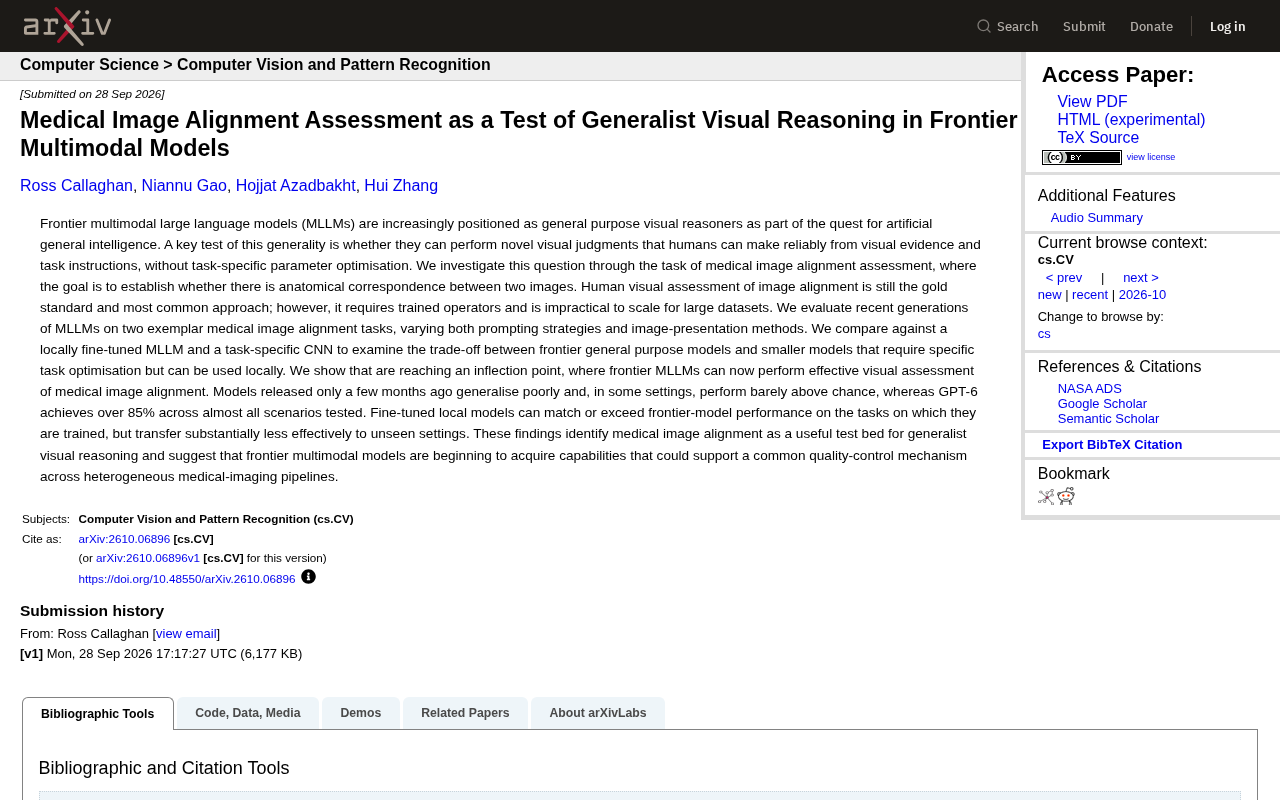
A new arXiv paper identifies a particularly representative testbed for this question: medical image alignment assessment. The core objective of this task is to determine whether two images share a valid anatomical correspondence. Human visual inspection remains the gold standard and most widely used approach for alignment judgment, but it relies on trained operators and doesn't scale to large datasets. That makes this task an ideal proving ground for evaluating whether a model possesses genuine general-purpose visual reasoning.
Medical image alignment (image registration/alignment) is the process of spatially matching images acquired at different time points, across different modalities (e.g., CT and MRI), or from different patient positions — such that anatomical structures correspond coordinate-by-coordinate. Traditional approaches rely on intensity-based registration algorithms (e.g., ANTs, Elastix) or deep learning-based registration networks, but assessing the quality of their outputs still depends heavily on manual visual review: operators overlay and compare images to judge whether key anatomical landmarks are properly aligned. This judgment demands significant training and doesn't scale to studies involving thousands of cases — creating an obvious gap in automated quality control that the paper aims to fill using MLLMs.
Experimental Design: Frontier General Models vs. Local Specialized Models
The research team evaluated recent generations of MLLMs on two representative medical image alignment tasks, varying two independent factors simultaneously: prompting strategies and image-presentation methods. This design helps distinguish whether model performance stems from genuine visual understanding or sensitivity to a particular input format.
For meaningful comparison, the study also included two reference model classes: locally fine-tuned MLLMs and task-specific CNNs (convolutional neural networks). This contrast is important because it surfaces a fundamental trade-off — frontier general-purpose models require no task-specific optimization but are typically accessible only via API, while smaller specialized models need targeted training yet can be deployed locally, making them more compatible with medical data privacy requirements.
Prompting strategies refer to techniques for guiding model behavior through input text design, without modifying model weights — common forms include zero-shot prompting, few-shot prompting, and chain-of-thought prompting. Image-presentation methods refer to how a pair of images to be compared is delivered to the model — for example, side-by-side as a single concatenated image, as two separate independent inputs, or as an overlay difference map. Both variables jointly influence what information the model can "see" and how it maps visual cues to the judgment task. Varying both dimensions simultaneously allows for a more granular diagnosis of whether model failures stem from insufficient visual understanding or from sensitivity to instruction format.
Key Findings: Frontier Models at an Inflection Point
The paper's most striking conclusion is that frontier MLLMs have reached an "inflection point" — these models are now capable of effectively performing visual quality assessment for medical image alignment.
The generational gap is dramatic. Models released just a few months earlier generalized poorly, with performance in some settings "barely better than random guessing." By contrast, GPT-6 achieved over 85% accuracy across nearly all tested scenarios. This substantial leap in such a short timeframe is the direct evidence the researchers cite for declaring an inflection point.
For locally fine-tuned models, the paper offers a more nuanced verdict: fine-tuned local models can match or even exceed frontier model performance on the tasks they were trained for — but their performance degrades substantially when transferred to unseen settings. This confirms a long-standing intuition: specialized models excel at what they know and struggle beyond it, while the value of general-purpose models lies precisely in cross-scenario robustness.
Implications for Medical Imaging Quality Control
The researchers argue that these findings establish medical image alignment as a useful testbed for general visual reasoning — and further suggest that frontier multimodal models are beginning to develop the capability to serve as universal quality-control (QC) mechanisms across heterogeneous medical imaging pipelines.
In real-world medical imaging workflows, images produced by different equipment, protocols, and departments vary enormously in format and characteristics. Training a dedicated QC model for every individual pipeline is costly and difficult to maintain. If a general-purpose model can judge image alignment with over 80% reliability, it could potentially serve as a unified quality checkpoint — without requiring separate modeling for each pipeline.
A note of caution is warranted, however. The paper's core contribution remains a methodological exploration rather than a clinical deployment proposal. An 85% accuracy rate represents significant progress from a research standpoint, but it still falls short of the reliability threshold required for clinical use. Moreover, the poor generalization of locally fine-tuned models serves as a reminder to practitioners: in privacy-sensitive medical contexts, the trade-off between general-purpose and specialized approaches is far from settled.
Heterogeneous medical imaging pipelines refer to the reality that images produced under different hospital systems, equipment vendors, and clinical protocols differ substantially in resolution, field of view, contrast, and file format. For example, scans of the same anatomical region from a 1.5T vs. a 3T MRI scanner differ markedly in signal-to-noise ratio and tissue contrast, and alignment between radiotherapy planning images and diagnostic images poses different challenges than longitudinal follow-up registration. Training dedicated QC models for every such combination demands extensive annotated data and ongoing maintenance overhead. A general-purpose model capable of making reliable judgments across these variations could substantially reduce the cost of deploying imaging QC — particularly for resource-constrained healthcare settings.
Conclusion: A Quantifiable Entry Point for General Visual Reasoning
The value of this work lies not merely in confirming that frontier models are getting stronger, but in providing a quantifiable, well-controlled evaluation framework grounded in real-world needs. Medical image alignment demands both fine-grained spatial perception and semantic understanding of anatomical structures — making it a strong benchmark for testing whether a model genuinely "understands" images rather than simply "recognizing" them.
As model generations iterate ever faster, benchmarks like this one — focused on novel, professional-domain judgment tasks — may prove more revealing of a multimodal model's true progress toward AGI than general visual question answering ever could.
Related articles

Chain of Thought Isn't Just for AI: How Humans Can Use CoT to Improve Thinking Quality
Chain of Thought isn't just a prompt trick for large models. Starting from a Hacker News discussion, this article analyzes why CoT works for human thinking too, breaks down actionable ways to transfer it, and highlights the key differences between human CoT and machine CoT.
Cloudflare Teams Up with OpenAI: Closi…
Cloudflare Teams Up with OpenAI: Closing the Loop from Vulnerability Discovery to Defense with AI
Cloudflare uses OpenAI Daybreak to investigate security vulnerabilities and generate reviewable remediation plans, while developers use Codex to boost coding efficiency and quality.

Orca Multi-Agent Orchestration in Practice: A Guide to Parallel Collaboration with Claude and Codex
Orca is Stable AI's free open-source agent workbench supporting 34 agents like Claude Code and Codex in parallel. Learn its Git worktree isolation, multi-model orchestration, and mobile management.