Fugleramme: An E-Ink Picture Frame That Listens to Birdsong and Renders 19th-Century Illustrations
An open-source e-ink frame that identifies birdsong and displays 19th-century naturalist illustrations.
Fugleramme (Norwegian for "bird frame") is an open-source hardware project that continuously listens for ambient birdsong via microphone, uses acoustic recognition models like BirdNET to identify species, and displays matching illustrations in the style of 19th-century naturalist prints on an e-ink screen. The project cleverly draws on public domain resources like Audubon's The Birds of America, combining copyright-free historical artwork with modern AI to create a collectible-quality aesthetic. E Ink's low power consumption and paper-like display are a natural fit. The project earned 519 upvotes on Hacker News, resonating with engineers drawn to its "anti-efficiency" philosophy: using frontier AI tools to serve everyday poetry rather than productivity.
In an era when smart home devices increasingly chase practical utility, one open-source project has taken a different path — bringing the beauty of nature back into our homes. A project called Fugleramme (Norwegian for "bird frame") made it to the front page of Hacker News, earning 519 upvotes and 85 comments, making it one of the more celebrated creative hardware projects in the geek community recently.
An E-Ink Picture Frame That "Listens" to Birds
Fugleramme's core concept is genuinely poetic: an e-ink display frame that continuously listens to ambient birdsong through a microphone, identifies the species, and then renders an illustration of that bird on screen — in the style of 19th-century naturalist engravings.
Think of it as a classic bird field guide fused with modern AI audio recognition. When a robin or blue tit passes by your window, the frame doesn't simply flash a text notification. Instead, it presents an illustration with the etched, hand-colored quality of a Victorian-era print — as if drawn by a naturalist's own hand. This "technology in service of aesthetics" philosophy is exactly what resonated with the Hacker News community.
Tech Stack Breakdown: Audio Recognition + Generative Illustration
From a technical standpoint, Fugleramme brings together several key capabilities:
Bird Audio Recognition
Ambient audio is captured via microphone and fed into a bird call recognition model to identify the species. Acoustic bird identification has matured considerably in recent years — open-source models like BirdNET can identify thousands of species from short audio clips. For edge device projects like this, the key challenges are accuracy and real-time performance: background noise, overlapping bird calls, and recording quality all affect results.
BirdNET is an open-source neural network model jointly developed by Chemnitz University of Technology and the Cornell Lab of Ornithology. It currently recognizes over 6,000 bird species worldwide and is one of the most widely used acoustic identification tools in amateur birding and ecological monitoring. It runs on low-power single-board computers like the Raspberry Pi, processing a 3-second audio clip in under a second — making it ideal for edge devices like Fugleramme. Beyond BirdNET, the eBird community's Merlin Bird ID app offers similar capabilities, though it's primarily mobile-focused. For DIY projects, BirdNET-Analyzer provides a Python interface that can be integrated directly into a local inference pipeline without relying on cloud APIs — a significant advantage for developers who want the frame to work offline.
19th-Century Style Illustration Generation
Once a species is identified, the system needs to generate or retrieve a matching illustration. Adopting the aesthetic of 1800s naturalist prints is a clever choice: a wealth of public domain material exists in this style (John James Audubon's The Birds of America and similar classic field guides have all passed into the public domain), so the project can either pull directly from historical artwork or use generative models to replicate the style. This aesthetic decision sidesteps the "cheap feel" that modern photographs might convey, instead giving the device the character of a collectible artifact.
John James Audubon's The Birds of America (1827–1838) is one of the most iconic works in the history of naturalist illustration. The original edition contains 435 life-size hand-colored copper engravings, all of which are now in the public domain and freely available as high-resolution scans through institutions like the Smithsonian National Museum of Natural History and the Biodiversity Heritage Library (BHL). Public domain means the copyright protection on these images has expired — anyone can use, copy, and redistribute them freely without licensing fees. BHL has digitized over 60 million pages of historical natural history literature, making it an ideal source for this type of project. Developers who want to use generative models to "replicate" this style can also use these public domain images as training data for LoRA fine-tuning, enabling consistent-style illustrations for species not covered in the historical archives.
E-Ink Display
The choice of an e-ink screen is equally well-suited to the project's character. E-ink's ultra-low power consumption and paper-like visual quality are a natural match for the static aesthetics of classical illustration. Unlike an LCD, it doesn't emit harsh light — it feels much closer to an actual painting hanging on a wall, and it's well-suited to long-running, always-on edge device scenarios.
E Ink technology is based on microencapsulated electrophoresis: the screen surface is covered with millions of tiny microcapsules, each containing positively charged white particles and negatively charged black particles. By changing the direction of the local electric field, particles are driven up or down to create black and white pixels. Because no continuous power is needed to maintain the displayed image after it changes (bistable characteristic), E Ink screens consume virtually zero power in their static state — ideal for always-on display devices. Popular models for DIY projects include the Waveshare series (7.5-inch to 13.3-inch) and the Pimoroni Inky Impression (with ACeP 7-color support), the latter of which can reproduce the warm yellows and reddish-browns found in historical illustrations, making it particularly well-matched to the naturalist aesthetic. E Ink's main limitations are slow refresh rates (a full refresh typically takes 2–5 seconds) and a limited color gamut, but for static image display, these drawbacks are largely negligible.
Why This Project Resonated with the Geek Community
519 upvotes is a strong result on Hacker News. "Show HN" posts (where authors share their personal projects) tend to gain traction not because of extreme technical difficulty, but because they strike an emotional or aesthetic chord.
Fugleramme represents a kind of "anti-efficiency" technical philosophy. It solves no urgent problem — it simply takes AI, acoustic recognition, and display technology and applies them to creating a delightful everyday experience. This approach of "downscaling" cutting-edge tools to serve the pleasures of daily life is something many engineers quietly aspire to: technology doesn't always have to serve productivity. Sometimes it can serve poetry.
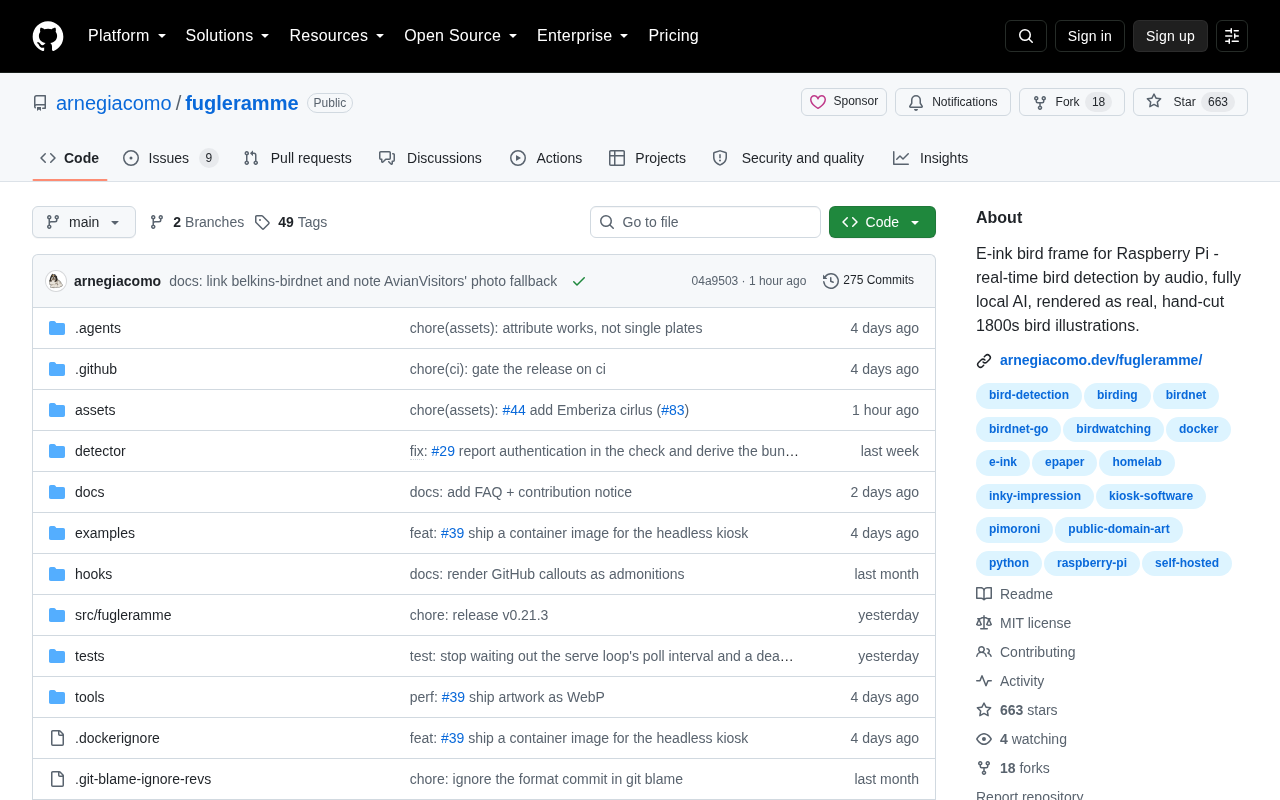
The project is open-sourced on GitHub, meaning interested developers can reproduce, modify, and extend it. For hobbyists who enjoy DIY hardware and edge AI, it's a solid blueprint for a weekend project — accessible enough to build, interesting enough to care about.
What Developers Can Take Away
Beyond the romantic framing, Fugleramme offers a few genuinely practical insights for developers:
Edge AI use cases are diversifying. Audio recognition is no longer limited to voice assistants. Vertical applications — birdsong, ambient soundscapes, mechanical anomaly detection — are all ripe for exploration, and many of these tasks can run on low-power devices.
Public domain assets are a treasure trove for generative applications. Leveraging historical artwork that has entered the public domain lets you sidestep copyright risk while building a distinctive visual identity — a strategy worth borrowing for content-driven AI products.
Emotional value is a competitive advantage. In a smart hardware market rife with feature parity, a device with genuine aesthetic sensibility and a compelling story is far more likely to be remembered and shared.
Conclusion
Fugleramme is a prime example of technology made small and beautiful. It doesn't chase grand problems — instead, it combines acoustic recognition and classical illustration to transform the birdsong outside your window into a painting on your wall. For readers interested in edge AI and creative hardware, this open-source project is both a source of inspiration and a hands-on opportunity. Head over to its GitHub repository to explore the implementation details.
Related articles

LangGraph Beginner's Guide: The Complete OS for AI Agents
LangGraph is called the OS for AI Agents. This guide covers its relationship with LangChain, State/Node/Edge fundamentals, checkpoints, human-in-the-loop, and subgraphs.

Andrew Ng on Agentic AI: Cutting Through the Hype to Find the Core Skills That Actually Matter
Andrew Ng's Agentic AI course cuts through industry hype to reveal the real skills that matter: systematic evals and error analysis for building reliable agent workflows.

Andrew Ng on Agentic AI: The Core Methodology for Building Intelligent Agent Applications
Andrew Ng's Agentic AI course decoded: from overhyped buzzword to real applications in customer support, research, legal, and healthcare — with evals and error analysis as the core methodology.