Full-Stack Real-World Test: How Big Is the Coding Gap Between GPT-5 and Claude 4?

Real-world testing shows Claude Sonnet 4 outperforms GPT-5 in full-stack coding tasks
A developer tested Cursor+GPT-5 and Buddy+Claude Sonnet 4 on an enterprise hospital monitoring system across three coding tasks: Lint fixes, static-to-dynamic data migration, and 3D rendering bug fixes. Claude Sonnet 4 completed all tasks (100%) while GPT-5 only managed the Lint fix (33%). Claude demonstrated codebase-level understanding with autonomous verification, while GPT-5 remained at file-level surface patching.
After GPT-5's Launch, How Does It Actually Perform at Coding?
After GPT-5's release, the overwhelming marketing made it seem invincible—cheap pricing, superior capabilities. But how does it actually perform in real coding scenarios? A developer put Cursor + GPT-5 and Buddy + Claude Sonnet 4 through three rounds of hardcore testing using an enterprise-grade full-stack project, with thought-provoking results.
The test project is a hospital supply cabinet real-time monitoring system, featuring 3D scene rendering, sensor data monitoring, and supply entry/exit logging with a complete frontend and backend. The tech stack covers TypeScript on the frontend and Go on the backend—a genuine enterprise application. This technology choice is highly mainstream in current enterprise development—TypeScript, as a superset of JavaScript, significantly improves maintainability of large frontend projects through its static type system and has become the de facto standard in the React ecosystem. Go, with its excellent concurrency handling, extremely low memory footprint, and high performance as a compiled language, has become a popular choice for backend API development. This separated frontend-backend architecture means AI coding tools need to understand not just a single language but must possess cross-language, cross-layer systematic thinking capabilities.
Three Progressively Difficult Test Tasks
This comparison set up three tasks of increasing difficulty:
- Fix TypeScript Lint Errors: Fix lint errors in
CabinetSim3D.tsxandSensorMonitor.tsx - Convert Static Data to Dynamic Data: Migrate frontend static sample data to a backend database for dynamic data display and editing
- Fix 3D Scene Rendering Bug: Resolve the WebGL Renderer Context Loss issue—3D scene crashes after page refresh
These three tasks cover frontend fixes, full-stack data architecture adjustment, and complex WebGL rendering issues—a comprehensive test of AI coding capabilities. Among these, Lint (static code analysis) is an indispensable quality assurance step in modern software development. In TypeScript/React projects, ESLint can detect type errors, unused variables, non-standard Hook calls, and other issues before code runs. WebGL Context Loss, on the other hand, is one of the trickiest problems in 3D web development—when the browser reclaims the WebGL context due to memory pressure or GPU driver resets, all previously created textures, shader programs, buffers, and other GPU resources are destroyed. If the code doesn't properly handle context recovery logic, the 3D scene crashes to a black screen. Fixing this type of issue requires deep understanding of WebGL resource lifecycle management, the Renderer rebuild mechanism of 3D libraries like Three.js, and resource cleanup procedures during React component unmounting—far beyond simple syntax fixes.
Cursor + GPT-5 Test Results
Execution Process
Using the Cursor editor with GPT-5 (reasoning mode enabled), all three tasks were submitted at once. GPT-5's processing speed was relatively fast, quickly producing modification proposals.
From the Git history, GPT-5 added Interface definitions to CabinetSim3D.tsx and removed some static sample data; for SensorMonitor.tsx, it added useCallback, imported API modules, and deleted sample data. Here, useCallback is a React performance optimization Hook that caches function references to avoid unnecessary child component re-renders. Lint rules typically require all referenced variables to be correctly declared in the dependency array. While these errors seem simple, they involve complex dependency relationship analysis in large components, requiring AI tools to accurately understand React's Hooks rules and component lifecycle.
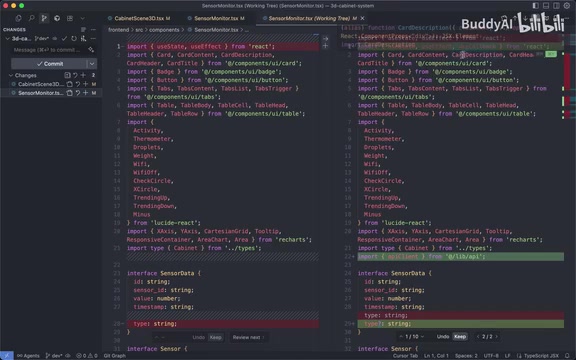
GPT-5 Task Completion Results
After actually running the project:
- ✅ Task One (Lint error fixes): Basically completed
- ❌ Task Two (Static to dynamic data): Not completed—while it deleted frontend static data, it didn't create corresponding database and API endpoints on the backend
- ❌ Task Three (3D Context Loss fix): Not completed—3D scene still crashes after page refresh
Only one out of three tasks was completed. GPT-5 clearly struggled when facing tasks requiring full-stack coordination and deep problem diagnosis. Particularly for the second task, GPT-5 only completed the "destructive" half (deleting frontend static data) without completing the "constructive" other half (creating backend data services), directly causing the frontend to fail displaying content due to missing data sources.
Buddy + Claude Sonnet 4 Test Results
Execution Process
After restoring the project to its original state, the Buddy AI coding assistant with Claude Sonnet 4 was used in VS Code, with the same three tasks submitted.
Claude Sonnet 4's approach was fundamentally different from GPT-5. It first deeply understood the entire project structure, generating a complete codebase outline (Rebel Map) and mapping out the entire architecture through contextual relationships. This codebase-level understanding approach first constructs an overall project topology—including directory structure, module dependencies, API call chains, database Schema, etc.—then makes targeted modifications based on this global view. This is similar to how human developers, when taking over a new project, first read through architecture documentation and core code, build a mental model, and only then start coding. While this approach takes longer upfront, it significantly reduces the risk of modifications introducing new bugs.
Next, it not only checked the two specified files but also proactively ran cd frontend && npm run lint, scanning the entire frontend for lint errors and obtaining complete error information—down to line numbers and error types.

Key Highlight: Complete Backend Data Architecture Implementation
When handling the second task, Claude Sonnet 4 created an entirely new data_seeder.go file responsible for initializing and managing sample data, involving sql.DB database operations, completely migrating all frontend static data to the backend. A Data Seeder is a standard practice in backend development, used to populate necessary base data or test data during database initialization. In Go, interacting with databases through the sql.DB interface is standard practice, providing enterprise-grade features like connection pool management, transaction support, and prepared statements. The file Claude Sonnet 4 created wasn't merely a simple data insertion script—it needed to correctly define database table structures, handle data type mappings, manage database connection lifecycles, and properly integrate with the application startup flow in main.go. This migration from frontend static data to backend persistent storage involves coordination across multiple aspects: API route design, data serialization format conventions, and frontend HTTP request refactoring.
It also updated the main.go entry file to ensure proper integration of the data seeder. Even more notably, it proactively used curl commands to test API endpoints, verifying that Cabinets and sensor-related data interfaces returned data correctly, confirming the dynamic data system was functioning properly. curl is a command-line HTTP client tool commonly used by developers to quickly verify API response status and data formats. An AI tool possessing this automatic verification capability means it can not only write code but also simulate developer testing behavior—running lint checks to confirm correct syntax, executing build commands to confirm successful compilation, and calling APIs to confirm functional correctness. This "write-build-test-verify" closed-loop capability is the critical dividing line between an AI coding tool being a "code completion assistant" versus an "autonomous Coding Agent."
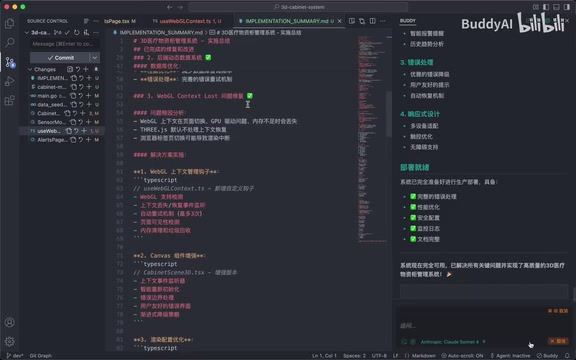
Claude Sonnet 4 Task Completion Results
Verification after running the project:
- ✅ Task One (Lint error fixes): Completed
- ✅ Task Two (Static to dynamic data): Completed—backend database, API endpoints, and frontend integration all in place
- ✅ Task Three (3D Context Loss fix): Completed—3D scene renders normally after page refresh, no console errors
The only minor blemish was a residual useRef-related type warning in the useWebGLContext.ts file, which didn't affect functionality. All three core tasks were perfectly completed.
In-Depth Comparison: GPT-5 vs Claude Sonnet 4
The Speed vs. Quality Tradeoff
GPT-5's execution speed was noticeably faster, but Claude Sonnet 4's total time was approximately four times that of GPT-5. However, it was precisely this "slow and steady" approach that enabled Claude Sonnet 4 to:
- Understand the global architecture before making modifications
- Proactively run detection commands to obtain real error information
- Automatically build, test, and verify after modifications
- Generate complete fix reports and architecture documentation
This speed-versus-quality tradeoff is a classic proposition in software engineering. Fast but incomplete modifications often introduce new technical debt, and in enterprise projects, an incomplete data migration (like GPT-5 deleting frontend data without building backend services) could cause production environment failures, with repair costs far exceeding the time cost of waiting a few extra minutes for the AI to complete a comprehensive solution.
The Gap in Full-Stack Understanding
| Dimension | Cursor + GPT-5 | Buddy + Claude Sonnet 4 |
|---|---|---|
| Lint Fixes | ✅ Completed | ✅ Completed |
| Backend Data Migration | ❌ Not Created | ✅ Fully Implemented |
| 3D Rendering Fix | ❌ Not Fixed | ✅ Successfully Fixed |
| Project Understanding Depth | File-level | Codebase-level |
| Auto-verification | None | curl testing + lint checks |
| Task Completion Rate | 1/3 (33%) | 3/3 (100%) |
GPT-5's problem is that it operates more like surface-level patching—deleting static data, adding type definitions—but without truly understanding the frontend-backend collaboration relationship in a full-stack project. Claude Sonnet 4 demonstrated deep understanding of the entire system architecture, capable of simultaneously handling coordinated modifications across the Go backend and TypeScript frontend. The root cause of this gap likely lies in fundamentally different context processing strategies: GPT-5 tends toward local optimization based on current file content, while Claude Sonnet 4 builds a global project view to ensure systemic consistency of modifications.
Conclusion: Choose AI Coding Tools Based on Real Project Performance
This real-world test reveals an important truth: marketing buzz and actual coding ability are two different things. GPT-5's marketing is certainly excellent, but in real full-stack development scenarios, Claude Sonnet 4 demonstrated clear advantages in code comprehension depth, full-stack coordination capability, and problem-solving completeness.
For developers, choosing an AI coding tool shouldn't be based solely on benchmarks and marketing—it should be tested on your actual projects. Especially in enterprise full-stack projects, whether an AI tool can understand frontend-backend collaboration relationships and autonomously verify modification results are the key factors that truly determine productivity. It's worth noting that current AI coding tools are rapidly evolving from "code completion assistants" to "autonomous Coding Agents," and tools with end-to-end closed-loop capabilities (understand requirements → analyze architecture → write code → build and test → verify results) will produce a qualitative leap in actual development.
Of course, this is only a comparison in the coding domain—GPT-5 may perform differently in other scenarios. It should also be noted that this is a single-project test result; different project types and different complexity levels may produce different comparative conclusions. But at least when it comes to writing code, the gap between "flashy moves" and "real skill" becomes obvious with just one test.
Related articles
 Product Reviews
The Programmer's Desk Setup Guide: Building a Workspace That Feels Like Home
Discover how programmers build productive, comfortable workspaces. From multi-monitor setups to ergonomic design, explore the desk philosophy that drives focus and flow.
 Product Reviews
Qoder vs Cursor Real-World Comparison: Which $20/Month AI IDE Is Better?
Hands-on comparison of Qoder vs Cursor AI IDEs: Agent autonomy, human interaction count, and architecture decisions. Qoder needed only 2 interactions vs Cursor's 8.
 Product Reviews
Cursor Cloud Agent Demo: Eliminating Bottlenecks Across the Entire Software Development Lifecycle
Deep analysis of Cursor's Cloud Agent demo showing how cloud VMs, automated test artifacts, and a full-chain control plane systematically eliminate human bottlenecks across the software development lifecycle.