Functional Gradient Descent with Adaptive Representations: A NeurIPS Paper That Challenges Neural Networks

NeurIPS paper proposes adaptive representations to make Functional GD both provably convergent and practically implementable, outperforming neural networks by an order of magnitude.
A NeurIPS-accepted paper introduces the Adaptive Representations framework to address why Functional Gradient Descent (Functional GD) has been difficult to reliably deploy. Functional GD optimizes directly in function space, but its gradients are infinite-dimensional, and naive approximations cause systematic convergence to wrong solutions. Adaptive representations dynamically adjust the approximation function space at each iteration, provably guaranteeing convergence to the global minimizer while remaining immediately implementable. The authors report order-of-magnitude improvements over neural network baselines across multiple experimental settings, positioning this as the starting point of a promising research direction.
A New Paper Accepted at NeurIPS
Neural networks dominate today's machine learning narrative, but not every optimization method has to revolve around network parameters. A paper accepted at NeurIPS, titled Functional Gradient Descent with Adaptive Representations, charts an alternative course: performing gradient descent directly in function space (Functional Gradient Descent, or Functional GD), and resolving its long-standing implementation challenges through a mechanism called "adaptive representations."
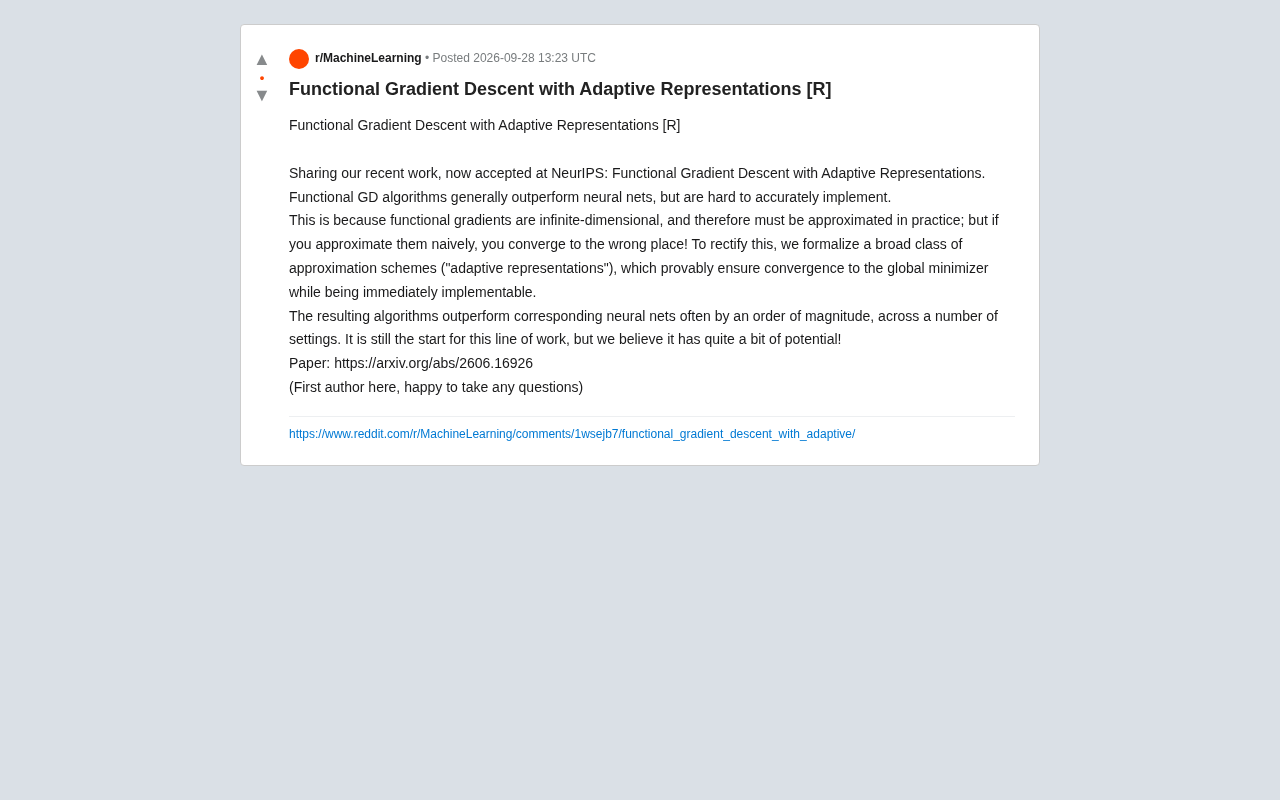
The paper's first author shared the work on Reddit and openly addressed community questions. According to the author, Functional GD algorithms often outperform neural networks in many settings, yet are notoriously difficult to implement correctly — and that is precisely the bottleneck this research aims to break through.
Why Functional Gradient Descent Is Hard to Implement
To appreciate the value of this work, it helps to understand the core tension at the heart of Functional GD.
The Approximation Dilemma of Infinite Dimensions
Conventional neural network optimization updates a finite set of parameters, whereas Functional GD optimizes directly in function space. The catch is that gradients in function space are infinite-dimensional objects. Infinite dimensionality means they cannot be stored or computed exactly on a computer, so approximations are unavoidable in practice.
The authors highlight a trap that is easy to overlook: if these infinite-dimensional gradients are approximated naively, the algorithm ultimately converges to the wrong place. In other words, the approximation scheme itself introduces a systematic bias that steers the optimization away from the true objective — not merely a loss of precision, but a fundamental misdirection. This is why Functional GD, despite its theoretical appeal, has long been difficult to deploy in a stable and correct manner.
The theoretical foundations of Functional GD stem from Reproducing Kernel Hilbert Spaces (RKHS) and variational methods in function space. The basic idea is to treat the objective F as a functional whose argument is a function f; at each iteration, instead of updating a parameter vector, you move the current function f in the direction of the "negative functional gradient" to obtain a new function f'. Classic boosting algorithms (e.g., Gradient Boosting) can be understood as special cases of this framework, where each iteration takes a step in function space and approximates the gradient direction with a new decision tree. The infinite-dimensional challenge arises because the true functional gradient is itself a function, not a finite-dimensional vector — computers cannot represent it exactly. Every step must approximate this gradient function with a finite-dimensional "basis" (such as kernel functions, trees, or networks), and approximation errors accumulate across iterations, undermining convergence.
What Does It Mean to Converge to the "Wrong Place"?
For an optimization algorithm, the convergence point determines the model's final quality. If the approximation scheme breaks the convergence guarantee, then no matter how many iterations are run, the result is not the global optimum but a shifted point driven by approximation error. Such issues are often hard to detect in practice, yet they materially limit the reliability of the method.
Adaptive Representations: Correctness Meets Practicality
The central contribution of the paper is formalizing a broad class of approximation schemes and naming them "adaptive representations."
This class of schemes has two key properties. First, it provably guarantees convergence to the global minimizer, fundamentally avoiding the incorrect convergence caused by naive approximations. Second, it is immediately implementable — not a theoretical construction that lives only on paper, but one that can be directly translated into runnable algorithms.
This combination of theoretical correctness and engineering feasibility is where the method's value lies. It does not sacrifice practicality for convergence guarantees, nor does it abandon mathematical rigor for ease of implementation.
The core idea behind adaptive representations is that the finite-dimensional function space used for approximation is not fixed but dynamically adjusted throughout the iterative process, ensuring that the error between the approximate gradient at each step and the true functional gradient satisfies controllable mathematical conditions. The key distinction from traditional Gradient Boosting or fixed-kernel methods is that those approaches use the same approximation family throughout the entire optimization, whereas adaptive representations choose the most suitable approximation structure based on the current state of the function. Mathematically, this is analogous to performing gradient flow on a Riemannian manifold where the local metric must be matched appropriately — an ill-chosen metric causes the trajectory to deviate from the true gradient flow. The paper formalizes this idea into a general framework, allowing kernel methods, shallow networks, and other parameterized families to serve as concrete instances of adaptive representations, yielding convergence guarantees under a unified theory.
Experimental Results: An Order-of-Magnitude Lead
According to the authors, algorithms derived from adaptive representations frequently outperform their neural network counterparts by an order of magnitude across multiple settings.
"An order of magnitude" is a significant claim. If these results hold up under broader, independent verification, it would suggest that Functional GD can provide efficiency or accuracy far exceeding neural network baselines on certain tasks. That said, caution is warranted: the results come from the authors' own report, and the specific experimental setups, the strength of the comparison baselines, and the applicable scope all await further replication and assessment by the community.
The authors themselves acknowledge that this is "the beginning of this line of research," while expressing confidence in its potential. This measured framing conveys conviction without overstating the method's maturity.
How to Interpret the Significance of This Work
In an era dominated by neural networks, revisiting optimization methods in function space carries genuine intellectual value. Functional GD is not a new concept, but "correctly approximating infinite-dimensional gradients" has always been the barrier standing between theory and application. This paper's contribution lies in providing a framework that is both provably convergent and practically deployable — advancing an idea that has long remained theoretical toward real-world engineering use.
For researchers, the key open questions include: What is the computational overhead of adaptive representations? Do they maintain their advantage on large-scale, high-dimensional real-world tasks? How does their scalability compare against the many training tricks available for modern neural networks? These are the critical factors in determining whether the method can move beyond "lab-setting advantages."
For interested readers, the paper is available on arXiv (arxiv.org/abs/2606.16926), and the authors have indicated on Reddit that they are happy to answer questions — providing a direct channel for digging into the method's details.
Summary
This NeurIPS-accepted work addresses a core pain point of Functional GD — approximating infinite-dimensional gradients — through the proposed adaptive representations framework. Grounded in provable global convergence guarantees while maintaining practical implementability, it reports significant advantages over neural network approaches across multiple settings. As a starting point for a research direction, whether it can scale to more complex real-world scenarios remains to be seen, but it at minimum offers a compelling new example of an optimization path worth following beyond neural networks.
Related articles

Chain of Thought Isn't Just for AI: How Humans Can Use CoT to Improve Thinking Quality
Chain of Thought isn't just a prompt trick for large models. Starting from a Hacker News discussion, this article analyzes why CoT works for human thinking too, breaks down actionable ways to transfer it, and highlights the key differences between human CoT and machine CoT.
Cloudflare Teams Up with OpenAI: Closi…
Cloudflare Teams Up with OpenAI: Closing the Loop from Vulnerability Discovery to Defense with AI
Cloudflare uses OpenAI Daybreak to investigate security vulnerabilities and generate reviewable remediation plans, while developers use Codex to boost coding efficiency and quality.

Orca Multi-Agent Orchestration in Practice: A Guide to Parallel Collaboration with Claude and Codex
Orca is Stable AI's free open-source agent workbench supporting 34 agents like Claude Code and Codex in parallel. Learn its Git worktree isolation, multi-model orchestration, and mobile management.