Fusion Startups Court the Defense World: A New Alliance Between Energy and Security
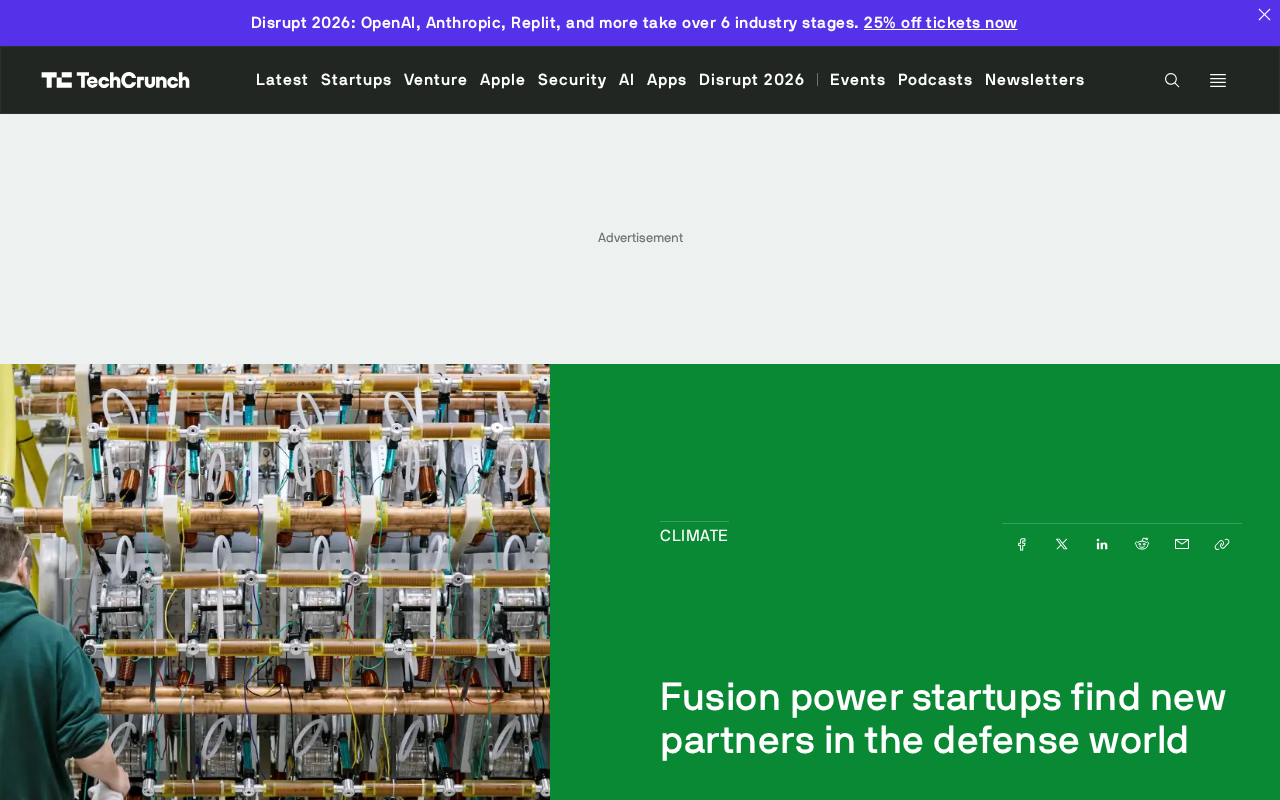
Fusion startups are turning to defense partnerships for diversified funding and real-world application scenarios.
Fusion energy startups are signing agreements with defense-related institutions, reactivating the long-standing historical connection between fusion technology and national security. For early-stage, capital-intensive fusion companies, defense institutions offer stable funding, clear technical requirements, and tolerance for high-risk, long-cycle projects — filling the financing gap before commercial power generation becomes viable. Defense application scenarios such as space propulsion and compact battlefield power sources also provide pathways beyond grid electricity. At the same time, the dual-use nature of fusion technology brings added scrutiny around export controls and security reviews, and the debate over whether clean energy or defense should take priority remains an open question for the industry.
Fusion and Defense: Reconnecting Old Ties
Fusion energy startups are signing agreements with defense-related institutions, reigniting a long-standing connection between fusion technology and national security — a relationship that may have quieted in recent decades, but never truly disappeared.
Historically, fusion research and defense needs have always shared deep roots. Early fusion science grew largely out of high-energy physics and weapons technology exploration. Now, with the rise of private fusion startups, that partnership is returning in a new form.
Why Private Fusion Companies Are Turning to Defense
For early-stage, capital-intensive fusion startups, defense partnerships offer a genuinely attractive path forward. Defense institutions tend to have stable funding streams, well-defined technical requirements, and a high tolerance for cutting-edge, high-risk technology — precisely the resources that are hardest to come by before commercial fusion power becomes a reality.
By building ties with the defense world, fusion startups gain not only additional financing channels, but also application scenarios beyond grid-scale electricity generation. This diversified partnership model helps companies sustain operations and accumulate technical validation across what are often very long R&D cycles.
Strategic Significance and Potential Controversy
The convergence of fusion technology and national security carries a dual significance. On one hand, mastering advanced energy technology is increasingly viewed as a key component of national competitiveness and strategic autonomy. On the other hand, the inherently sensitive nature of fusion technology means such partnerships will attract stricter regulatory scrutiny.
This trend also raises questions about technological priorities: should fusion primarily serve the clean energy transition, or play a role in defense and security? In practice, the two may not be mutually exclusive — defense investment has historically accelerated the maturation of foundational technologies, which in turn feeds back into civilian commercialization.
Conclusion
The new handshake between fusion startups and the defense world reflects the practical reality of a frontier technology seeking diverse support on its long road to commercialization. It also reveals the deep, hard-to-sever connection between energy and security. As more partnership agreements take shape, this space is well worth watching.
Note: This article was written based on limited source material; additional details await further information.
Related articles

Perplexity Hybrid Compute: Cloud Research, Local Mac Privacy Protection
Perplexity's Hybrid Compute splits AI tasks by data sensitivity: cloud handles research, local Mac handles private files. Requires Apple Silicon, 24GB RAM, Pro/Max/Enterprise plan.

Resurf: The Personal Context Manager That Feeds Your Data to AI
Resurf is a personal context app for Apple devices that saves notes, links, images, and PDFs, then feeds them to AI via MCP and CLI. Local storage with iCloud sync keeps your data private.
Cognition Launches SWE-2 Coding Model: Near Top-Tier Performance at 64% Lower Cost
Cognition releases SWE-2, a coding model post-trained on Kimi K3 with RL. Scores 50% on FrontierCode, nearly matching Fable 5.1 at 64% lower cost and 1/4 the price of GPT-6 Astra.