Fuzzy e-Means: A New Breakthrough in Big Data Clustering, Moving-Average Mini-Batch Accelerates FCM

e-FCM borrows the e-means optimizer to cut data passes for large-scale fuzzy clustering from dozens to single digits.
The article introduces e-FCM, a new fuzzy c-means method for large-scale data. Standard FCM relies on alternating optimization (AO), which scans the full data each round and needs many rounds to converge, becoming a big-data bottleneck. e-FCM borrows e-means' moving-average mini-batch optimizer, but direct transfer causes two problems: near-empty clusters being mistakenly removed and random initialization falling into poor local minima. The researchers therefore use a two-stage strategy: first run e-means with hard assignments, then perform a fuzzy moving-average pass without relocation. On 28 configurations with up to 109.5 million points and 16,384 clusters, e-FCM needs only two to four passes to reach the objective function value of AO after 25 iterations; in a million-point, 1024-cluster scenario it is 11 to 20 times faster than AO, with an objective function value gap within 0.16%. However, e-FCM is slower for small-scale low-dimensional problems, and with high-dimensional data m=2 easily causes center collapse, so the fuzzification factor must be chosen carefully.
Why Do We Need Faster Fuzzy Clustering?
Fuzzy c-means (FCM) assigns each data point a degree of membership in each cluster, providing richer information than hard clustering. But its standard solver—alternating optimization (AO)—requires a full scan of the data in every iteration, and often needs many iterations to converge. For large-scale datasets, this becomes a performance bottleneck. Existing big-data methods either perform poorly on the objective function or still require dozens of data passes.
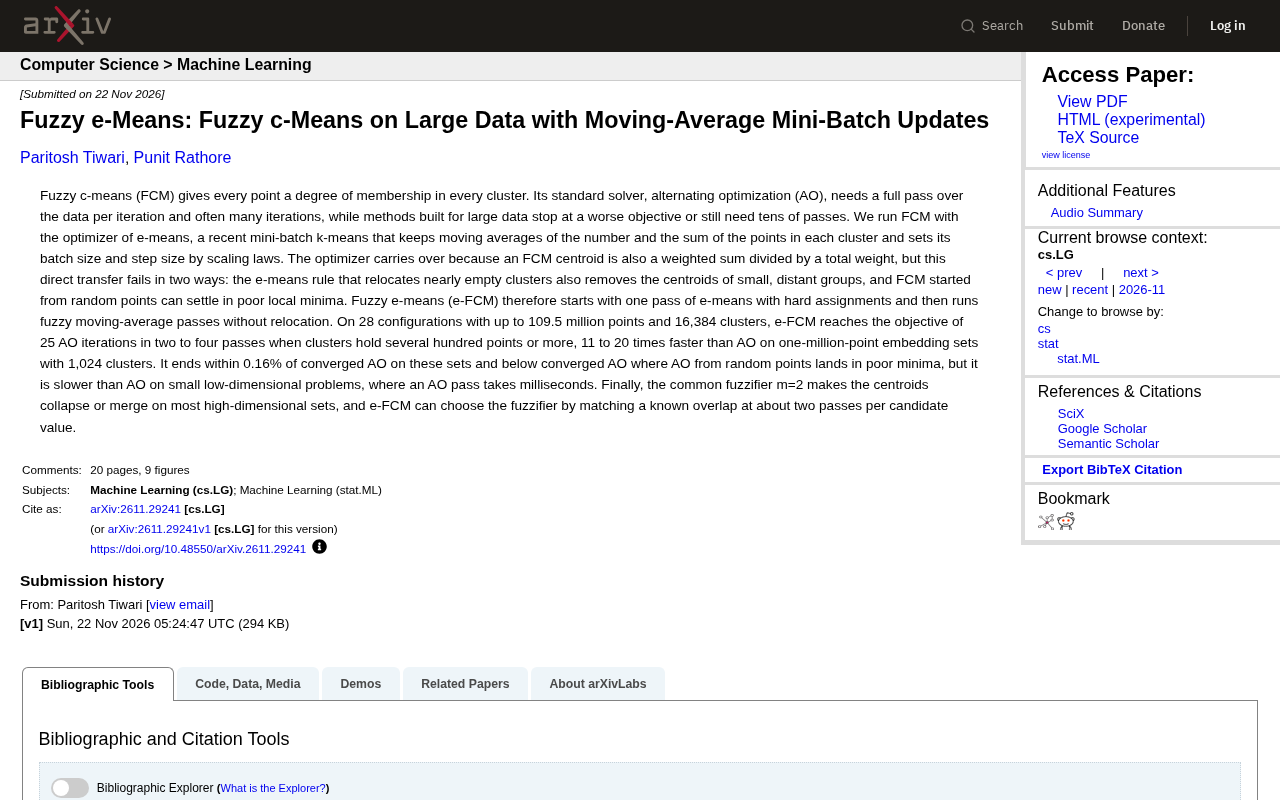
According to the paper "Fuzzy e-Means: Fuzzy c-Means on Large Data with Moving-Average Mini-Batch Updates," a new method called e-FCM significantly reduces the number of required data passes by borrowing from the e-means optimizer.
How Is the e-means Optimizer Transferred to FCM?
e-means is a recently proposed mini-batch k-means method that maintains moving averages of the point count and point sum for each cluster centroid, and sets the batch size and step size via scaling laws. FCM's cluster centers are likewise weighted sums divided by total weight, so the e-means optimizer can be transferred directly.
However, direct transfer has two problems:
- The rule in e-means for relocating near-empty clusters would remove the centers of small, distant clusters.
- FCM initialized from random points may fall into poor local minima.
Moving Average in this kind of online optimization means that instead of directly overwriting old values with the statistics of the latest mini-batch, the cumulative quantities of the clusters are updated in an exponentially weighted manner: new estimate = (1-α)·old estimate + α·current batch statistic. Here α is the step size, controlling the blending ratio of new and old information. Compared with full recomputation each round, moving average requires only constant-level memory to store historical cumulative quantities, and a single batch update can advance the model, thus greatly reducing the number of data passes. e-means further uses scaling laws to automatically set the batch size and α according to data scale and cluster size, making the update statistically close to the effect of a full gradient.
The Two-Stage Strategy of e-FCM
To solve the above problems, the researchers proposed fuzzy e-means (e-FCM). It first runs one pass of e-means with hard assignments, then runs a fuzzy moving-average pass without relocation. This preserves the efficiency of e-means while avoiding the drawbacks of direct transfer.
Tested on 28 configurations (up to 109.5 million points and 16,384 clusters), when clusters contain hundreds of points or more, e-FCM needs only two to four passes to reach the objective function value that AO reaches after 25 iterations. On a million-point embedding set with 1024 clusters, it is 11 to 20 times faster than AO.
Alternating Optimization (AO) is the standard iterative framework for solving FCM: fix the memberships and update the cluster centers (centers are membership-weighted averages), then fix the centers and update the memberships (normalized by negative powers of distance), alternating until the change in the objective function falls below a threshold. Each round requires a complete scan of the dataset to compute distances from all points to all clusters, with complexity O(n·c·d). Convergence usually requires dozens of rounds, so the total cost is proportional to the number of passes. The core improvement of e-FCM is precisely to compress this number of passes, rather than changing the computational structure of each round.
The Trade-off Between Accuracy and Efficiency
On these datasets, the final objective function value of e-FCM differs from converged AO by less than 0.16%, and it performs better when AO falls into poor minima from random points. However, for small low-dimensional problems (where AO needs only milliseconds for one pass), e-FCM is actually slower.
In addition, the common fuzzification factor m=2 causes cluster centers to collapse or merge on most high-dimensional datasets. e-FCM can select the fuzzification factor by matching a known degree of overlap, requiring roughly two passes per candidate value.
The fuzzification factor m controls how "soft" or "hard" the memberships are: as m→1, memberships tend toward hard assignment; the larger m is, the more uniform the memberships and the more overlap between clusters is tolerated. m=2 is the default value in the literature, stemming from an empirical choice for the unconstrained case of the objective function. But in high-dimensional spaces, distances between points tend to concentrate; if m is too small, memberships become over-polarized, causing the effective weight of some clusters to approach zero, manifesting as cluster center collapse or merging. Therefore, high-dimensional scenarios require increasing m according to the actual degree of overlap in the data, and e-FCM's approach of traversing candidate values one by one to match the overlap serves exactly this purpose.
Conclusion
e-FCM provides an efficient solution for large-scale fuzzy clustering, particularly suitable for scenarios with large clusters and higher dimensions. But the method is not a panacea; traditional AO remains suitable for small-scale problems. The study also reminds practitioners to pay attention to the impact of the choice of fuzzification factor on high-dimensional data.
One-line Summary
e-FCM borrows the e-means optimizer to reduce the number of data passes for large-scale fuzzy clustering from dozens to single digits.
Paragraph Summary
The article introduces e-FCM, a new fuzzy c-means method for large-scale data. Standard FCM relies on alternating optimization (AO), which scans the full data each round and requires many rounds to converge, becoming a bottleneck for big data. e-FCM borrows e-means' moving-average mini-batch optimizer, but direct transfer would cause two problems: near-empty clusters being mistakenly removed and random initialization falling into poor local minima. To address this, the researchers adopt a two-stage strategy: first run e-means with hard assignments, then perform a fuzzy moving-average pass without relocation. On 28 configurations with up to 109.5 million points and 16,384 clusters, e-FCM needs only two to four passes to reach the objective function value of AO after 25 iterations; in a million-point, 1024-cluster scenario it is 11 to 20 times faster than AO, with an objective function value gap within 0.16%. However, e-FCM is actually slower for small-scale low-dimensional problems, and with high-dimensional data m=2 easily causes center collapse, so the fuzzification factor must be chosen carefully.
Related articles

From 0 to 1: Vibe Coding an AI Knowledge Base — A Practical Retrospective and Tech Stack Breakdown
A retrospective on building the AI knowledge base OilBook from scratch with Vibe Coding: Next.js+Neon stack, Oil Dev Skill workflow, Stripe paywall security, interview-style writing, AI-flavor control, and Vercel deployment.

GLM-5.4 Hands-On: Native Vision Meets a New Vibe Coding Workflow
Hands-on with Zhipu GLM-5.4: native vision tested across a 3D product demo, pure-code video generation, and remote-control Vibe Coding, compared with GPT-6.2 and Gemini Neon.

AI and Humans Claim to Prove the Riemann Hypothesis: Machine-Verified, Yet Nobody Can Understand It
Anthropic mathematician and AI Claude claim to prove the Riemann Hypothesis with 17 million lines of Lean code, machine-verified but unreadable by humans. This article analyzes the event, the zero proportion record from 41.6% to 67.2%, and the gap between machine verification and human understanding.