Game Theory of Academic Effort and Hiring in the AI Era: Does Deep Understanding Still Pay?

AI lowers the cost of producing papers, trapping academic hiring in a game-theoretic dilemma of distorted signals and misaligned incentives.
The article discusses how AI is shaking academia's traditional mechanism of using paper quality as a signal of ability. The study points out that AI dramatically reduces the marginal cost of generating "good-looking" theoretical papers, so papers can no longer reliably distinguish those who truly understand the field from those skilled at producing output with tools; the signal thus depreciates and directly hits academic hiring. The authors model the choices of job seekers and recruiters as a game, completely classify all pure-strategy equilibria, and use learning simulations to observe the behavioral patterns populations may evolve in actual repeated interaction. The conclusion: changing behavior on one side alone is not enough to restore signal effectiveness; the incentives of both sides must be aligned at the same time, and directly probing understanding in interviews becomes a screening source harder for AI to replace.
Title
Game Theory of Academic Effort and Hiring in the AI Era: Does Deep Understanding Still Pay?
Meta Description
A game-theory study analyzes how AI has stripped academic papers of their ability-signaling function, and the two-sided dilemma between job seekers and recruiters over "deep understanding" versus "volume output," mapping out equilibrium types and learning simulation results.
Article Content
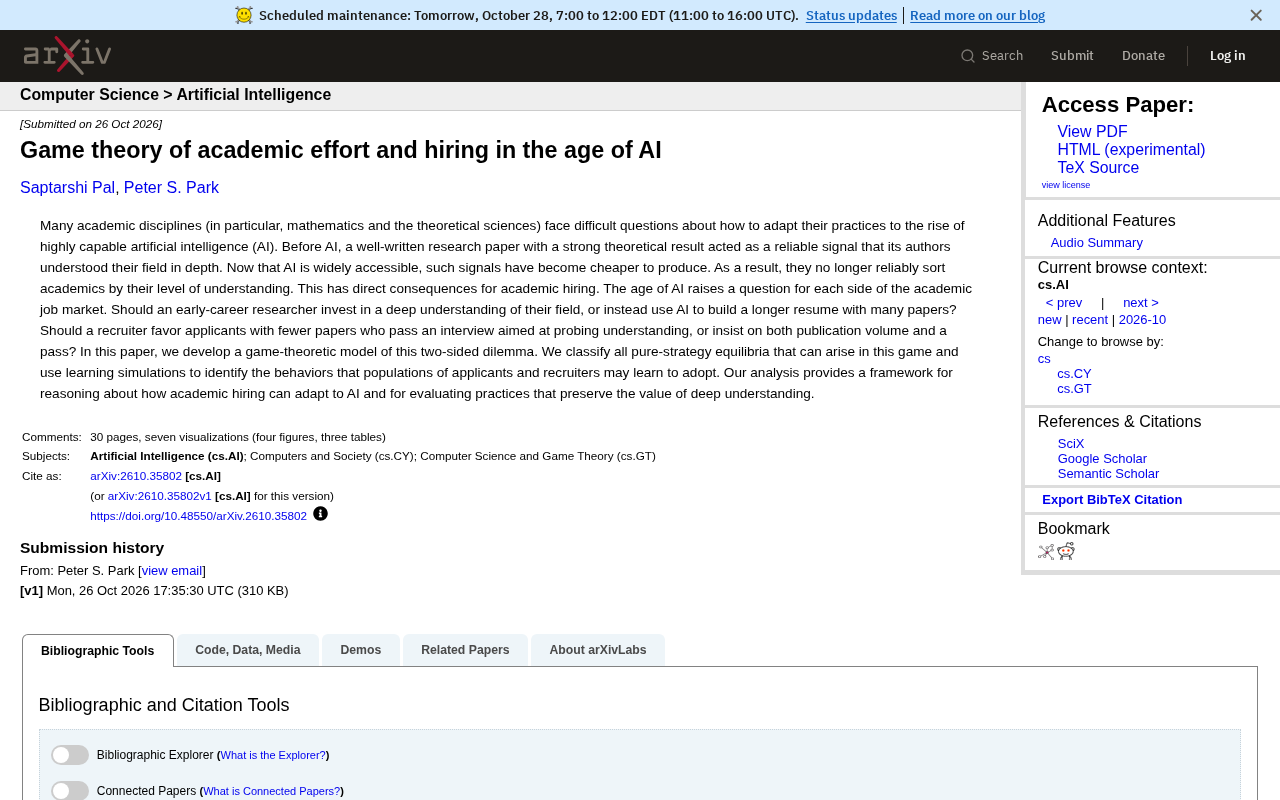
AI's widespread adoption is shaking a long-held default signaling mechanism in academia: a solid theoretical paper was once seen as reliable proof that its author deeply understood the field. But when AI makes such papers easier to produce, the signal starts to distort. A study on "game theory of academic effort and hiring in the age of AI" places this two-sided dilemma between job seekers and recruiters into an analyzable model.
A Broken Signal: A Paper No Longer Equals Understanding
Before AI, disciplines like mathematics and the theoretical sciences relied on an implicit screening mechanism: producing a weighty theoretical result required genuine understanding, so the quality of a paper was itself a credible signal of ability. AI changed the cost structure—the marginal effort needed to generate a paper that "looks good" dropped sharply, the cost of producing the signal was pushed down, and it lost its discriminating power.
The study points out that this signal devaluation flows directly into academic hiring. Recruiters who once relied on publications as a screening basis now struggle to judge from paper counts and completion whether a candidate has truly mastered the field. The problem is not that papers themselves have lost value, but that they can no longer reliably separate "people with deep understanding" from "people skilled at producing output with tools."
Signal theory was proposed by Spence in 1973, with the core idea being: when one party holds private information that the other cannot directly observe (such as true ability), it can be conveyed through some costly action, and that action must cost high-ability individuals less than low-ability ones for the signal to be credible. Academic papers long served this role—writing a good paper costs less for someone who truly understands the field and is extremely costly for someone who does not. What AI changes is precisely this cost gap: it lowers production costs across the board and, more critically, significantly flattens the cost difference between deep understanders and tool users, so the separating condition no longer holds and the signal fails.
The Dilemma for Both Sides: Go Deep or Pile Up
The study models this situation as a game in which each side has a choice between two directions.
On the job seeker side: invest time in building deep understanding of the field, or use AI to rapidly expand the résumé and accumulate more papers? The former has a long payoff cycle and a weakening signal, while the latter is more easily noticed under the old standards.
On the recruiter side: prefer candidates with fewer papers who can be assessed through in-depth interviews, or stick to the dual threshold of "paper count + passing the interview"? The former may miss high-volume producers, while the latter may be exploited by candidates skilled at packaging.
The choices on both sides influence each other: if recruiters generally look only at quantity, job seekers have no incentive to go deep; if job seekers generally pile up volume, it becomes harder for recruiters to screen by quantity. This is exactly the structure game theory is suited to handle—individual rational choices can lead to outcomes no one collectively wants.
Pure-strategy equilibrium is a foundational concept in game theory, referring to a state in which, after all participants have chosen a strategy, no party can benefit by unilaterally changing strategy—that is, a Nash equilibrium. In the two-player game in this article, the job seeker and the recruiter each have only two candidate strategies (deep work/volume, interview-focused/quantity-focused), so there are at most 2×2=4 strategy combinations. The so-called "complete classification" is to determine, one by one, within which parameter ranges each combination constitutes an equilibrium and under what conditions it would be deviated from. The limitation of pure-strategy equilibrium is that it only characterizes stable states and does not explain how a population reaches them, which is precisely what learning simulations fill in.
Learning simulation in game theory and multi-agent modeling refers to having a large number of boundedly rational participants play repeatedly and adjust their strategy choices based on historical payoffs, observing how the distribution of group behavior evolves over time. Common mechanisms include fictitious play, replicator dynamics, and reinforcement learning. Unlike solving for equilibria, learning simulation focuses on dynamic convergence paths: some equilibria may never be learned at all, while other seemingly unstable combinations may persist for a long time within a finite horizon. For scenarios like the hiring market, with repeated interactions and information asymmetry, learning simulation is closer to reality than one-shot equilibrium analysis.
What the Model Delivers: Equilibrium Classification and Learning Simulation
The paper's core work has two parts. First, the authors provide a complete classification of all possible pure-strategy equilibria in this game, characterizing which behavioral combinations the two sides will stably settle into under different parameter conditions. Second, they use learning simulations to observe the behavioral patterns that applicant and recruiter populations may gradually learn to adopt in actual interaction.
The two steps carry different meanings: equilibrium classification answers "which outcomes are self-consistent," while learning simulation answers "where the population may evolve to." The latter is especially important because the hiring market is not a one-shot game but a repeated interaction in which behavior adjusts with experience. The study thereby provides a reasoning framework for assessing which hiring practices can preserve the value of "deep understanding" rather than letting it passively depreciate in the signal competition.
Implications for Academic Hiring
The value of this work lies not in offering a specific institutional recommendation but in turning vague anxiety into a discussable structure: why signals fail, how the incentives of the two sides are misaligned, and which practices can maintain screening effectiveness in the equilibrium sense.
For recruiters, directly probing understanding in interviews becomes more critical, because it is a signal source that AI cannot easily substitute for. For early-career researchers, the question becomes how to trade off short-term visible output against long-term capability building—and AI has clearly increased the short-term temptation of this trade-off. The paper does not give a single answer, but it provides an analytical starting point for further reasoning.
As AI capabilities continue to improve, discussions like this about "how academic practice should adapt" will only grow. The game-theory perspective reminds us: changing behavior on one side alone is not enough; the effectiveness of a signal depends on whether the incentives of both sides are aligned at the same time.
One-line Summary
AI lowers the cost of producing papers, trapping academic hiring in a game-theoretic dilemma of distorted signals and misaligned incentives.
Paragraph Summary
The article discusses how AI is shaking academia's traditional mechanism of using paper quality as a signal of ability. The study points out that AI dramatically reduces the marginal cost of generating "good-looking" theoretical papers, so papers can no longer reliably distinguish those who truly understand the field from those skilled at producing output with tools; the signal thus depreciates and directly hits academic hiring. The authors model the choices of job seekers (deep understanding vs. piling up volume with AI) and recruiters (preferring few but excellent vs. sticking to the dual threshold of quantity plus interview) as a game, completely classify all pure-strategy equilibria, and use learning simulations to observe the behavioral patterns populations may evolve in actual repeated interaction. The conclusion: changing behavior on one side alone is not enough to restore signal effectiveness; the incentives of both sides must be aligned at the same time, and directly probing understanding in interviews becomes a screening source harder for AI to replace.
Related articles

The Truth About AI Coding: Code Output Soars, So Why Is Delivery Still Hard to Speed Up?
Engineering leaders from Databricks, Uber, and Google Maps discuss AI coding's real impact: code output soars but delivery bottlenecks shift, code review faces rethinking, and enterprises begin fine-grained token governance.

A New Paradigm for Text Editing in Compose: TextFieldState Replaces the Old API
Jetpack Compose introduces the TextFieldState API to fix dropped characters and cursor jumps from async input. The old value/onValueChange callbacks will be deprecated in 1.13. This article covers InputTransformation, OutputTransformation, four state hoisting patterns, and new formatted text editing capabilities.

Remote Compose: A New Document-Driven Paradigm for Cross-Platform UI on Android
Remote Compose transmits compact binary documents instead of screen pixels, enabling efficient UI rendering on remote surfaces like Wear OS and widgets. This article covers its document creation API, expression animations, size optimization techniques, and Wear OS progress.