GameGo Framework: Training Game Development AI Agents with Synthetic Trajectories

GameGo auto-generates PRD intermediates to turn vague game ideas into playable games, with 55K training trajectories and a benchmark.
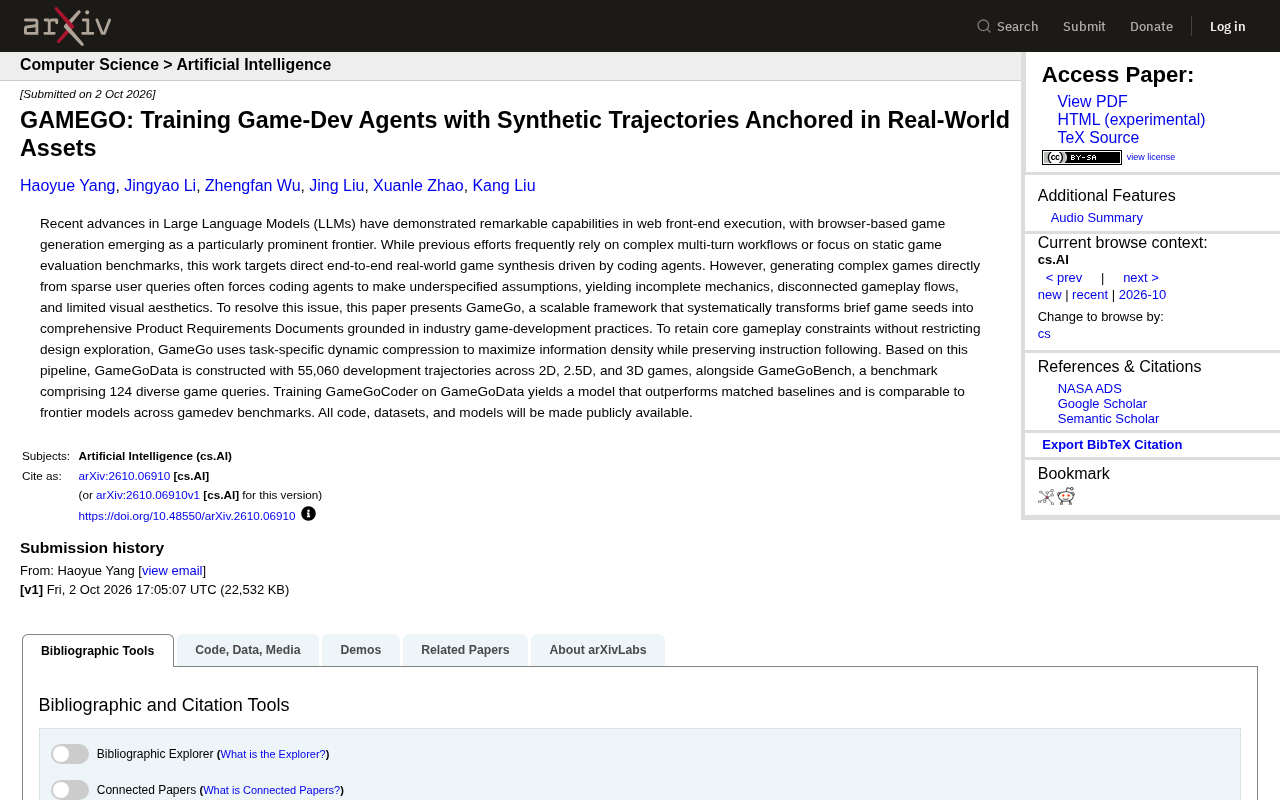
GameGo is an end-to-end game synthesis framework driven by AI coding agents. Its key innovation is automatically expanding brief user game ideas into structured Product Requirements Documents (PRDs), which then drive code generation — solving the incomplete mechanics and disjointed gameplay caused by sparse prompts. The team built GameGoData (55,060 synthetic development trajectories across 2D/2.5D/3D games), GameGoBench (124 diverse evaluation queries), and trained GameGoCoder, which outperforms same-scale baselines and approaches frontier model performance. All assets will be publicly released.
From Sparse Instructions to Complete Games: A New Challenge for AI Coding Agents
Large language models have demonstrated remarkable capabilities in web front-end execution, with browser-based game generation emerging as a compelling frontier. However, current research approaches face clear bottlenecks: they either rely on complex multi-turn workflows or are confined to static game evaluation benchmarks. A newly published arXiv paper introduces the GameGo framework, which aims to directly advance end-to-end real-world game synthesis driven by coding agents.
The core pain point is this: when users provide only a brief game idea (sparse user queries), coding agents are often forced to make a large number of unstated assumptions. The result is generated games with incomplete mechanics, disjointed gameplay loops, and limited visual presentation. This "fill-in-the-gaps" generation approach rarely produces work that meets acceptable standards for playability and completeness.
How GameGo Systematically Expands Creative Seeds
GameGo's core idea is to systematically transform brief "game seeds" into comprehensive Product Requirements Documents (PRDs), grounded in real-world game development practices. In other words, rather than having AI leap directly from a single sentence to a finished product, it first completes a professional requirements specification, then generates based on that.
This design addresses a critical tension: how to preserve core gameplay constraints while not limiting design exploration. GameGo employs a task-specific dynamic compression mechanism, aimed at maximizing information density while maintaining the model's ability to follow instructions. This means that when expanding PRD details, the output must be information-rich without deviating from the user's original intent.
A Product Requirements Document (PRD) is a standard planning tool in the software and game industry, typically containing structured sections covering game objectives, core mechanics, level design, art style, and technical constraints. In traditional game development, PRDs are written by designers and serve as a shared baseline for the development team, preventing misalignment across subsystems. GameGo "mechanizes" this human process — using a large language model to automatically expand a one-sentence seed into a full PRD, which then drives code generation. This effectively inserts a structured "translation layer" between user intent and final implementation. The benefit is clear: the format constraints of a PRD force the model to explicitly handle design decisions that are implicitly omitted in short prompts, reducing arbitrary "gap-filling" during the code generation stage.
GameGoData and GameGoBench: Building Both Data and Benchmarks
Built on this pipeline, the research team has produced two important assets. GameGoData contains 55,060 development trajectories spanning 2D, 2.5D, and 3D game types, providing a large-scale synthetic data foundation for training.
Complementing this is GameGoBench, an evaluation benchmark consisting of 124 diverse game queries. This "dataset + benchmark" combination ensures both the scale of training material and a standardized measurement tool for assessing model capabilities. Notably, these synthetic trajectories are described as "anchored in real-world assets" — a key distinction from purely static evaluations.
Development trajectories are the core data format in agent training, recording the complete sequence of operations from initial state to final output, including intermediate code drafts, debugging steps, and revision decisions. Unlike static datasets that only preserve the final code, trajectory data enables models to learn "how to think and iterate" rather than just "what the correct answer looks like." Synthetic trajectories are those automatically generated by another model or pipeline, rather than sourced from real developer activity logs. The advantage of this approach is that it enables large-scale production, but the risk is that synthetic data may systematically lack certain error patterns or repair strategies found in real development, causing trained models to underperform on specific edge cases. GameGo partially mitigates this by "anchoring in real-world assets."
GameGoCoder's Performance
GameGoCoder, the model trained on GameGoData, reportedly surpasses baseline models of comparable scale on game development benchmarks and achieves performance on par with frontier models across several metrics. For a training approach focused on a vertical domain, matching general-purpose frontier model performance signals that the synthetic data path is genuinely competitive for specific tasks.
The research team states that all code, datasets, and models will be publicly released — a significant boost for reproducibility and further iteration by subsequent researchers in the game AI generation space.
Implications for AI Game Generation
GameGo's value lies not only in a specific model's benchmark scores, but in demonstrating a viable methodology: using structured requirements documents as an intermediate layer to translate vague user intent into executable development trajectories. This "PRD-mediated" approach, in some ways, mirrors real game team workflows — design documentation first, then development implementation.
Of course, questions remain: can synthetic trajectories truly capture the tacit knowledge embedded in complex game development? Will dynamic compression drop critical constraints in real-world applications? These questions await further independent validation. But as a systematic attempt at end-to-end game synthesis, GameGo offers a valuable reference framework for the deployment of AI coding agents in creative generation domains.
Related articles

Chain of Thought Isn't Just for AI: How Humans Can Use CoT to Improve Thinking Quality
Chain of Thought isn't just a prompt trick for large models. Starting from a Hacker News discussion, this article analyzes why CoT works for human thinking too, breaks down actionable ways to transfer it, and highlights the key differences between human CoT and machine CoT.
Cloudflare Teams Up with OpenAI: Closi…
Cloudflare Teams Up with OpenAI: Closing the Loop from Vulnerability Discovery to Defense with AI
Cloudflare uses OpenAI Daybreak to investigate security vulnerabilities and generate reviewable remediation plans, while developers use Codex to boost coding efficiency and quality.

Orca Multi-Agent Orchestration in Practice: A Guide to Parallel Collaboration with Claude and Codex
Orca is Stable AI's free open-source agent workbench supporting 34 agents like Claude Code and Codex in parallel. Learn its Git worktree isolation, multi-model orchestration, and mobile management.