Gaming Wiki Hit by DDoS Attack After Banning AI Content Creator

Gaming wiki DDoSed after banning a user for bulk-submitting AI-generated content.
A popular gaming wiki was knocked offline by a DDoS attack after banning a user who had been flooding the site with AI-generated content. The incident highlights the growing friction between the AIGC wave and volunteer-driven knowledge communities, while exposing the security vulnerabilities of open-source platforms that lack the resources to defend against increasingly cheap and accessible cyberattacks.
The Incident: DDoS Attack Triggered by Banning an AI Content Creator
A recent clash between AI-generated content and open-source community rules has drawn widespread attention across the tech world. According to Hacker News, a popular video game wiki was hit by a massive DDoS (Distributed Denial of Service) attack shortly after banning a user who had been bulk-submitting AI-generated content — a user the community dubbed an "AI Bro." The attack knocked the site offline.
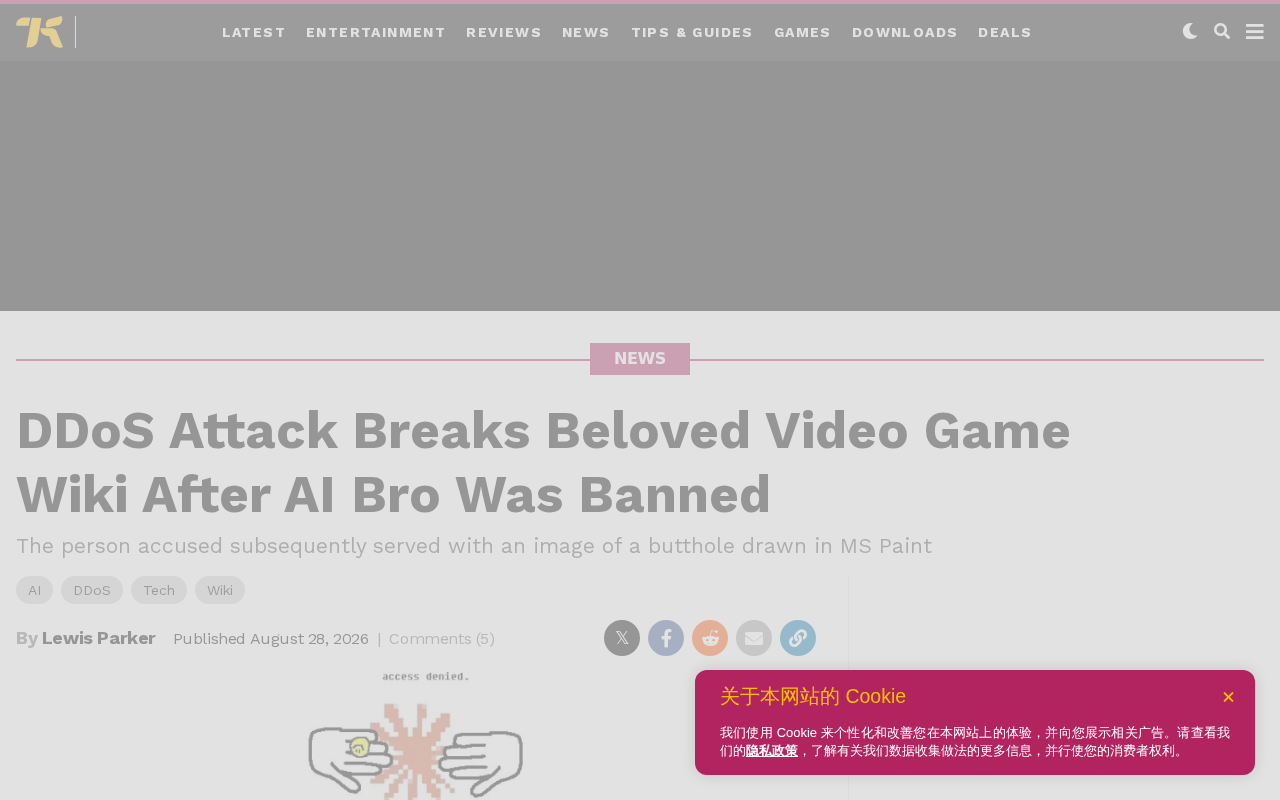
On the surface, this looks like a run-of-the-mill cyberattack. But underneath, it reveals the increasingly sharp tensions between the AIGC wave and the norms of community collaboration. When a volunteer-maintained, carefully human-edited knowledge community encounters a user flooding it with unchecked AI-generated content, conflict is virtually inevitable.
The Root Conflict: AI-Generated Content vs. Community Quality Standards
Why Gaming Wiki Communities Resist AI Content
Video game wikis are typically maintained by passionate volunteer players who prioritize accuracy, firsthand experience, and community consensus. The core value of these platforms lies in human-verified reliability — every walkthrough and every data table is backed by hands-on testing and repeated cross-checking.
Wiki communities, exemplified by Wikipedia, operate on a distinctive "open collaboration + consensus governance" model. Any registered user (or even anonymous users) can edit content, but every change is recorded in the version history and can be reviewed or reverted by other editors. Communities maintain content quality through a hierarchical governance structure — regular editors, patrollers, and administrators. This system is heavily dependent on human effort: patrollers must review each new addition and modification, while administrators handle editing disputes and user violations. When AI tools enable a single user to submit dozens or even hundreds of edits in a short period, this human-powered review system can be rapidly overwhelmed. This is the core reason why many wiki communities adopt a zero-tolerance policy toward bulk AI submissions.
AI-generated content presents several hard-to-ignore problems:
- Severe hallucination issues: Large language models can fabricate non-existent game mechanics or numerical data out of thin air. LLM "hallucination" refers to the model outputting factually incorrect or entirely fabricated content with high confidence. The root cause lies in how LLMs work — they are fundamentally statistical next-token predictors, not genuine semantic understanding or fact-retrieval knowledge systems. During training, models learn language patterns and statistical correlations between words. When facing domains poorly covered by their training data (such as hidden mechanics in specific games or stat changes after version updates), they tend to "make reasonable guesses" rather than admit ignorance, producing content that appears credible but is actually wrong. In a context like gaming wikis where data precision is paramount, the hallucination problem is especially deadly.
- Content lacks real-world experience: AI-generated text tends to be generic and repetitive, missing the nuanced insights that come from actual gameplay
- Dramatically increased moderation burden: Volunteers must spend enormous time and effort identifying and cleaning up low-quality AI content
For these reasons, a growing number of open-source platforms and content communities are establishing explicit rules to restrict or outright ban the direct submission of AI-generated content.
The Ban Decision and an Unexpectedly Severe Retaliation
According to reports, the wiki community in question banned the user who had been frequently submitting AI-generated content based on exactly these concerns. However, this community management decision triggered a backlash far beyond expectations — the website was subsequently hit by a DDoS attack. This use of technical means to cripple a service escalated what was originally a community governance dispute into a serious cyberattack incident.
Technical Perspective: Why Community Websites Are Defenseless Against DDoS
The principle behind DDoS attacks is straightforward: attackers use a large number of geographically distributed devices (a botnet) to flood a target server with massive requests, exhausting its bandwidth or computing resources and making it inaccessible to legitimate users.
From a technical standpoint, DDoS attacks can be categorized into several types: volumetric attacks (such as UDP floods) overwhelm networks by consuming bandwidth; protocol attacks (such as SYN floods) exploit the TCP three-way handshake mechanism to exhaust server connection table resources; and application-layer attacks (such as HTTP floods) simulate legitimate requests to drain web server processing capacity. Modern DDoS attacks typically rely on botnets — distributed attack networks composed of IoT devices, home routers, or even servers infected with malware. More notably, DDoS-as-a-Service has become a mature underground industry on the dark web, where attackers can rent a botnet for just a few dozen dollars to launch attacks lasting several hours, dramatically lowering the barrier to entry.
For community wikis that run on volunteer labor with limited funding and technical resources, defending against such attacks is prohibitively expensive. Large commercial websites can rely on CDN providers like Cloudflare and professional anti-DDoS services, but many nonprofit community sites simply lack the budget for comprehensive protection.
Cloudflare is one of the world's largest CDN (Content Delivery Network) and cybersecurity providers. Its core approach involves deploying hundreds of edge nodes globally and routing website traffic through these distributed nodes. When a DDoS attack occurs, malicious traffic is dispersed across edge nodes for identification and filtering, rather than hitting the origin server directly. Cloudflare's protection system includes multiple layers: rate limiting, IP reputation scoring, JavaScript challenge verification (distinguishing real browsers from automated scripts), and machine-learning-driven traffic anomaly detection. While Cloudflare offers a free tier, advanced DDoS protection and WAF (Web Application Firewall) features typically require paid subscriptions — still a significant expense for community wikis operating on extremely tight budgets.
This also exposes the fragility of open-source and community-driven internet infrastructure — these platforms host invaluable public knowledge resources, yet remain at a clear disadvantage when it comes to security.
The Community Governance Dilemma in the AIGC Era
The Dual Challenge of Content Rules and Technical Tools
Although small in scale, this incident is a highly representative case study. As generative AI tools like ChatGPT become ubiquitous, anyone can produce pages of professional-looking text in seconds. This poses an unprecedented challenge to knowledge communities that rely on human collaboration and quality gatekeeping, forcing community managers to find a balance between "embracing new technology" and "safeguarding content quality."
Specifically, communities face a dilemma:
- A blanket ban on AI seems like throwing the baby out with the bathwater — AI does offer genuine value in translation assistance, formatting, and draft writing
- Completely permitting AI content would dilute the community's core competitive advantage — a flood of unverified content would erode user trust
How to establish clear, enforceable guidelines for AI content usage has become an issue every content community must confront.
Industry Practices: Differentiated Governance Strategies Across Platforms
Different platforms have explored varied governance strategies in response to AI-generated content. Stack Overflow was among the first to announce a complete ban on AI-generated answers in late 2022, citing an unacceptably high error rate that was difficult to quickly identify. Wikipedia took a more nuanced stance — it doesn't completely prohibit AI-assisted editing but explicitly requires editors to take full responsibility for the accuracy of AI-generated content and to disclose AI usage. Some Reddit subreddits use AutoModerator and other automated tools combined with human review to filter suspected low-quality AI-generated posts. On the technical front, AI text detection tools like GPTZero and OpenAI Text Classifier have been adopted by some communities, though the accuracy of these detectors remains controversial, and false positives risk harming genuine human contributors. These diverse approaches offer valuable governance models for gaming wikis and similar communities.
From Policy Disagreements to Cyberviolence: A Dangerous Signal
What's more alarming is that when an individual's dissatisfaction with community rules escalates to deploying DDoS attacks, the nature of the situation fundamentally changes. This is no longer a debate over ideas or a discussion about rules — it's deliberate destruction of public digital resources. It reminds us that lowered technical barriers haven't just made content creation easier; they've also made cyberattacks cheaper and more casual. As the DDoS-as-a-Service underground economy mentioned earlier demonstrates, the cost of launching an attack capable of taking down a community website can be shockingly low, while the damage inflicted on the target — and the blow to community morale — can be enormous.
Conclusion: Technological Progress Should Not Come at the Cost of Community Spirit
This incident — a DDoS attack triggered by banning an AI content creator — is a textbook example of community conflicts in the AIGC era. It serves as a warning: the advancement of technological tools should not come at the expense of community collaboration and content quality.
For public knowledge platforms sustained by passion and dedication, we need both reasonable AI content governance frameworks and better security support in terms of technology and funding. As AI becomes ever more deeply embedded in content production, how to make technology truly serve the accumulation and sharing of knowledge — rather than becoming a tool for destruction and abuse — is a question that deserves serious consideration from everyone in the field.
Related articles

Python 3.15 New Feature: Is the sentinel Type Better Than None?
Python 3.15 adds the sentinel type, using named unique sentinel objects to replace None and bare object(), resolving confusion among missing values, explicit emptiness, and invalid input while avoiding type hint failures.

Deep Learning's Three Architectures and the Universal Approximation Theorem: A Complete Guide to MLPs, CNNs, and Transformers
Explaining the inductive bias differences among MLP, CNN, and Transformer, the existence meaning of the Universal Approximation Theorem (UAT), and the role of Taylor expansion in approximation analysis, while clearing up common misconceptions.

GitLab Emergency Patch Release: Analysis of Critical Security Fixes
GitLab releases critical patch 19.5.1, sparking 355 points of discussion on Hacker News. This article analyzes the background, upgrade steps for self-hosted instances, and verification points to help DevOps teams respond quickly to security updates.