GAP-DPO: Reshaping Personalized Preference Optimization with Gradient Alignment

GAP-DPO uses gradient-geometric alignment for preference pair selection to systematically improve personalized LLM alignment.
The core challenge of personalized LLM alignment is that the optimization target is a specific user's preferences, not an aggregate average. Existing DPO-based methods typically construct preference pairs using likelihood extremes, but likelihood only reflects model confidence and systematically diverges from true user utility. This arXiv paper reformulates pair selection as a geometric alignment problem, showing that under off-policy sampling, aligning the preference margin with the user utility gradient shifts DPO updates from correction mode to reinforcement mode. The proposed GAP-DPO combines utility-aware geometric pair selection with epoch-wise regeneration to control distribution shift, achieving consistent improvements over standard DPO variants across stylistic fidelity, preference alignment, and generation quality — with gains that are comprehensive rather than traded off against each other.
The Core Pain Point of Personalized LLMs: Aligning to "What You Want" — Not Just "What's Good"
Personalizing large language models is fundamentally a hard problem: the model needs to cater to an individual user's preferences, rather than approximating some aggregate notion of "high quality." A response that most people would consider well-written may not suit a particular user's preferred casual tone — and vice versa. This means the goal of personalized alignment is fundamentally at odds with the "average optimum" pursued by general-purpose alignment.
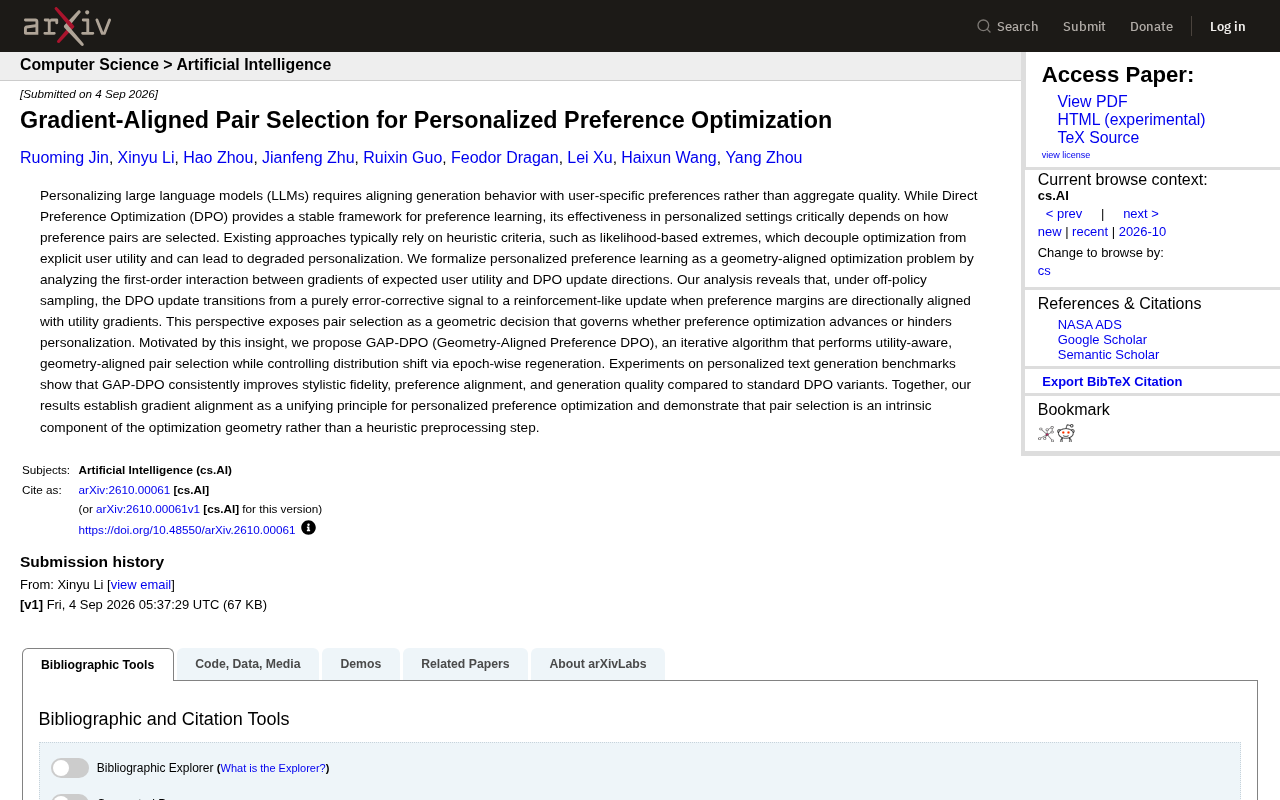
Direct Preference Optimization (DPO) offers a stable training framework for preference learning, eliminating the need to build an explicit reward model, and has seen widespread adoption in recent years. But a newly published arXiv paper (arXiv:2610.00061) argues that whether DPO can succeed in personalized settings hinges not on the algorithm itself, but on how preference pairs are selected.
The Hidden Pitfall of Heuristic Pair Selection
Most existing approaches rely on heuristic criteria to construct preference pairs — for example, using likelihood-based extremes by picking the samples the model assigns the highest and lowest probabilities to as positive and negative examples. The paper argues that this approach harbors an overlooked flaw: it completely decouples preference pair selection from user utility.
In other words, likelihood reflects the model's own confidence, not how much value a given sample holds for a specific user. When the two diverge, the optimization direction can drift away from the generation behavior the user actually wants — and personalization ends up worse, not better. This exposes a step long treated as mere "preprocessing" that in fact profoundly shapes the success or failure of optimization.
In the context of personalized alignment, user utility is typically modeled as a function measuring how suitable a generated output is for a specific user — expressed either as an explicit rating signal or implicit behavioral feedback. Unlike the average human preference pursued in general alignment, user utility varies from person to person and is difficult to measure directly. This heterogeneity is precisely what makes substituting global likelihood for user utility so dangerous: high-likelihood samples are simply what the model "feels confident generating," not what any particular user actually wants. The greater the divergence between the two, the more a likelihood-based pair selection strategy risks pushing optimization in the wrong direction.
Turning Pair Selection into a Geometric Problem
The paper's most central contribution is reformulating personalized preference learning as a geometry-aligned optimization problem. The authors analyze the first-order interaction between two directions: the gradient of expected user utility, and the parameter update direction of DPO.
This analysis yields a highly insightful conclusion: under off-policy sampling, when the preference margin is directionally aligned with the utility gradient, DPO's updates shift from being a simple "correction signal" to something resembling a reinforcement-style update.
Correction vs. Reinforcement: Direction Is Everything
The value of this perspective is that it elevates preference pair selection from an empirical engineering trick to a geometric decision. Select the right direction, and optimization drives personalization forward; select the wrong direction, and it actively pulls things backward. Preference pairs are no longer data casually prepared before training — they become an intrinsic component embedded within the geometric structure of optimization.
This reformulation provides a clear theoretical criterion for "which samples to select": check whether they align with the direction of the user utility gradient, rather than relying on intuition based on likelihood scores.
Off-policy sampling refers to training data that is not generated in real time by the current policy (i.e., the model being updated), but rather comes from earlier versions of the model or other sources. In contrast, on-policy sampling generates data using the latest model at each step — far more accurate in terms of distribution, but extremely expensive. DPO is typically trained on off-policy data, which introduces distribution shift risk: as model parameters continue to update, the gap between the model that originally collected the data and the current model widens, and the original preference pairs become less informative. GAP-DPO's epoch-wise regeneration mechanism directly addresses this issue.
GAP-DPO: A Utility-Aware Iterative Algorithm
Building on these insights, the paper proposes GAP-DPO (Geometry-Aligned Preference DPO) — an iterative algorithm with two core mechanisms:
- Utility-aware, geometry-aligned preference pair selection: At each iteration, preference pairs are selected based on the direction of the utility gradient, ensuring that update directions serve the personalization objective.
- Epoch-wise regeneration to control distribution shift: Since off-policy sampling tends to introduce distribution shift, GAP-DPO mitigates this risk by regenerating samples at each epoch, maintaining training stability.
This design translates the theoretical principles established earlier into an executable training procedure — rather than leaving them at the level of analysis.
The core idea of Direct Preference Optimization (DPO) is: given a preference pair consisting of a "good response" and a "bad response," directly optimize the language model's parameters to widen the gap between them at the log-probability level — without needing to first train a separate reward model and then apply reinforcement learning. Compared to the classical RLHF pipeline, DPO is simpler, more stable, and incurs lower training costs. However, DPO's objective function is highly sensitive to the quality of preference pairs — it assumes the positive and negative examples provided genuinely reflect a true preference signal. When the pair selection logic is flawed, the model will "faithfully" learn in the wrong direction, and the loss function itself has no way to detect this error. This is the fundamental contradiction the paper sets out to resolve.
Experimental Results: Consistent Gains Across Three Dimensions
On personalized text generation benchmarks, GAP-DPO achieves consistent improvements over standard DPO variants across three dimensions:
- Stylistic fidelity: Generated content more closely matches the target user's expressive style;
- Preference alignment: Outputs better match users' actual preferences;
- Generation quality: Overall text quality is not sacrificed for personalization.
The phrase "consistent improvement" is worth noting — it means the gains are not traded off against each other, but represent across-the-board progress.
Gradient Alignment: A Unifying Principle
The broader significance of this work lies in proposing gradient alignment as a unifying principle for personalized preference optimization. It brings previously scattered heuristic techniques under a coherent theoretical framework, and explicitly argues that preference pair selection is an intrinsic part of the optimization geometry — not an optional data preprocessing step.
For researchers and engineers working on LLM personalization, RLHF, and preference learning, this perspective offers an actionable direction: rather than endlessly iterating through data filtering heuristics, return to the optimization direction itself and let the utility gradient guide sample selection. As personalization demands become increasingly common in real-world products, methodology grounded in geometric structure like this may become a new entry point for improving alignment quality.
Related articles

Chain of Thought Isn't Just for AI: How Humans Can Use CoT to Improve Thinking Quality
Chain of Thought isn't just a prompt trick for large models. Starting from a Hacker News discussion, this article analyzes why CoT works for human thinking too, breaks down actionable ways to transfer it, and highlights the key differences between human CoT and machine CoT.
Cloudflare Teams Up with OpenAI: Closi…
Cloudflare Teams Up with OpenAI: Closing the Loop from Vulnerability Discovery to Defense with AI
Cloudflare uses OpenAI Daybreak to investigate security vulnerabilities and generate reviewable remediation plans, while developers use Codex to boost coding efficiency and quality.

Orca Multi-Agent Orchestration in Practice: A Guide to Parallel Collaboration with Claude and Codex
Orca is Stable AI's free open-source agent workbench supporting 34 agents like Claude Code and Codex in parallel. Learn its Git worktree isolation, multi-model orchestration, and mobile management.