GAtrends: AI-Powered Keyword Anomaly Monitoring with Instant Telegram Alerts

GAtrends monitors 7 data sources, learns keyword baselines, alerts via Telegram on anomalies, and supports AI chat queries.
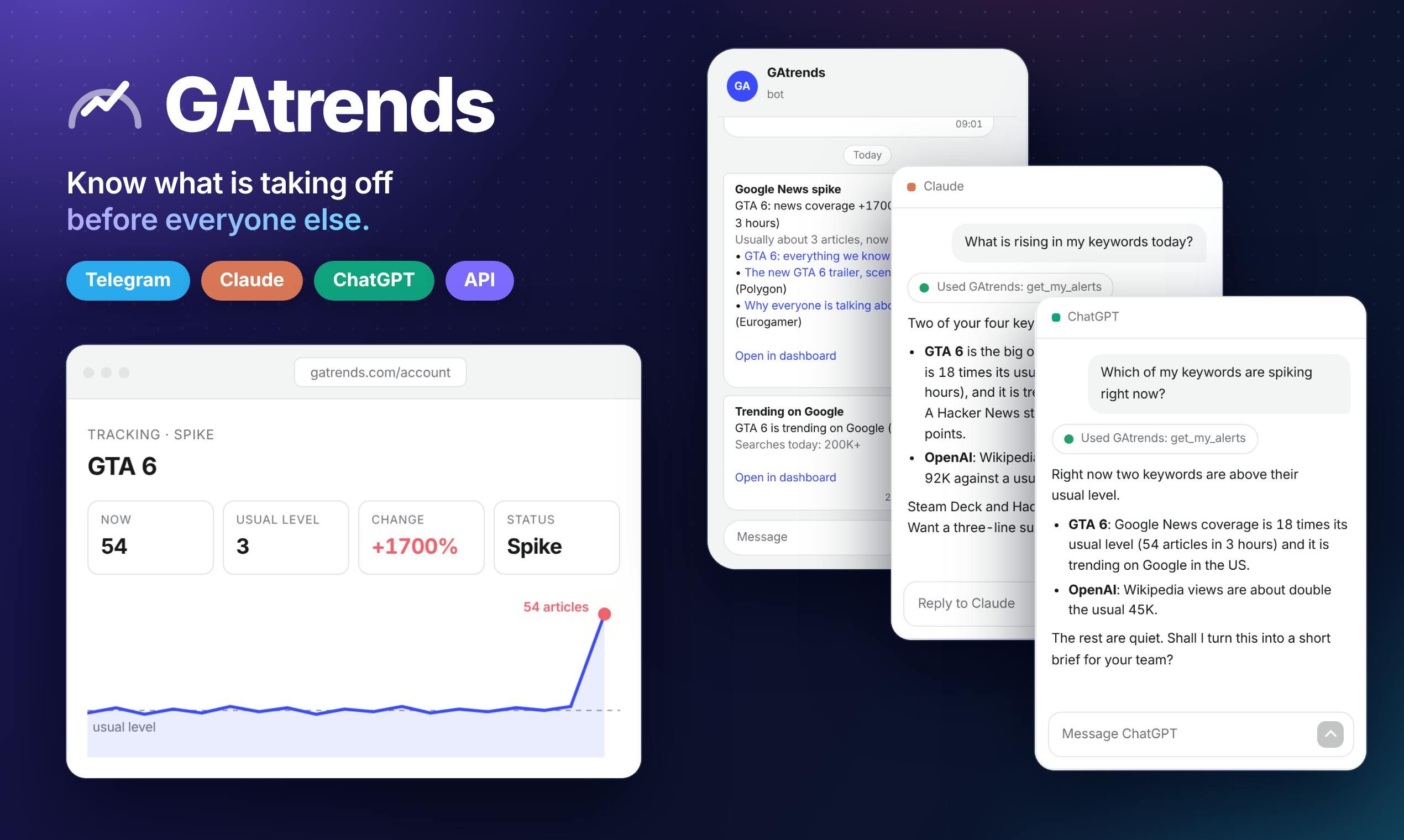
GAtrends is a trend-monitoring tool ranked #10 on Product Hunt that builds an "anomaly radar" for user-defined keywords. It draws on 7 data sources—Google News, Hacker News, Wikipedia, Steam, Google Trends, GitHub, and Product Hunt—learning each keyword's normal activity level and pushing Telegram alerts only when values deviate from the baseline. It also supports Claude and ChatGPT for natural-language trend queries, plus a Dashboard, signal history, CSV export, Webhook, and API. The free plan includes 3 keywords with no credit card, and Telegram alerts work on all plans. The product is early-stage, so validate alert accuracy with the free quota first.
In an age of information overload, how do you catch trend fluctuations relevant to your business as they happen? GAtrends, a new product ranked #10 on Product Hunt, offers a lightweight answer: an "anomaly radar" for your keywords. It monitors 7 data sources, learns the normal level for each term, and pushes alerts via Telegram when values spike.
Core Mechanism: Learn the Baseline, Report Only Anomalies
GAtrends has a clear positioning—not yet another generic trending list, but a monitoring dashboard built around keywords you define yourself. Its data sources include Google News, Hacker News, Wikipedia, Steam, Google Trends, GitHub, and Product Hunt, covering dimensions such as news, developer communities, encyclopedia traffic, gaming platforms, search trends, code repositories, and product launches.
Rather than simply capturing absolute values, GAtrends first "learns" the normal occurrence level of each keyword to establish a baseline, and only triggers an alert when a keyword's activity suddenly deviates from the norm. This approach filters out daily noise and makes notifications more targeted.
Baseline Learning and Anomaly Detection: GAtrends' "baseline learning" is essentially a time-series anomaly detection method. The system collects historical activity data for each keyword across multiple data sources, computes the mean, variance, or quantiles over a window period to form the keyword's "normal fluctuation range." Only when a new observation significantly deviates from this range (for example, exceeding the mean by several standard deviations, or breaking through a historical high percentile) is it judged an anomaly and an alert triggered. Compared with fixed thresholds, this approach better accommodates the natural popularity differences between keywords—a small rise for a niche term may carry more business significance than a surge for a popular one. Common implementations include moving averages, exponential smoothing, Z-scores, or robust statistics (such as median absolute deviation, MAD); the specific algorithm varies by product.
AI Integration: Ask About Trends Through Chat
Beyond automatic alerts, GAtrends also supports connecting to Claude or ChatGPT. Users can directly ask in natural language "what's rising lately," and the model answers based on monitoring data. This lowers the analysis barrier and turns trend querying from reading charts into conversational interaction.
This design approach is becoming increasingly popular among current tools: exposing structured monitoring data to large models via API, then consuming it in conversational form. GAtrends also provides Dashboard charts, signal history, CSV export, Webhook, and API, leaving room for users with further analysis needs.
Connecting Monitoring Data to Large Models: GAtrends' conversational querying relies on Tool Calling / Function Calling or Retrieval-Augmented Generation (RAG) patterns. The system provides structured monitoring metrics (such as time series from each data source and anomaly signal history) to Claude or ChatGPT via API; upon receiving a natural language question, the model decides which data interfaces to call, how to aggregate results, and then organizes the answer in natural language. The advantage of this architecture is that users don't need to learn query syntax or chart operations, but answer quality is limited by the model's understanding of the data, data freshness, and prompt design. For users who need reproducible analysis, raw data and CSV export remain important.
Pricing and Target Audience
The free plan includes 3 keywords with no credit card required. Telegram alerts are available on all plans, which is relatively friendly for budget-constrained indie developers or small teams.
Judging from its category tags, GAtrends sits at the intersection of analytics, marketing, and AI. It suits: marketers who need to track brand or competitor activity, developers interested in the popularity of technical topics, and content creators who want to build a trend-monitoring workflow at low cost.
Product Hunt Ranking Mechanism: The "ranked #10" mentioned in this article refers to the product's position on Product Hunt's daily or weekly leaderboard. Product Hunt rankings are determined by a combination of user upvotes, comment activity, and time decay, with votes received within 24 hours of launch carrying the highest weight. 83 upvotes, 9 comments, and a #10 ranking mean the product gained some attention on its launch day but has not yet entered the top tier of breakout hits. For early-stage products, this data can serve as a reference for initial market validation, but it does not reflect long-term retention or paid conversion capability.
Points to Note
Currently the product has 83 upvotes, 9 comments, and ranks #10 on Product Hunt, placing it in an early stage. The 7 data sources offer broad coverage, but the specific weighting of each source and the anomaly detection algorithm are not explained on the page; the quality of AI Q&A also depends on the underlying model and data freshness. For users seeking fine-grained trend analysis, it's advisable to first use the free quota to validate the alert accuracy for your keywords before deciding whether to integrate it into your workflow.
One-line Summary
GAtrends monitors 7 data sources, learns keyword baselines, alerts via Telegram on anomalies, and supports AI conversational queries.
Paragraph Summary
GAtrends is a trend-monitoring tool ranked #10 on Product Hunt, built around an "anomaly radar" for user-defined keywords. It draws on 7 data sources—Google News, Hacker News, Wikipedia, Steam, Google Trends, GitHub, and Product Hunt—first learning each keyword's normal activity level and pushing Telegram alerts only when values deviate from the baseline, filtering out daily noise. It also supports connecting to Claude or ChatGPT for natural-language trend queries, and offers a Dashboard, signal history, CSV export, Webhook, and API. The free plan includes 3 keywords with no credit card required, and Telegram alerts are available on all plans. The product is still at an early stage, with data source weights and anomaly algorithms undisclosed; it's recommended to first use the free quota to validate alert accuracy.
Related articles
Agent Project in Practice: Real Delivery and Pitfalls from Requirements to Launch
Based on a real Agent project, this article breaks down the full process from a minimal viable loop to autonomous long-task delivery, analyzes the pitfall of over-constrained prompts, and provides acceptance criteria and pitfall records for context management, tool calling, and long-task decomposition.

When AI Becomes the Manor Lord: A Tech Experiment Behind a Murder Mystery
From YouTube interactive mystery video Brindley Manor, analyze how multi-agent AI plays eight roles, maintains information isolation, and generates dynamic murder puzzles, exploring the potential and current technical shortcomings of AI interactive narrative.

From Pulpit to Senate: A Pastor-Senator on What Sin Is
A pastor-senator at Ebenezer Church reflects on how his Senate experience reshaped his understanding of sin and hubris, making his sermons more powerful—even likening Washington to Sodom and Gomorrah.