GDDR7 Costs Bite: RTX 5080 24GB Version Reportedly Cancelled, 16GB Model Returns

Leak claims NVIDIA cancelled RTX 5080 24GB version due to GDDR7 costs, reverting to 16GB model.
The article centers on a Reddit community leak claiming NVIDIA cancelled the GeForce RTX 5080 24GB version and reverted to a 16GB model, citing GDDR7 memory cost pressure as the direct cause. The analysis suggests the cancellation reflects both cost control and product tiering considerations: GDDR7 has high per-unit costs in early mass production, and doubling capacity amplifies BOM pressure; meanwhile, a 24GB 5080 would squeeze the positioning of higher-tier models. For gamers, 16GB headroom is narrowing in 4K gaming and local AI inference, and the cancellation of the 24GB version will affect some users' purchasing decisions. The article emphasizes the information comes from community leaks, not official announcements, and final specs may still change, noting that VRAM costs are becoming a key variable inversely shaping GPU product spec planning.
A Product Roadmap Rewritten by VRAM Costs
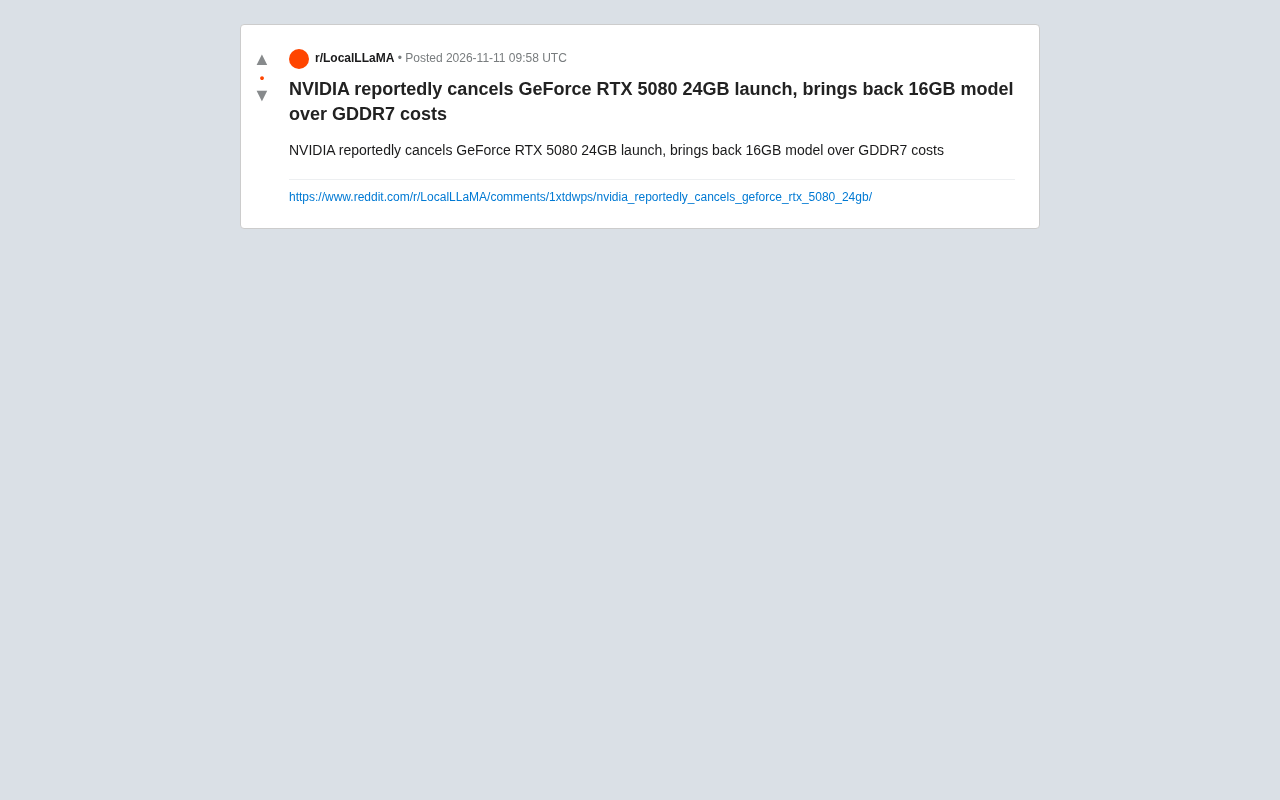
NVIDIA's RTX 50 series hasn't even fully rolled out yet, and its product roadmap is already showing signs of change. According to a leak cited by the Reddit community, NVIDIA has cancelled the 24GB VRAM version of the GeForce RTX 5080 and reverted to a 16GB model, with the direct cause pointing to cost pressure from GDDR7 memory.
The significance of this news isn't about "another graphics card getting delayed" — it's that it exposes a signal: the rising material costs brought by the new-generation memory standard have begun to inversely affect GPU vendors' SKU planning. For gamers, VRAM capacity often directly determines a graphics card's lifespan in high-resolution gaming and local AI inference. The difference between 24GB and 16GB is not just a numbers game on a spec sheet.
Why the 24GB Version Was Cut
The Cost Structure of GDDR7
GDDR7 is one of the core selling points of the RTX 50 series, with higher bandwidth and energy efficiency being its main advantages over GDDR6X. But new standards often come with higher per-unit costs in the early stages of mass production, and memory chip prices press directly on the graphics card BOM. For a product positioned like the RTX 5080, doubling VRAM capacity to 24GB means needing more chips, amplifying the cost stacking effect.
The leak explicitly attributes the cancellation to GDDR7 costs, indicating that NVIDIA made a trade-off between pricing and profit. The 16GB version can maintain a more controllable cost structure and is more likely to land within the target price range.
GDDR7 is the seventh-generation Graphics Double Data Rate memory standard led by JEDEC. Its most core change compared to GDDR6X is the introduction of PAM3 signal encoding, which allows per-pin speeds to reach 32Gbps and above, while adopting a higher-frequency clock architecture. This means that at the same bus width, GDDR7 can provide significantly higher bandwidth, but it also imposes stricter requirements on PCB routing, signal integrity, and heat dissipation. In addition, GDDR7 memory chips require redesigned memory controllers and PHY physical layer support, increasing the memory interface area and power budget within the GPU chip. These factors combined make GDDR7's per-unit cost higher in early mass production than mature GDDR6X. For graphics card vendors, memory costs depend not only on chip unit prices but also on supporting power delivery, routing, and cooling design costs, so each step up in VRAM capacity often results in a non-linear increase in BOM costs.
Product Tiering Considerations
From a product line perspective, a 24GB 5080 would also squeeze against higher-tier models. VRAM capacity is an important tool for NVIDIA to differentiate product tiers. If the 5080 gets 24GB, positioning at both ends becomes awkward. With cost pressure and product tiering needs combined, cutting the 24GB version is a "convenient" decision.
In GPU product lines, VRAM capacity and bus width are among the core means vendors use to differentiate tiers. The same GPU chip can spawn multiple SKUs through different memory configurations — for example, 16GB and 24GB versions sharing a core but with a price gap. The benefit of this approach is amortizing chip R&D costs while using VRAM capacity to create price anchors. But if a mid-range model's VRAM capacity approaches or matches that of a high-end model, the high-end model's premium justification is weakened, forcing vendors to re-establish the gap by reducing memory bus width, lowering clocks, or locking compute performance. Therefore, memory configuration is never just a technical parameter — it's a regulating valve in the product pricing system. If the RTX 5080 were equipped with 24GB, it would match higher-positioned models in VRAM capacity, forcing NVIDIA to make additional adjustments in price or specs. This is the realistic logic behind product tiering considerations.
What the 16GB Return Means for Gamers
16GB is still sufficient for current 4K gaming and content creation scenarios, but the headroom is narrowing. In recent years, VRAM usage in several AAA titles at high settings has approached this level, and 16GB can easily become a bottleneck when running large models locally. The 24GB version was originally seen by many users as a "future-proof" choice, and its cancellation will make some buyers who were holding out reassess.
It should be emphasized that the current information comes from community leaks rather than an official NVIDIA announcement, and final specs may still change.
The impact of VRAM capacity on gaming experience is mainly reflected in caching textures, lighting, and geometry data at high resolutions and high settings. When VRAM is insufficient, the GPU needs to frequently exchange data with system memory, causing frame rate drops or stuttering — especially noticeable at 4K resolution with ray tracing and high-quality texture packs. In recent years, VRAM usage in some AAA titles at 4K maximum settings has exceeded 12GB, and with background programs and screen recording software, 16GB of headroom is indeed narrowing. In local AI inference scenarios, VRAM capacity directly determines the scale and quantization precision of models that can be loaded — for example, 16GB VRAM typically can only run quantized models with 7B to 14B parameters, while 24GB can cover larger parameter models or longer context windows. Therefore, the impact of VRAM capacity on a graphics card's lifespan is amplifying on both gaming and AI fronts.
VRAM Costs Are Reshaping Graphics Card Specs
The most valuable part of this rumor is that it reveals the inverse effect of VRAM costs on product definition. GPU vendors usually like to use larger VRAM as a selling point during generational upgrades, but when new memory standards are expensive, capacity expansion gives way to cost control. The pace of GDDR7 adoption and the speed at which chip prices fall will both affect the memory configurations of other RTX 50 series models.
For consumers, this means they can't simply expect specs based on the惯性 thinking that "a new generation always means more." VRAM capacity will increasingly resemble a card that is repeatedly balanced between cost and product tiering. [Source: Reddit community leak]
In a GPU's BOM costs, memory chips typically account for a significant proportion, especially on mid-to-high-end graphics cards. When memory standards change generations, the initial yield and capacity ramp-up of new chips push up unit prices, while graphics card vendors' pricing is constrained by market competition and consumer psychological price points, squeezing profit margins from both sides. Historically, similar situations occurred during the early GDDR6 transition, with some models' VRAM capacity plans being adjusted due to cost reasons. Memory chip prices typically decline gradually as production capacity is released, but the speed and magnitude of the decline depend on upstream DRAM vendors' capital expenditure and overall memory market supply and demand. Therefore, the memory configurations of subsequent RTX 50 series models are likely to be dynamically adjusted with GDDR7 chip price trends, and the spec sheets consumers see at different stages of the product cycle may also change.
Related articles

SLAM Mapping and Navigation Tutorial: A Complete Learning Path from Theory to Practice
This Bilibili SLAM mapping and navigation tutorial starts with a navigation overview, covering architecture, installation commands, and practical prerequisites, then connects to the Fourteen Lectures on Visual SLAM, slam_toolbox, and Cartographer—a complete learning path from theory to practice.

LangChain Beginner's Guide: Core Concepts and Hands-On Tools
What is LangChain? This guide covers its core positioning—Agent = Model + Harness—and the three key problems it solves: training time limits, external data connections, and multi-turn conversation context.

FDE Forward Deployed Engineer: The New Species of AI Implementation and Two Schools of Practice
An analysis of FDE (Forward Deployment Engineer), the new species of AI implementation, covering Palantir's ontology-driven and AI Walking scenario-driven schools, Agent development and fine-tuning/distillation tech stacks, common enterprise pitfalls, and learning paths for entering the field.