FDE Forward Deployed Engineer: The New Species of AI Implementation and Two Schools of Practice

FDE is an AI implementation role that emerged in 2026, bridging the last mile between technology and business.
The article introduces FDE (Forward Deployment Engineer), an AI implementation role that emerged in 2026, whose core positioning is to solve requirement distortion between AI technology and enterprise business. FDE has two major schools: the ontology-driven approach from Palantir, suitable for finance and healthcare, and the scenario-driven AI Walking approach for budget-limited traditional enterprises. Technically, it recommends starting with Agent development and private deployment, then advancing to fine-tuning and distillation, with pre-training being the hardest and non-essential. The main obstacle to enterprise fine-tuning is unclear ROI and difficulty verifying results. FDE talent in China is extremely scarce, making now a window for career transition.
What Is FDE? A New Species of Enterprise Implementation in the AI Era
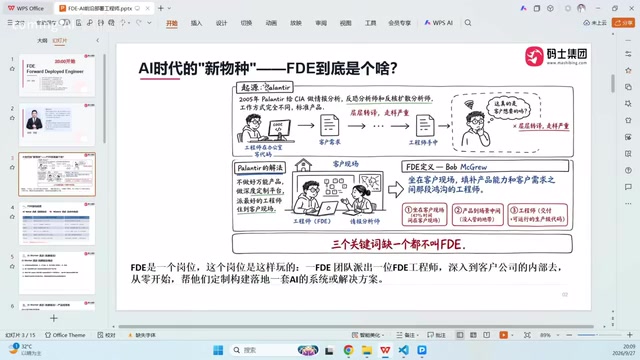
FDE stands for Forward Deployment Engineer, often translated into Chinese as "前沿部署工程师". This role became a hot concept in the AI field in 2026, with its core positioning being to bridge the "last mile" between AI technology and real enterprise business. Unlike traditional algorithm engineers or backend developers, FDEs need both technical depth and business understanding, and must be able to work on-site deep within customer scenarios to deeply integrate models, agents, and business processes.
According to a sharing by Bilibili creator Teacher Li Jin, the birth of FDE is closely related to Palantir. When Palantir was doing intelligence analysis for government agencies such as the CIA, it found that standardized products were often designed by programmers based on guesswork, and requirements became severely distorted after passing through layer after layer—the customer wanted A, but what was ultimately delivered became E. This pain point still commonly exists in current enterprise AI implementation, and FDE was born precisely to solve this problem.
The Two Major Schools of FDE: Ontology-Driven and Scenario-Driven
In practice, FDE has developed two main schools, corresponding to different implementation methodologies.
The Palantir School: Ontology-Driven
This school originates from Palantir's experience in government and defense projects. It emphasizes building an enterprise-level knowledge ontology, abstracting data, entities, relationships, and business rules into a unified model, and then developing AI applications on top of it. Its advantage lies in its strong modeling capability for complex business logic, making it suitable for scenarios with extremely high requirements for data rigor, such as finance, healthcare, and intelligence analysis.
Knowledge Ontology (Ontology) in computer and information science refers to an explicit, formal description of the concepts, entities, attributes, and their interrelationships within a domain. Enterprise-level ontologies usually include entity types (such as customers, orders, and devices), relationships (such as "belongs to" and "depends on"), business rules and constraints, and can be mapped to database tables or knowledge graphs. Palantir's ontology-driven approach essentially means first building a unified data model aligned with business semantics, and then letting AI applications perform reasoning and queries based on that model. The benefits are: centralized management of business logic, consistent data definitions, and explainable and auditable AI outputs. For scenarios such as financial risk control, medical diagnosis, and intelligence analysis, the ontology can also serve as a "business knowledge base" to constrain large model hallucinations and make the agent's decision-making chain more controllable.
The AI Walking School: Scenario-Driven
Another school leans more toward an agile "learn as you go" implementation approach, using specific business scenarios as entry points to rapidly build agents and iterate and optimize them. This method requires lower upfront investment from customers and is suitable for traditional enterprises to start AI transformation at a relatively low cost. In the course, Teacher Li Jin mentioned that many traditional companies are willing to pay very limited budgets for AI transformation, and scenario-driven lightweight solutions are easier to accept.
Agent refers to a software system that uses large language models as its reasoning core and can autonomously plan steps, call tools (such as search, databases, and APIs), execute multi-turn tasks, and observe results. Unlike traditional enterprise software, an Agent's behavior is jointly determined by prompts, tool definitions, and memory mechanisms, so it can be built quickly and tested quickly. In the scenario-driven school, FDEs usually first select a business scenario with clear boundaries and quantifiable value (such as customer service ticket classification or contract review assistance), build an Agent prototype using low-code or open-source frameworks, and then gradually expand after it works on real data. This "small steps, fast iteration" approach can significantly reduce the customer's upfront decision-making cost and also helps expose data quality and process integration issues early.
What Technologies Are Needed to Follow the FDE Path?
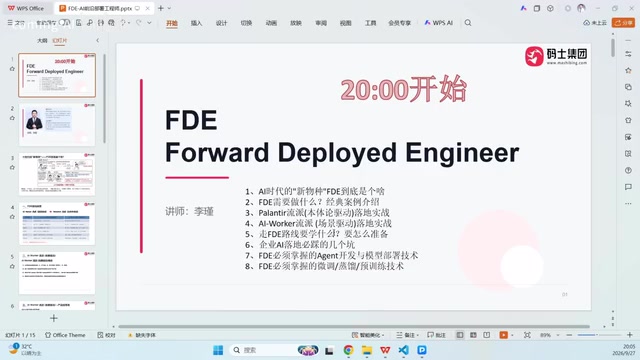
The FDE technology stack can be divided into several layers. The most fundamental is AI Agent development and private model deployment, which is the starting point for most enterprise projects. Teacher Li Jin suggests that beginners should not start by tackling pre-training, but should instead begin with Agent development or local deployment.
Moving upward are fine-tuning and distillation. In enterprise-level projects, agent development alone often only reaches "90 points", while business acceptance standards may require "95 points", at which point fine-tuning must be introduced. In terms of technical difficulty, fine-tuning is less difficult than distillation, and distillation is less difficult than pre-training. The core reason many companies are unwilling to do fine-tuning is not that "conditions are lacking", but that the return on investment is unclear—after tuning, who will verify the results? If fine-tuning cannot bring perceptible benefits, companies naturally lack motivation.
The cost of local deployment is also a practical issue FDEs must face. Teacher Li Jin recommends choosing models of at least 8B for enterprise-level deployment; models below 8B have limited significance in 2026 enterprise scenarios. Hardware costs vary enormously by customer type: first-tier internet companies may consider 2 million yuan not expensive, while small traditional companies may be willing to spend only 20,000 yuan on AI transformation. This budget gap directly determines the choice of technical solution.

Fine-tuning refers to continuing to train a pre-trained large model with labeled data from a specific domain so that the model adapts to downstream tasks. Common methods include full-parameter fine-tuning and parameter-efficient fine-tuning (such as LoRA and QLoRA); the latter updates only a small number of additional parameters, greatly reducing VRAM and compute requirements. Distillation means letting a larger "teacher model" guide a smaller "student model" to learn, compressing the capabilities of the large model into the small model in order to reduce inference costs and improve deployment feasibility. Pre-training means training a foundation model from scratch using massive unlabeled corpora, requiring thousand-GPU-level compute and months of time; usually only leading institutions have the conditions for this. The three increase in difficulty and differ enormously in cost scale, which also explains why FDE recommends starting with Agent development and private deployment, and then deciding whether to invest in fine-tuning or distillation based on project returns.
Common Pitfalls in Enterprise Implementation and How to Respond
The essence of FDE work is enterprise implementation, and enterprise implementation inevitably comes with a series of "must-hit pitfalls". The first is the distortion of requirement transmission, exactly like what Palantir observed back then. The second is the verification problem of fine-tuning—there is a lack of objective evaluation standards for the effects after model adjustment, leading customers to doubt the investment. The third is the mismatch between cost and expectations; there is often a huge gap between customer budgets and technical solutions.
Teacher Li Jin particularly pointed out that FDE talent is currently extremely scarce in China. If companies want to hire people with FDE experience, they can almost only look at companies like Palantir in the United States, because many Chinese enterprises have only just begun FDE transformation. This also means that for practitioners hoping to transition into FDE, the present is a window of opportunity.
RAG (Retrieval-Augmented Generation) is a technology frequently used by FDEs in enterprise implementation. It first retrieves fragments related to the user's question from an enterprise knowledge base (documents, databases, ticket records), and then provides these fragments as context to the large model to generate an answer. Compared with fine-tuning, RAG does not require retraining the model; updating knowledge only requires updating the index, so it is particularly suitable for scenarios where policy documents change frequently and answers must be traceable. The implementation difficulties of RAG lie in document chunking strategies, embedding model selection, and recall accuracy tuning—if retrieval is inaccurate, generation quality cannot be guaranteed. FDEs often need to combine RAG with multi-agent collaboration, for example having one Agent responsible for retrieval and another for validation and formatted output, in order to meet enterprise-level business requirements for accuracy and compliance.
Advice for Practitioners Who Want to Enter the FDE Field
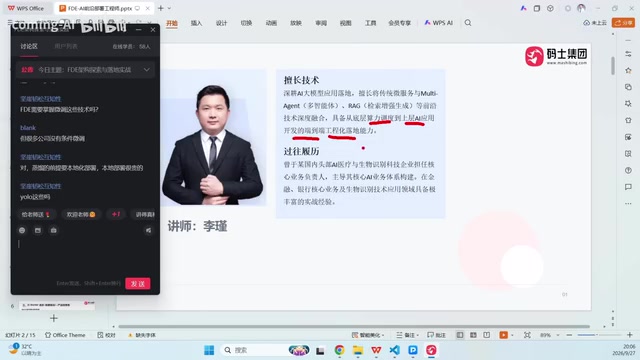
If you plan to follow the FDE path in 2026, the recommended learning path is: first master AI Agent development and model deployment, then gradually go deeper into fine-tuning and distillation, and finally touch on pre-training as project needs require. At the same time, pay attention to cultivating business understanding, because the core value of FDE is not writing code, but translating technology into business value. Teacher Li Jin himself has end-to-end development and implementation capabilities from underlying algorithms to AI applications, and his experience shows that the deep integration of traditional microservices with multi-agent systems, RAG retrieval, and other technologies is an important weapon for FDEs in real projects.
One-line Summary
FDE is an AI implementation role that emerged in 2026, bridging the last mile between technology and business.
Paragraph Summary
The article introduces FDE (Forward Deployment Engineer), an AI implementation role that emerged in 2026, whose core positioning is to solve the problem of requirement distortion between AI technology and enterprise business. FDE is divided into two major schools: the ontology-driven approach originating from Palantir, which emphasizes building an enterprise-level knowledge ontology and is suitable for rigorous scenarios such as finance and healthcare; and the scenario-driven AI Walking approach, which uses specific business scenarios as entry points for rapid iteration and is suitable for traditional enterprises with limited budgets. On the technical path, it is recommended to start with Agent development and private model deployment, then gradually go deeper into fine-tuning and distillation; pre-training is the most difficult and not essential. The core obstacle to enterprise fine-tuning is not technical conditions, but unclear return on investment and difficulty in verifying results. The article also points out that FDE talent in China is extremely scarce, and the present is a window of opportunity for transitioning into the field.
Related articles

Codex in Practice: From Environment Setup to Skills and MCP Calls
Codex is OpenAI's AI coding assistant. This guide covers its positioning, how it compares to Claude Code, model configuration pitfalls, and practical Skills and MCP usage for beginners.
Getting Started with ROS2 Robot Development: Core Concepts and Environment Setup
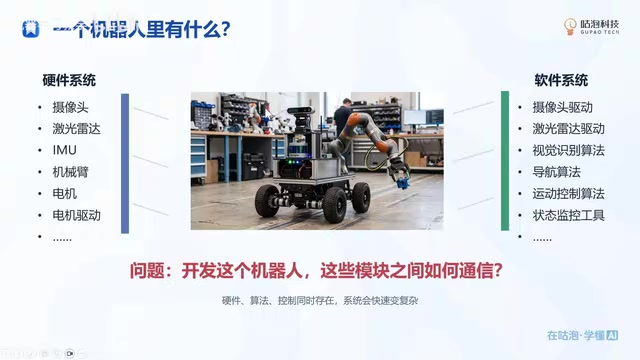
This article introduces the core concepts and environment setup of ROS2 robot development, explains why ROS2 unifies module communication and facilitates collaborative work, and outlines the Turtlesim simulation experiment to help beginners get started quickly.

SLAM Mapping and Navigation Tutorial: A Complete Learning Path from Theory to Practice
This Bilibili SLAM mapping and navigation tutorial starts with a navigation overview, covering architecture, installation commands, and practical prerequisites, then connects to the Fourteen Lectures on Visual SLAM, slam_toolbox, and Cartographer—a complete learning path from theory to practice.