GeckIt: Manage Your Multiple Claude Code Sessions with a Kanban Board

GeckIt brings a Kanban board to manage multiple parallel Claude Code sessions — free, open-source, no API key required.
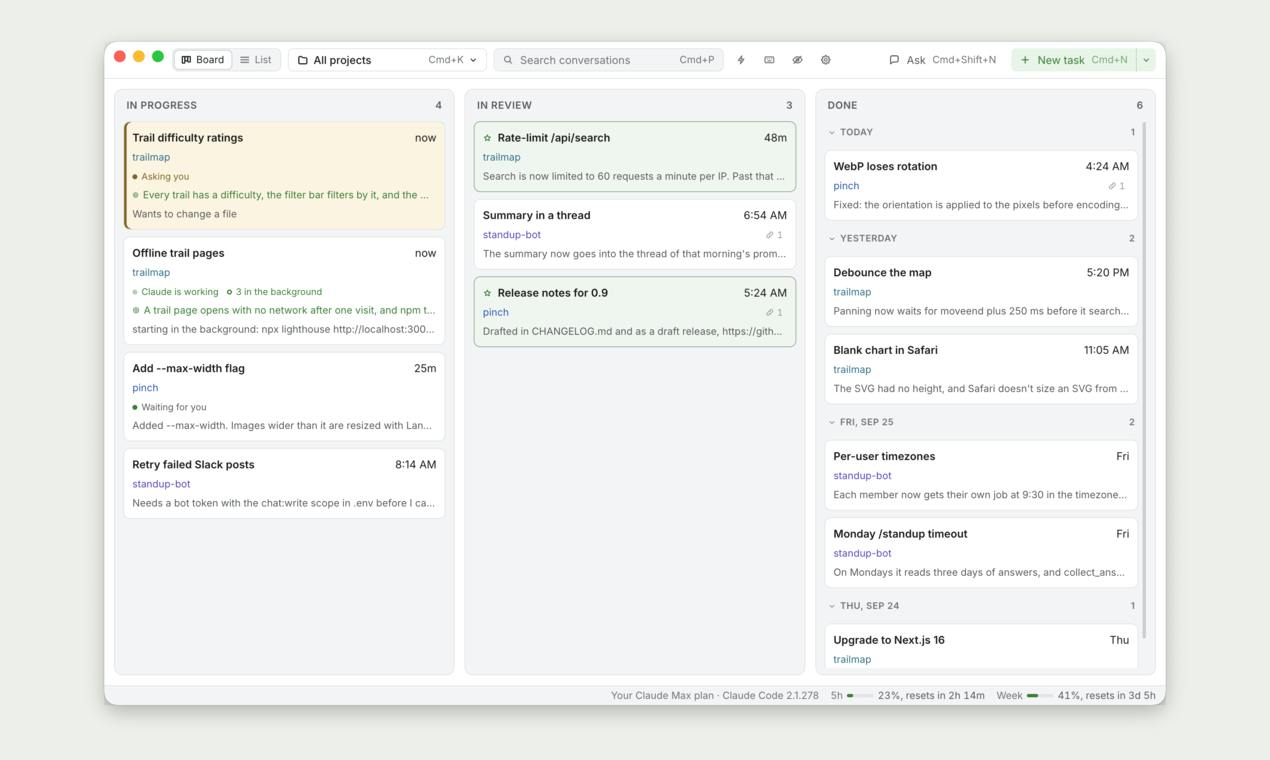
GeckIt is an open-source desktop tool designed for developers running multiple Claude Code sessions simultaneously. It maps each session to a Kanban card displayed across three columns — working, waiting for you, and done — consolidating parallel tasks scattered across terminal tabs into a single unified view. Its standout design decision: it drives the user's local Claude Code process directly, running on an existing Claude subscription with no Anthropic API key required, avoiding the extra API costs that come with parallel sessions. Free, open-source, and available on Mac, Windows, and Linux, it's ideal for heavy Claude Code users who habitually juggle multiple coding tasks at once.
When you have several Claude Code conversation windows open at once, it's easy to lose track — which one is still running a task, which is waiting for your input, and which has finished? The open-source tool GeckIt aims to solve this chaos with a Kanban board. It treats each Claude Code session as a card, displayed in columns by status, giving you a clear at-a-glance view of all your parallel development contexts.
What Problem Does It Solve
As AI coding assistants become more deeply embedded in daily development, more and more developers are no longer satisfied with single-threaded conversations. A typical scenario: one session is refactoring a backend module, another is writing unit tests, and a third is debugging a CI error. When multiple Claude Code instances run simultaneously, terminal windows and tabs pile up, making it hard to quickly assess the progress of each task.
This is where GeckIt's core value lies. It borrows the proven Kanban paradigm from project management and aggregates scattered sessions into a single unified view. According to its official description, the board distinguishes three states: working, waits for you, and done. This column-based status layout essentially externalizes the high-frequency cognitive burden of "is the AI working or waiting for me" into the interface itself.
No API Key Required — Runs on Your Own Subscription
One notable design choice: GeckIt runs your local Claude Code installation, leveraging your existing Claude subscription rather than requiring a separate API key.
This distinction has real practical significance. Many third-party AI tools ask users to enter an Anthropic API key, which involves additional billing (API calls are pay-per-use) as well as key management and security concerns. GeckIt directly reuses your existing Claude Code environment, meaning subscribers incur no extra API costs for running multiple sessions and skip the key configuration step entirely. For developers already using Claude Code, the barrier to entry is as low as it gets.
Claude Code itself is Anthropic's command-line coding assistant, built into the terminal environment, capable of writing, refactoring, and debugging code through natural language instructions. It supports two primary access modes: via Claude's Pro/Max subscription plans (included in the monthly fee), or via the Anthropic API (billed per token). The functionality is similar, but the billing logic is very different — subscription users can run multiple instances within their usage limits at no extra cost, while API users pay for every call, with parallel sessions multiplying expenses. GeckIt drives the locally installed Claude Code process directly rather than proxying API requests, exploiting exactly this difference — letting subscription users gain multi-session management without increasing their costs.
Open Source and Cross-Platform
GeckIt is released as a free, open-source tool with support for Mac, Windows, and Linux. The open-source nature is especially important for developer tools — users can inspect how it interacts with local Claude Code and how it manages session data, which is a significant plus in privacy-sensitive coding environments.
Based on Product Hunt information, it was built by independent developer Aleksandr Netrebskii, earning 69 upvotes and ranking 18th on launch day, categorized under task management, open source, and developer tools. This is a classic "small tool that solves a specific pain point" positioning — modest in scope, but precise in its target.
Does the Kanban Paradigm Make Sense for AI Sessions?
Applying Kanban to AI session management is an interesting product concept. Traditional Kanban manages the lifecycle of tasks, and AI sessions happen to have a clear state flow as well: issue a command → AI executes → confirmation needed → complete. The two are structurally well-matched.
That said, the long-term value of tools like this still depends on several factors. First is the accuracy of state detection — whether it can reliably determine if a session is "waiting for you" versus "stuck" directly determines the board's usefulness. Second is scalability: as session counts grow further, will richer grouping, search, and history browsing capabilities be needed? Third is keeping pace with Claude Code's own evolution — if Anthropic adds similar multi-session management features natively, third-party tools like this would face pressure.
Kanban originated in the Toyota Production System and was later widely adopted in software development, with tools like Trello and Jira bringing it into the mainstream. Its core logic is using "columns" to represent work states and "cards" to represent work units, exposing bottlenecks through visual flow. In traditional software project management, moving cards between columns typically requires manual dragging. In GeckIt's scenario, however, state transitions can be partially triggered by the AI session's own behavior — for example, Claude Code automatically switching to a "waiting" state after completing a round of output. This means the board is no longer just a manually maintained static snapshot; it has the potential to become a dynamic dashboard reflecting the AI's work rhythm in real time — a new characteristic that emerges from transplanting the Kanban paradigm into the AI tools context.
Who Is It For
GeckIt's most direct audience is developers who use Claude Code heavily and are accustomed to pushing multiple coding tasks forward in parallel. If you typically only have one conversation window open, its value is relatively limited. But as soon as you're regularly switching between three or four sessions, a board that presents their status in one place can significantly reduce the cost of context switching.
For users looking to improve their AI coding workflow without increasing API spending, combined with the free, open-source, cross-platform nature of the tool, GeckIt is at least worth trying.
Related articles

Chain of Thought Isn't Just for AI: How Humans Can Use CoT to Improve Thinking Quality
Chain of Thought isn't just a prompt trick for large models. Starting from a Hacker News discussion, this article analyzes why CoT works for human thinking too, breaks down actionable ways to transfer it, and highlights the key differences between human CoT and machine CoT.
Cloudflare Teams Up with OpenAI: Closi…
Cloudflare Teams Up with OpenAI: Closing the Loop from Vulnerability Discovery to Defense with AI
Cloudflare uses OpenAI Daybreak to investigate security vulnerabilities and generate reviewable remediation plans, while developers use Codex to boost coding efficiency and quality.

Orca Multi-Agent Orchestration in Practice: A Guide to Parallel Collaboration with Claude and Codex
Orca is Stable AI's free open-source agent workbench supporting 34 agents like Claude Code and Codex in parallel. Learn its Git worktree isolation, multi-model orchestration, and mobile management.