Gemini 3.1 Pro vs Opus 4.6: A Hands-On Comparison of Front-End Programming Capabilities

Gemini 3.1 Pro and Opus 4.6 tie in a coding showdown, each excelling in different areas.
A tech blogger conducted comprehensive front-end programming tests between Google's Gemini 3.1 Pro and Anthropic's Opus 4.6. Results show Gemini excels in SVG generation, 3D animation, and other visual assets, with deeper Python algorithm knowledge. Opus clearly dominates in game development, complex animation choreography, and tasks requiring long-range logical planning, while also offering superior conversational coding and tool-calling capabilities. The final result was a tie, suggesting developers should choose based on their specific use case.
Test Overview
When two top-tier AI coding models go head-to-head, who reigns supreme in front-end development? A tech blogger spent two days conducting a comprehensive programming capability test between Google's Gemini 3.1 Pro and Anthropic's Opus 4.6, covering dimensions including SVG generation, 3D animation, game development, and data visualization. The final result was surprising — a tie, but each model demonstrated distinctly different areas of strength.
This article breaks down the key rounds of this showdown in detail, helping developers understand the real-world performance and ideal use cases for each model.
SVG and 3D Poké Ball: Gemini's Visual Generation Advantage
SVG (Scalable Vector Graphics) is an XML-based 2D graphics format standardized by W3C. Unlike raster images, SVG describes graphics through mathematical formulas, allowing lossless scaling to any size. The core challenge for AI models generating SVG lies in precisely converting visual intent into coordinate systems, path commands (such as control point parameters for cubic Bézier curves), transformation matrices, and other low-level numerical values. This places extremely high demands on a model's spatial reasoning and geometric computation capabilities — which is why the same "Poké Ball" prompt produces visibly different proportions from the two models.
The test started with a classic task — generating an SVG image of a Pokémon Poké Ball. Opus produced an accurate Poké Ball representation, complete with circular details representing reflections. However, Gemini 3.1 Pro achieved better color accuracy and proportion control, with the center circle's ratio relative to the overall ball being more precise.
When the task escalated to a 3D rotatable Poké Ball, the gap widened further. Opus showed line issues in the white half during its first iteration, with the center circle moving independently. After three iterations there was improvement, but Gemini, also after three iterations, produced a 3D Poké Ball closer to the original — with a precise center button and smooth, natural opening animation.
This reveals a key difference: Gemini has a clear advantage in asset generation (SVG, sprites, animations).
3D Animation and Flight Simulator: Each Model Has Its Strengths
In creating a "Fastest Things Ranking" 3D animated video, Opus produced decent building animations after 6 iterations, but spacecraft details lacked refinement. Gemini, after 11 iterations, rendered aircraft in three dimensions with clarity, buildings conveyed an excellent sense of speed, and overall visual quality was higher.
In the flight simulator test, Opus created a smooth simulator on the first iteration, featuring wind trails, sun glare effects, and 360-degree rotation support. Gemini's version was equally impressive, with propeller-equipped aircraft and reverse capability. Both performed comparably, though the tester gave Gemini a slight edge.
It's worth noting that 3D animation in browsers typically relies on CSS 3D transforms or WebGL. The CSS approach has a lower barrier to entry but limited expressiveness, while WebGL (a browser graphics API based on OpenGL ES) can achieve near-native rendering quality but with exponentially greater code complexity. Gemini's advantage in visual quality may partly stem from its tendency to generate more low-level, efficient rendering code.
Game Development Capabilities: Opus's Absolute Domain
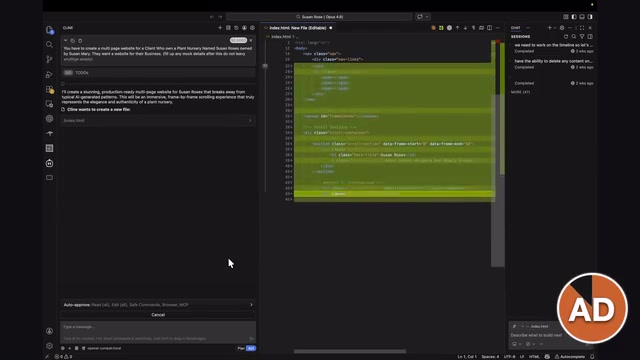
Game development was the most polarizing area in this AI coding showdown. The uniqueness of game logic demands highly consistent state management in code — collision detection, physics simulation, AI behavior, audio synchronization, and other systems must work in coordination. Any logical error in a single module can cause the entire experience to collapse. These tasks place extremely high demands on a model's long-range code planning and cross-module logical reasoning capabilities.
Super Mario Clone
After three iterations, Opus achieved accurate sound effects, the Mario power-up growth mechanic, and nearly replicated the original game experience. Gemini's performance was shocking — blocks and squares everywhere, no music, no power-ups. After three iterations, the music was inaccurate and gameplay was broken.
Hill Climb Racing
After six iterations, Opus had a car that could properly drive and flip over rough terrain. Gemini's version moved like a frog and still couldn't function properly after six iterations.
Pac-Man
Opus achieved working game mechanics after two iterations — ghost tracking and sound effects were all in place. After giving Gemini three chances, Pac-Man couldn't even move.
The conclusion is clear: when it comes to complex game logic and long code generation, Opus 4.6's programming capability is significantly stronger.
Rocket Launch Animation: Opus's Engineering Implementation Skills
Opus demonstrated powerful engineering implementation capabilities in the rocket launch task. After 4 iterations, the final version included a high-quality rocket and launch pad, countdown sequence, liftoff process, camera angle transitions, and a complete Falcon landing animation, with sound effects delivering a powerful sense of force.
Gemini encountered severe problems — the rocket wrapped in flames, diving headfirst into the platform, and other frequent bugs. After 3 iterations, the rocket disappeared leaving only boosters, with the final result far inferior to Opus.
Behind this gap lies a noteworthy engineering detail: rocket launch animation involves precise choreography across multiple timelines (countdown → ignition → liftoff → camera switch → landing), requiring the model to have a clear global plan for the entire animation state machine. Opus can maintain this cross-phase logical consistency, while Gemini's state management in long-sequence tasks is noticeably more fragile.

Trading Dashboard: A Battle of Feature Completeness
The trading dashboard test required implementing professional features including real-time charts, order placement, and Fibonacci level drawing. Fibonacci retracement levels are a core tool in technical analysis, using the golden ratios from the Fibonacci sequence (0.236, 0.382, 0.5, 0.618, 0.786) to draw horizontal support/resistance lines on price charts. Traders use them to predict potential reversal zones during price pullbacks. At the code implementation level, this requires precise price range calculations, dynamic overlay rendering, and synchronization with real-time data streams — making it one of the more technically complex features in financial visualization.
After 2 iterations, Opus achieved: realistic chart appearance, all chart type toggles, zoom functionality, channel drawing, Fibonacci levels, Bollinger Bands indicators, and real-time updating P&L display.
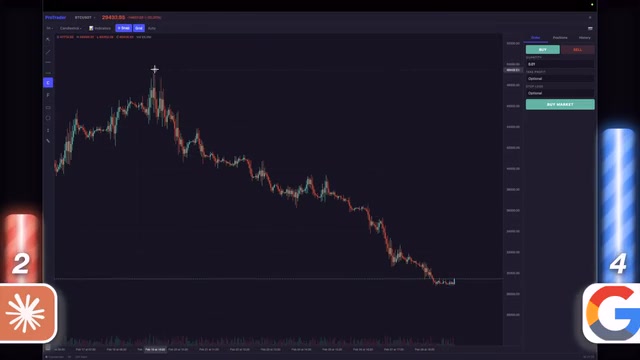
Gemini, also after 2 iterations, added more timeframes and drawing tools, but the real-time P&L lacked numerical updates, and overall feature richness fell short of Opus.
Python Programming Test: Gemini's Algorithm Advantage
In the image compression task, the two AI coding models demonstrated different problem-solving approaches.
After 8 iterations, Opus compressed a 9.9MB image to 1.2MB, showcasing excellent conversational coding ability throughout — proactively suggesting writing test code to diagnose issues rather than blindly rewriting.
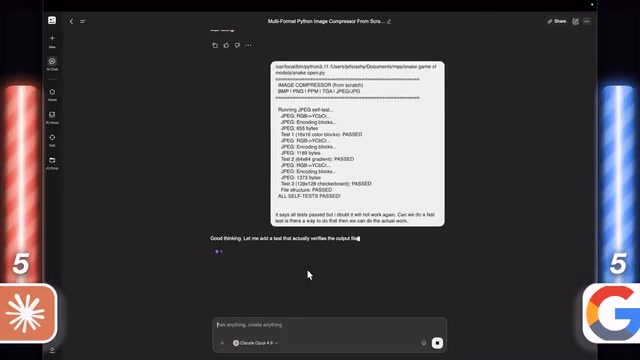
Gemini initially performed lazily, claiming the image was already optimized. But when challenged, it deployed "chroma subsampling" — a powerful low-level technique. Chroma Subsampling exploits the physiological property that human eyes are more sensitive to luminance changes than color changes, reducing the sampling rate of color information in images. Common formats include 4:4:4 (no compression), 4:2:2, and 4:2:0 — JPEG defaults to 4:2:0, which can significantly reduce file size with minimal visual quality loss. Gemini's ability to independently identify and apply this technique ultimately achieved 92% quality reduction, with compression results nearly 50% better than Opus — demonstrating deeper knowledge in image processing algorithms and stronger technical decision-making ability.
However, the tester noted that Gemini has an unpleasant habit — frequently using overly flattering expressions like "you've identified the exact cause" and "you've pointed out the most important thing." This "people-pleasing" output style is known in the industry as "model sycophancy," a recognized problem in current large language model alignment training that may cause models to cater to users rather than provide objective, accurate feedback.
Core Conclusions: Choose Your AI Coding Tool Based on Use Case
The final score was a tie, but the two models have distinctly different capability profiles:
Opus 4.6's Core Strengths
- Conversational coding: Solves problems through collaboration, proactively suggesting testing strategies
- Tool-calling ability: Proactively uses web search and other tools when necessary
- Agentic coding: Better suited for complex automated workflows. Agentic Coding is an advanced form of AI-assisted programming where the model not only generates code but autonomously plans task steps, calls external tools, iteratively corrects based on execution feedback, forming a complete "perceive-decide-act" loop
Related articles
 Product Reviews
The Programmer's Desk Setup Guide: Building a Workspace That Feels Like Home
Discover how programmers build productive, comfortable workspaces. From multi-monitor setups to ergonomic design, explore the desk philosophy that drives focus and flow.
 Product Reviews
Qoder vs Cursor Real-World Comparison: Which $20/Month AI IDE Is Better?
Hands-on comparison of Qoder vs Cursor AI IDEs: Agent autonomy, human interaction count, and architecture decisions. Qoder needed only 2 interactions vs Cursor's 8.
 Product Reviews
Cursor Cloud Agent Demo: Eliminating Bottlenecks Across the Entire Software Development Lifecycle
Deep analysis of Cursor's Cloud Agent demo showing how cloud VMs, automated test artifacts, and a full-chain control plane systematically eliminate human bottlenecks across the software development lifecycle.