Gemini 3.5 Flash Cyber: Google's AI Security Model Built for Vulnerability Detection and Remediation

Google launches Gemini 3.5 Flash Cyber, a lightweight AI model purpose-built for automated vulnerability detection and patching.
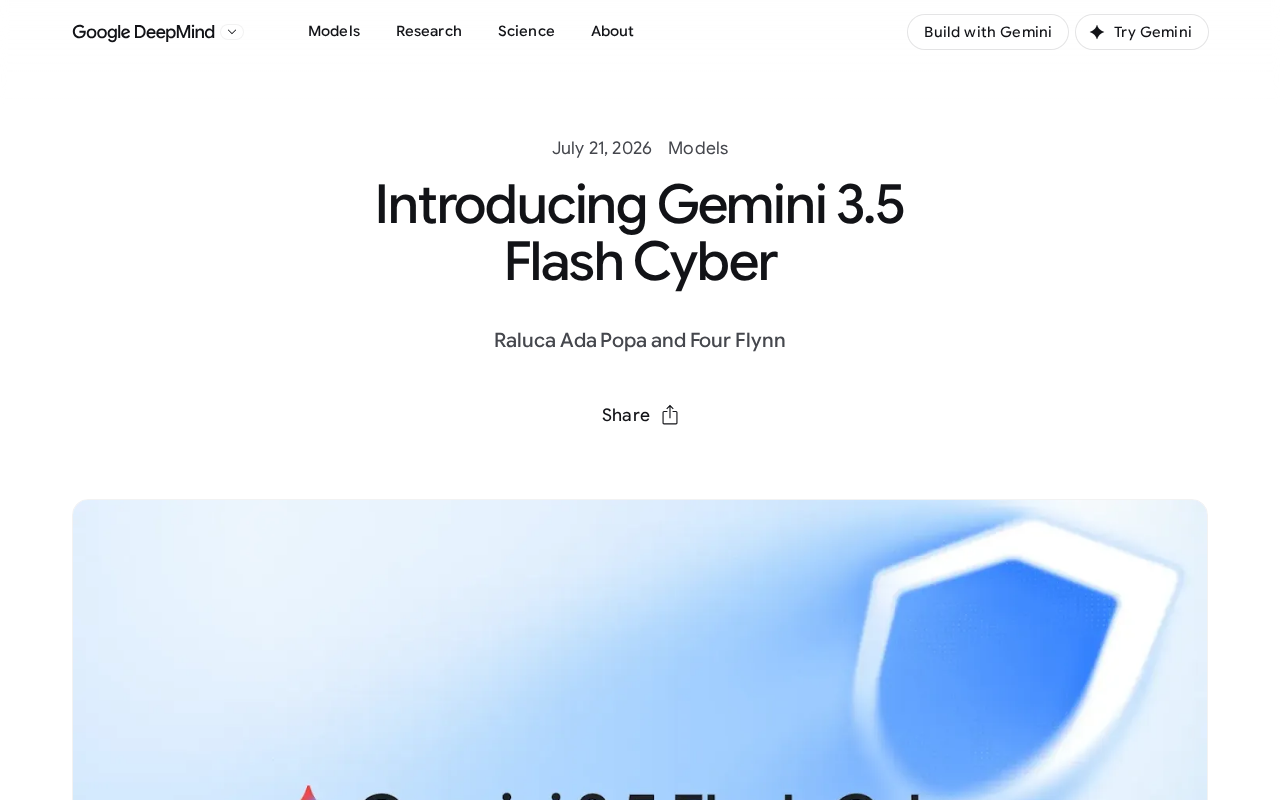
Google has released Gemini 3.5 Flash Cyber, a specialized lightweight AI model designed specifically for cybersecurity. Unlike general-purpose flagship models, it focuses on automatically discovering and patching software vulnerabilities, creating a complete detection-to-remediation closed loop. The model leverages the Flash series' low-latency, high-efficiency architecture to enable continuous, cost-effective security scanning at enterprise scale.
Google Doubles Down on AI Cybersecurity: Gemini 3.5 Flash Cyber Officially Released
Google has officially released Gemini 3.5 Flash Cyber, a lightweight AI model purpose-built for cybersecurity scenarios. Unlike flagship models that pursue general-purpose capabilities, this new model has a singular, well-defined focus: automatically discovering and patching software vulnerabilities.
This release marks a new phase in AI's application to cybersecurity — a shift from "assisted analysis" to "active defense." As software supply chains grow increasingly complex and attack surfaces continue to expand, traditional manual vulnerability auditing can no longer keep pace with the speed of threat evolution. Modern software development relies heavily on open-source components and third-party libraries; a typical enterprise application may include hundreds of direct dependencies and thousands of transitive dependencies. The 2020 SolarWinds incident and the 2021 Log4Shell vulnerability starkly revealed the destructive power of supply chain attacks — a single vulnerability buried deep in the dependency chain can affect tens of thousands of systems worldwide. Traditional manual auditing simply cannot cover such vast code dependency graphs, and this is precisely where automated AI scanning tools deliver their core value. Google's decision to address this pain point with a dedicated lightweight model reflects the industry's strong demand for "AI-native security tools."
Why a Lightweight Model for Security
At a time when the arms race for ever-larger models is intensifying, Google has taken a contrarian approach by releasing a Flash-tier lightweight model — and there's clear product logic behind this decision.
Speed and Cost: Critical Considerations
Cybersecurity scenarios demand extremely high real-time responsiveness. Vulnerability scanning, code auditing, and threat detection often require rapid, iterative execution across massive codebases and logs. If every invocation relied on a massive flagship model, the latency and cost would be unsustainable for large-scale, high-frequency security operations.
The Flash series was designed by Google specifically for high-throughput, low-latency scenarios. Within Google's Gemini product family, the Flash series is positioned as an "efficiency-first" inference engine — unlike Pro or Ultra flagship models that pursue maximum parameter scale and reasoning capability, the Flash series employs techniques such as Knowledge Distillation and sparse attention mechanisms to dramatically compress model size while retaining core capabilities. This design reduces inference latency to a fraction of that of flagship models, with significantly lower per-call costs. Applying this to security enables enterprises to conduct continuous vulnerability scanning across entire code repositories at much lower cost, rather than one-time spot checks.
The Advantage of Specialized Models in Vulnerability Detection
While general-purpose large models are broadly capable, they often suffer from a "jack of all trades, master of none" problem in specific verticals. By training and optimizing specifically on cybersecurity data, Flash Cyber is expected to outperform general-purpose models in vulnerability identification accuracy and false positive rates — which is critical for security teams, as excessive false positives quickly erode team trust and drain energy.
A Complete Closed Loop from Discovery to Automated Patching
The most noteworthy aspect of this release is Google's emphasis that the model can not only find vulnerabilities but also patch them.
Traditional Static Application Security Testing (SAST) tools mostly stop at "reporting problems," leaving remediation to human effort. SAST tools analyze source code, bytecode, or binary files to discover security vulnerabilities without running the program, with representative products including Fortify, Checkmarx, and SonarQube. The core limitation of these tools is that they rely on predefined rule-based pattern matching, making it difficult to understand the semantic logic and contextual relationships of code. As a result, they generate numerous false positives while also missing security issues in complex logic. More critically, they only "report problems" without providing remediation solutions.
If an AI model can directly generate repair patches, it could dramatically shorten the window between vulnerability discovery and remediation — a period that often represents the attacker's window of opportunity. This Vulnerability Window, according to industry statistics, shows that the average Mean Time To Remediate (MTTR) for a known vulnerability typically ranges from 60 to 90 days, while the time from public disclosure of a critical vulnerability to mass exploitation can be as short as hours to days. This enormous time gap is precisely the attacker's opportunity, and the fundamental reason why automated patching capability holds tremendous value.
This integrated "detection-remediation" capability is essentially building an automated security defense closed loop. For security teams stretched thin on resources, AI-assisted generation of candidate patches for human review can significantly improve response efficiency. Of course, the reliability of automated code fixes — and whether they might introduce new issues — will still need to be proven in practice.
Industry Trends and Competitive Landscape
The launch of Gemini 3.5 Flash Cyber is a microcosm of the broader AI + security trend.
AI Becomes a Core Weapon for Both Attackers and Defenders
You might not have noticed, but AI is a double-edged sword. Attackers are also leveraging large models to automate malicious code generation and vulnerability discovery. On the offensive side, large language models have been proven capable of automating phishing email generation, polymorphic malware creation, fuzzing scripts, and even direct discovery of zero-day vulnerabilities. Researchers have demonstrated that GPT-4-level models can autonomously write exploit code given a CVE description. This means the barrier to attack has been dramatically lowered, and the scale and speed of attacks are increasing rapidly. If defenders continue to rely on traditional tools and manual analysis, they face a serious "speed asymmetry" dilemma — attackers can use AI to discover and exploit vulnerabilities in minutes, while defenders may need days or even weeks to respond.
This creates an AI vs. AI arms race. Google's release of a dedicated security model aims to help defenders keep pace in this race.
Tech Giants Racing to Stake Claims in the AI Security Track
Beyond Google, Microsoft, OpenAI, and other vendors are also integrating AI capabilities into their respective security products. By packaging security capabilities as an independent, callable model, Google signals its intent to serve not just its own products but to integrate into broader development and operations workflows through APIs and other interfaces.
Real-World Challenges Facing AI Security Tools
Despite the promising outlook, these AI security tools still face some challenges that cannot be ignored:
- Trustworthiness: Can AI-generated patches be trusted by security teams? Incorrect or incomplete fixes could introduce even greater risks.
- Data Privacy and Compliance: Submitting sensitive enterprise code to cloud-based models for analysis involves data protection regulations (such as GDPR, China's Data Security Law, etc.) and security concerns. Enterprises need to balance the convenience of AI analysis against the confidentiality of code assets, which is why private deployment and local inference capabilities are essential requirements for many organizations.
- Adversarial Robustness: Could the model itself be "fooled" or bypassed by malicious samples, creating security blind spots? Adversarial Robustness refers to an AI model's ability to resist malicious input interference. Attackers may craft adversarial samples to deceive AI security tools — for example, inserting specific obfuscation patterns into malicious code to make the AI model misclassify it as safe (evasion attacks), or deliberately triggering massive false positives to exhaust the security team's attention (poisoning attacks). If attackers can infer the security model's training data distribution or decision boundaries, they could also systematically bypass detection through model reverse engineering. Therefore, the security of AI security tools themselves constitutes a meta-problem that needs to be solved.
Conclusion: AI Security Tools Moving Toward Specialization and Closed-Loop Operations
Gemini 3.5 Flash Cyber represents a clear direction for AI in cybersecurity: specialization, lightweight design, and closed-loop operations. It doesn't pursue extreme parameter scale but instead focuses on the specific, high-value scenario of vulnerability discovery and remediation.
For developers and security professionals, the maturation of such tools means that routine security work will increasingly be handled by AI for foundational tasks, freeing human experts to invest their energy in more complex threat analysis and decision-making. As more technical details are disclosed, its real-world performance deserves continued attention.
Key Takeaways
Related articles

DeepCell: One-Click AI Generation of Documents, Spreadsheets, and Slides
DeepCell tops Product Hunt with one-click generation of documents, spreadsheets, and slides, using the .deepcell format for linked updates, designed for System 2 tasks like modeling and sales reviews.

Doneas: 15-Minute Daily Accountability Calls That Keep Indie Developers From Procrastinating
Doneas is a daily accountability tool for indie developers: plan tasks on Monday, join a 15-minute call with five builders each day, and log deliveries on a public progress page. This article analyzes its core mechanics, effectiveness, and potential issues around retention and matching.

Fastlane 2.0: Fully Automated AI Ad Campaigns, From Creative to Optimization
Fastlane 2.0 is an AI ad automation tool: enter your website and it learns your brand, generates video and image ads, and runs and optimizes them on Meta, TikTok, Instagram, and YouTube.