Gemini 3.5 Flash Deep Dive: Google's AI Agent Execution Engine

Google launches Gemini 3.5 Flash, redefining frontier model standards with extreme speed and Agent capabilities.
At Google I/O, Google launched Gemini 3.5 Flash, positioned as the execution engine for the AI Agent era. The model surpasses the previous-generation flagship Pro on coding and Agent benchmarks, runs 4x faster than competitors, and achieves up to 12x speedup when optimized through the Antigravity project. Its core capabilities include sub-Agent collaboration, high-frequency iterative loops, and support for deployment at scale, marking Google's shift from pursuing model parameter size to pursuing comprehensive real-world application effectiveness.
At this year's Google I/O conference, Google officially launched the Gemini 3.5 series of models. The first member, Gemini 3.5 Flash, redefines what a "frontier model" should be capable of, thanks to its outstanding coding ability, efficient Agent workflow execution, and remarkable inference speed.
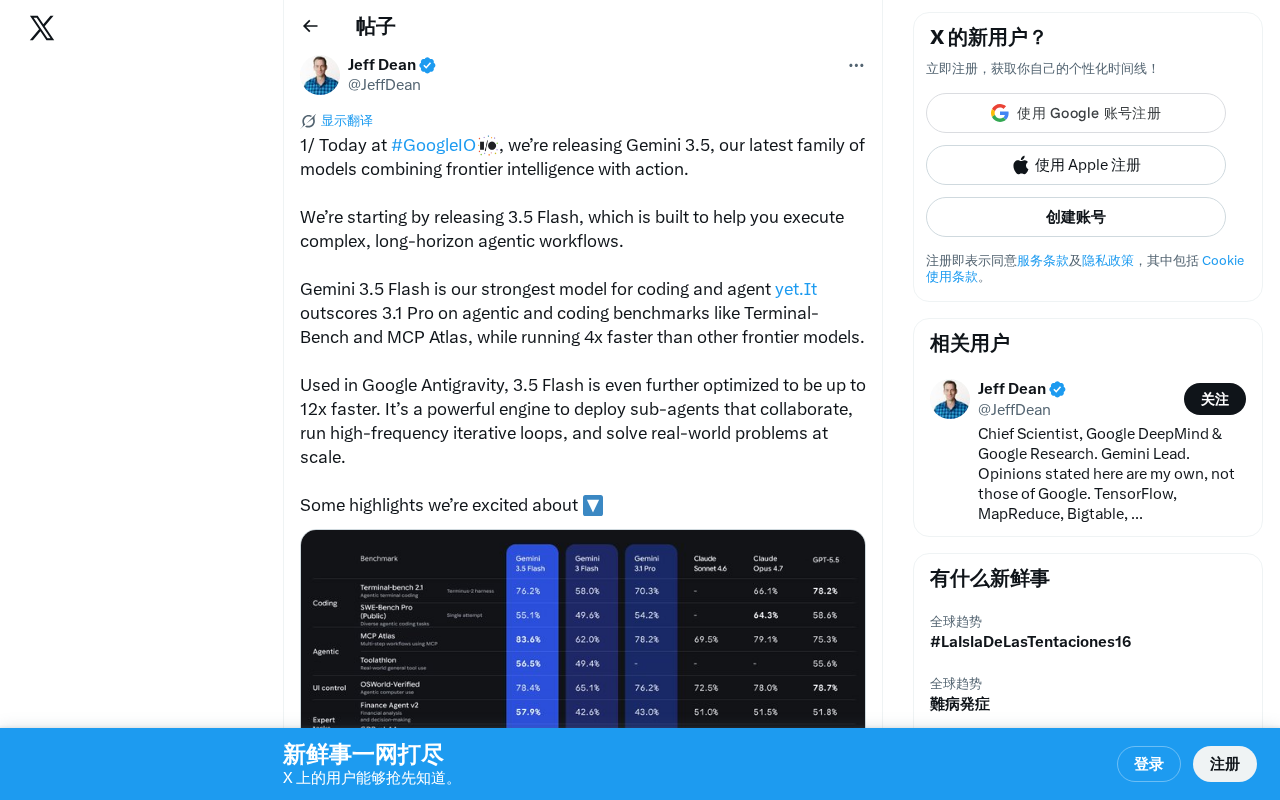
Gemini 3.5 Flash: A Frontier Model Built for Agents
The core positioning of the Gemini 3.5 series is crystal clear — combining frontier intelligence with the ability to take action. Google's decision to release 3.5 Flash first rather than the larger-parameter Pro version sends a key signal in itself: in the AI Agent era, speed and execution matter more than raw intellectual ceiling.
What is an AI Agent? An AI Agent is an AI system capable of autonomously perceiving its environment, formulating plans, and executing actions to achieve goals. Unlike traditional single-turn Q&A-style LLM calls, Agent workflows typically involve multiple "think-act-observe" loops and can invoke external tools (such as code executors, search engines, and databases). Multi-Agent frameworks take this further by decomposing complex tasks across multiple specialized Agents working in coordination — similar to the microservices architecture concept in software engineering — where each Agent focuses on its area of expertise, and the overall system's capability far exceeds that of any single model.
According to Google's officially published benchmark data, Gemini 3.5 Flash delivers impressive results:
- Surpasses its own flagship: On Agent and coding benchmarks like Terminal-Bench and MCP Atlas, 3.5 Flash scores higher than the previous-generation Gemini 3.1 Pro
- Crushes competitors on speed: Runs 4x faster than other frontier models
- Extreme optimization: After further optimization in Google's Antigravity project, speed improvements reach up to 12x
Benchmark Context: Terminal-Bench is a benchmark specifically designed to evaluate AI models' ability to execute complex tasks in command-line environments, covering real engineering scenarios like file operations, script writing, and system debugging. MCP Atlas is based on Anthropic's Model Context Protocol and measures a model's Agent execution capability under standardized tool-calling protocols. Compared to traditional academic tests like MMLU and HumanEval, these two benchmarks more closely mirror the actual workloads of Agents in production environments, which is why the industry considers them more effective indicators of "usability" rather than "intelligence."
This data shows that Google is breaking away from the traditional "bigger = better" model paradigm, instead pursuing comprehensive effectiveness in real-world application scenarios.
From Model to Engine: Three Core Capabilities for Agent Architecture
3.5 Flash's design goal isn't just to be a faster language model — it's meant to serve as the execution engine for complex Agent workflows. Google highlighted breakthroughs across three dimensions:
Sub-Agent Collaboration
3.5 Flash supports deploying multiple sub-agents and enabling them to work together. A complex task can be decomposed into multiple parallel or sequential subtasks, each handled by a specialized Agent, with results converging into a complete solution.
This aligns closely with the multi-Agent framework approaches popular across the industry — whether it's Microsoft's AutoGen, LangChain's LangGraph, or OpenAI's Swarm framework, all are exploring how to enable multiple AI roles to divide labor and collaborate. But Google has built this collaborative capability directly into the model layer, reducing integration costs for developers and eliminating the need to build complex orchestration middleware.
High-Frequency Iterative Loops
In traditional LLM applications, each call is relatively independent. But 3.5 Flash supports high-frequency iterative loops, where the model can rapidly execute complete "think → act → observe → adjust" cycles in extremely short timeframes.
This capability is particularly critical for scenarios requiring repeated trial and error, such as code debugging, data analysis, and automated testing. A coding Agent might need dozens of debugging iterations to fix a single bug, and high-frequency iteration capability directly determines task completion efficiency. Taking real software engineering benchmarks like SWE-Bench as an example, top models typically require an average of 30-50 tool calls to complete a single issue fix — differences in inference speed are linearly amplified here.
Realistic Foundation for Deployment at Scale
The 4x or even 12x speed improvement isn't just a number on paper. When an Agent needs to execute hundreds of tool calls to complete a complex task, milliseconds saved on each call accumulate into massive efficiency gains. This speed advantage directly determines whether Agents can run at scale and at low cost in production environments.
Google Antigravity: The Engineering Optimization Behind 12x Speed Improvement
Google revealed that 3.5 Flash has been applied and deeply optimized within its internal Antigravity project. While publicly available information is currently limited, based on the description, Antigravity is likely Google's large-scale internal Agent platform, used to validate and optimize model performance in real-world complex scenarios.
The fact that a 12x speed improvement was achieved within Antigravity demonstrates that Google's optimizations go beyond the model itself, encompassing deep engineering improvements at the system level — including inference infrastructure, Agent scheduling strategies, and context management.
This "model + system" approach represents a comprehensive optimization philosophy.
Related articles
Deep Dive into AI Agent Skill Design: …
Deep Dive into AI Agent Skill Design: Engineering Practices from Anthropic and Perplexity
A deep dive into Skill design philosophy from Anthropic's Claude Code team and Perplexity's Agent team, covering the Tax Test, Gotchas Flywheel, progressive disclosure, and Eval-First practices for building high-quality AI Agent skill systems.
Deep Dive into OpenAI's Official GPT-5…
Deep Dive into OpenAI's Official GPT-5.6 Prompting Guide: The Shift from Manual to Automatic
A deep dive into OpenAI's official GPT-5.6 Sol prompting guide: conciseness-first, outcome-oriented design, autonomy boundaries, tool routing, and reasoning intensity tuning.
 Deep Dives
Deep Dive into How OpenClaw (Open-Source Crayfish) AI Agent Works
Deep analysis of OpenClaw AI Agent internals: System Prompt, tool calling, SubAgents, Skill system, memory, and Context Engineering explained.