Gemini 3.5 Flash vs Qwen3.6 Real-World Test: How Far Are Benchmark Scores from Actual Experience?

Gemini 3.5 Flash's real-world performance shows a notable gap from its leaderboard scores.
This article provides a comprehensive hands-on evaluation of Google's Gemini 3.5 Flash, comparing it side-by-side with open-source model Qwen3.6-27B. Results show minimal differences on core benchmarks like SWE Bench Pro, while Gemini 3.5 Flash's UI generation — despite achieving the highest leaderboard score (78.4) — only matches DeepSeek V3.2 in practice, falling far short of expectations. The article argues that benchmark scores may be inflated due to benchmark contamination and cannot represent true model capabilities.
Introduction: The Gap Between Benchmark Scores and Real Experience
Google's newly released Gemini 3.5 Flash model has impressive numbers across major leaderboards — coding ability reportedly surpassing Claude Opus 4.7, a UI generation score of 78.4 on par with GPT-5.5, and an 83% score on MCP agent workflows. However, after hands-on testing, we found a thought-provoking question worth exploring: Do leaderboard scores truly represent a model's real-world capabilities?
This article provides a comprehensive hands-on evaluation of Gemini 3.5 Flash across multimodal understanding, Agent capabilities, coding, and UI generation, with a side-by-side comparison against Qwen3.6-27B to help readers form a more objective assessment.
How to Use Gemini 3.5 Flash for Free
For users in China, directly accessing Google's services presents certain challenges. Here's a solution that requires no special network tools — accessing it through the Chatwise client.
The steps are straightforward:
- Obtain a Gemini API Key (you'll need to handle this yourself)
- Configure the API Key in Chatwise
- Select the Gemini 3.5 Flash model and start using it
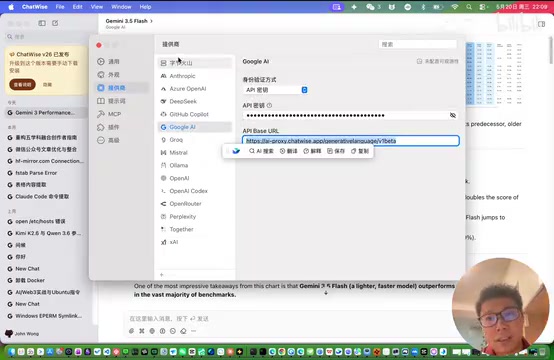
Once configured, you can call the model directly without any additional network setup. It's worth noting that even free accounts enjoy impressive token generation speeds, thanks to Google's powerful TPU computing infrastructure.
TPU Background: Google's TPU (Tensor Processing Unit) is a custom ASIC chip designed specifically for machine learning workloads. Since 2016, it has iterated to its fifth generation (TPU v5). Compared to general-purpose GPUs, TPUs have significant throughput advantages in matrix multiplication operations, with single-chip peak performance reaching hundreds of TFLOPS. Google deploys TPU clusters in its own data centers and offers external access through Cloud TPU services — this is the core hardware reason why Gemini series models generally have faster inference speeds than competitors.
In comparison, Alibaba's Qwen series models (including 3.7 Max and Plus) are noticeably slower in inference speed.
Gemini 3.5 Flash vs Qwen3.6-27B: A Head-to-Head Comparison
Why Choose a 27B Model for Comparison?
Some might question whether comparing Google's model against a 27B parameter model is unfair. In reality, this comparison is quite reasonable for three reasons:
- Gemini 3.5 Flash is positioned as a small model, not a Pro-level large model
- Qwen3.6-27B's actual capabilities are no worse than many distilled large models, offering excellent cost-performance ratio
- Both support multimodal inputs, allowing fair comparison on the same dimensions
The Qwen series is developed by Alibaba's DAMO Academy, and Qwen3.6-27B is a mid-scale version of its third-generation architecture. The 27B parameter count falls in the "sweet spot" of the current open-source ecosystem — offering clear capability advantages over 7B models while remaining deployable on consumer-grade GPUs (such as a single RTX 4090 or dual RTX 3090s). Notably, Knowledge Distillation technology allows the "knowledge" of large models to be transferred to smaller ones, enabling them to approach or even surpass larger base models on specific tasks. This is a key reason why 27B open-source models can compete with closed-source models with tens of billions more parameters.
Key Benchmark Comparison
During testing, images containing score data were sent directly to both models, asking them to extract data and perform comparative analysis — which itself is a test of multimodal understanding capabilities.
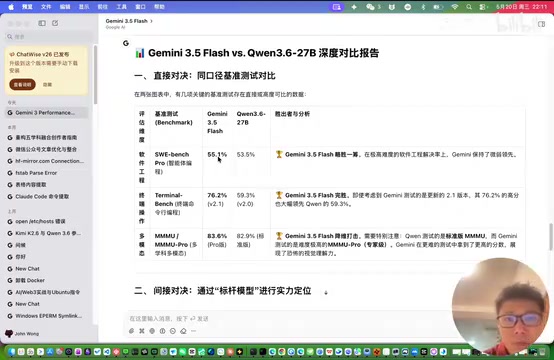
From the comparison results:
- SWE Bench Pro (Software Engineering): Gemini 3.5 Flash leads by less than 2 points — a negligible gap
- MMLU Pro (Comprehensive Knowledge Understanding): Gemini 3.5 Flash has a moderate advantage
- Mid-level Reasoning Tasks: Gemini 3.5 Flash shows more noticeable improvement over the 27B model
Background on these two core benchmarks: SWE-bench (Software Engineering Benchmark) was proposed by a Princeton University research team to evaluate software engineering capabilities by extracting coding tasks from real GitHub Issues. It tests models' code repair and engineering skills. The Pro version introduces more complex multi-file modification scenarios, making it difficult to game through targeted tuning since tasks come from real development scenarios. MMLU Pro expands the original 57-subject four-choice format to ten-choice and introduces more questions requiring reasoning rather than pure memorization, effectively reducing the probability of models scoring high through guessing.
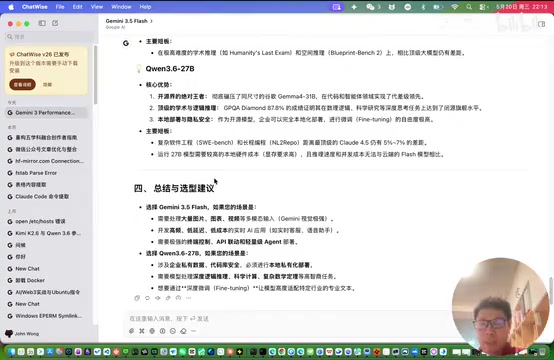
Overall, Qwen3.6-27B, as an open-source model, can go head-to-head with Google's closed-source model. While it falls slightly behind, the gap is minimal. This is a very positive signal for the open-source community.
Agent Capability Evaluation
In MCP agent workflow evaluation, Gemini 3.5 Flash scored 83%, outperforming Claude Opus 4.7.
MCP Protocol Background: MCP (Model Context Protocol) is a standardized protocol proposed and open-sourced by Anthropic in late 2024, designed to address the fragmentation of AI model integration with external tools and data sources. Through a unified client-server architecture, MCP allows models to invoke external resources like file systems, databases, and APIs in a standardized way, significantly reducing the development complexity of Agent applications. Currently, major vendors including Google and OpenAI have announced MCP support, and the protocol is gradually becoming the de facto standard for the AI Agent ecosystem. Therefore, MCP workflow evaluation scores have some reference value for assessing a model's practical Agent deployment capabilities.
However, it's important to note that scores from scenario-specific evaluations shouldn't be over-interpreted, as some benchmarks may be designed with certain model vendors in mind and may not fully reflect performance in real-world usage scenarios.
UI Generation: The Contradiction Between Scores and Experience
Test Design
Since Gemini 3.5 Flash reportedly achieved the highest score in UI generation (78.4), even surpassing Opus 4.7, let's put its strongest claimed area to the test. The test involved having the model generate an introduction page using HTML5.
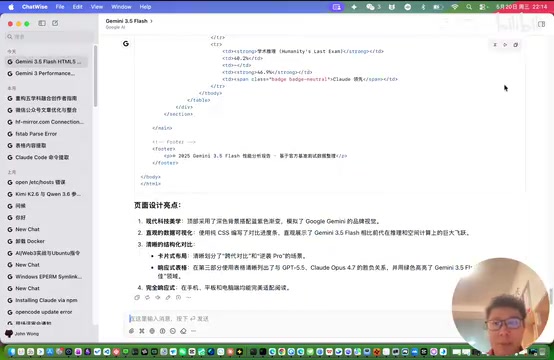
Surprisingly Disappointing Results
Frankly speaking, the generated output severely mismatches the leaderboard scores. Looking at the page output:
- Overall quality is roughly on par with DeepSeekAd V3.2
- It doesn't even match V4's performance
- Previous tests on the web interface produced even worse results
This isn't to say Gemini 3.5 Flash is a bad model, but rather that its demonstrated capability in actual UI generation tasks shows a clear gap from what the leaderboard scores advertise. This phenomenon is likely related to the widely recognized issue of Benchmark Contamination in the industry — where models are exposed to evaluation dataset questions or highly similar content during pre-training or fine-tuning, causing artificially inflated test scores. As open-source evaluation sets become widely circulated, some vendors also engage in targeted optimization for specific leaderboards (i.e., "benchmark gaming").
Related articles
 Product Reviews
The Programmer's Desk Setup Guide: Building a Workspace That Feels Like Home
Discover how programmers build productive, comfortable workspaces. From multi-monitor setups to ergonomic design, explore the desk philosophy that drives focus and flow.
 Product Reviews
Qoder vs Cursor Real-World Comparison: Which $20/Month AI IDE Is Better?
Hands-on comparison of Qoder vs Cursor AI IDEs: Agent autonomy, human interaction count, and architecture decisions. Qoder needed only 2 interactions vs Cursor's 8.
 Product Reviews
Cursor Cloud Agent Demo: Eliminating Bottlenecks Across the Entire Software Development Lifecycle
Deep analysis of Cursor's Cloud Agent demo showing how cloud VMs, automated test artifacts, and a full-chain control plane systematically eliminate human bottlenecks across the software development lifecycle.