Gemini 3.5 Pro Coming Soon? AI Studio Leaks a Key Clue
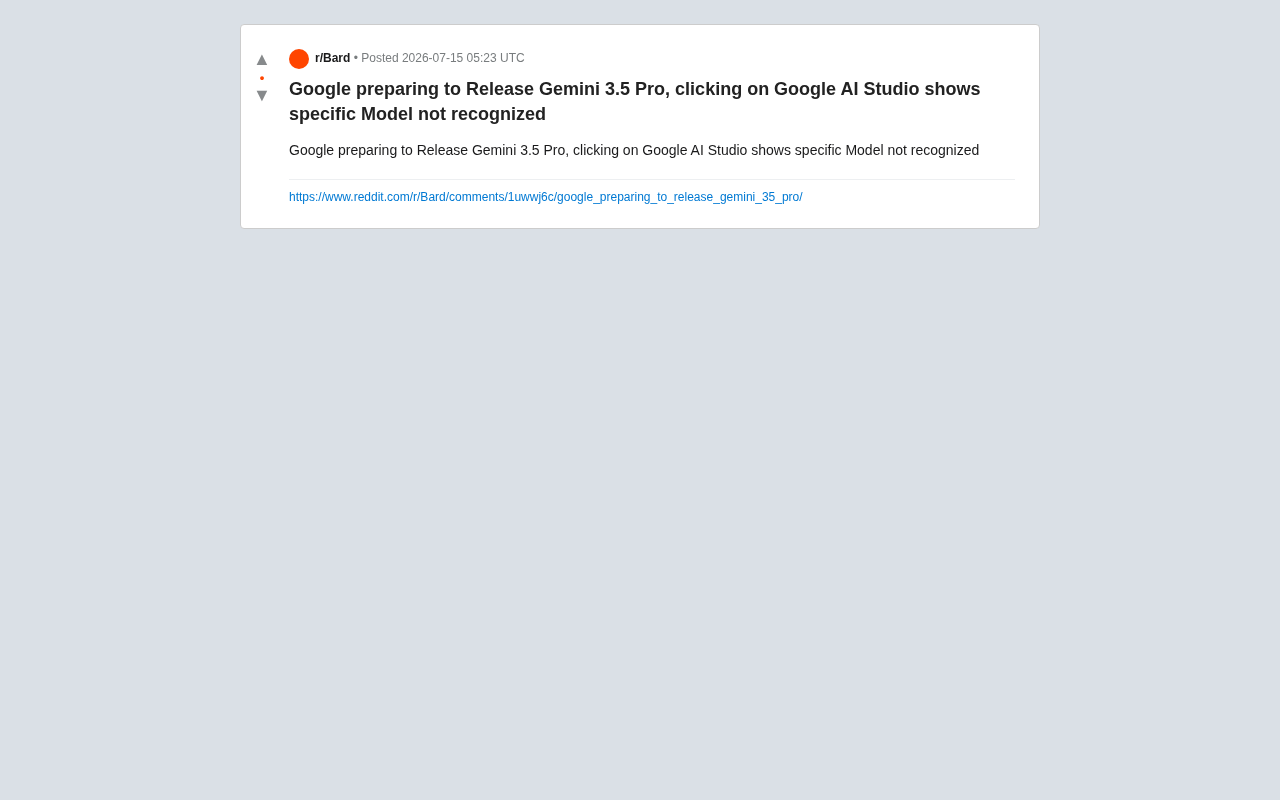
A mysterious model identifier in Google AI Studio hints that Gemini 3.5 Pro may be on the way.
A Reddit user discovered a suspected Gemini 3.5 Pro model identifier in Google AI Studio that returned a 'Model not recognized' error — a pattern often seen just before new model launches. While unconfirmed, the leak aligns with Google's versioning strategy and intensifying competition with OpenAI and Anthropic, with real implications for developers building on the Gemini API.
The Incident: An Unexpected Discovery in AI Studio
Recently, a post from the Reddit community stirred up considerable buzz in the AI world. A user reported noticing an unusual detail while using Google AI Studio: upon attempting to access a specific model identifier, the platform returned a "Model not recognized" error. The community quickly interpreted this as a sign that Google is quietly laying the groundwork for its next-generation flagship model — Gemini 3.5 Pro.
Google has yet to issue any official response, but this pattern of "backend configurations on developer platforms quietly revealing upcoming products" is nothing new in the tech industry. The appearance of a model identifier often signals that the related service has been partially deployed in the backend, waiting only for its public access to be formally unlocked.
Why AI Studio Became the Source of the Leak
The Unique Nature of Developer Platforms
Google AI Studio (formerly Google MakerSuite) is a developer-facing AI experimentation platform officially launched by Google in 2023. It functions essentially as a visual frontend for the Gemini API, directly interfacing with Google's model inference infrastructure on the backend. Developers use it for prompt engineering, multi-turn conversation testing, and side-by-side comparisons of different model variants. Because AI Studio shares the same model routing layer as the production environment, changes to its API endpoints often reflect backend infrastructure updates earlier than official blog posts — which is precisely why it serves as an early warning system for product signals.
In the engineering practice of large AI platforms, a model identifier is the core routing key for API requests. When a user makes an API call, the request first reaches the load balancer, which routes it to the corresponding inference cluster based on the identifier. From an engineering perspective, a "not recognized" error could mean the identifier has been registered in the routing table, but the corresponding inference service instance hasn't been started yet or the access whitelist hasn't been opened. This "register before activate" deployment pattern is common in microservice architectures — it allows engineering teams to roll out changes in stages, while inadvertently giving outside observers a glimpse into the product timeline.
When a model isn't fully live yet, its identifier may already exist in the routing system while the corresponding inference service remains access-restricted. When a user tries to call it, they naturally encounter a "model not recognized" or insufficient-permission error. This "half-live" state has historically been a classic signal that a new product is approaching launch.
What the Naming Convention Suggests
Google's Gemini versioning follows a dual-axis naming logic: the vertical major version number (1.0, 1.5, 2.0, 2.5…) represents a significant upgrade in model architecture or training paradigm, while the horizontal tier suffix (Ultra, Pro, Flash, Nano) corresponds to different parameter scales and deployment scenarios. The introduction of ".5" sub-versions — such as 1.5 and 2.5 — is a common tactic Google uses to maintain market presence between major releases and apply competitive pressure. This mirrors strategies like OpenAI's GPT-4o mini and Anthropic's Claude 3.5 Haiku: intermediate releases designed to fill competitive gaps and retain developer ecosystem loyalty during the long development cycles of flagship models.
If the Gemini 3.5 Pro identifier has indeed been written into the system, it suggests Google may be continuing its "incremental progress" approach — releasing an enhanced intermediate version between two major versions to maintain a competitive rhythm against OpenAI and Anthropic.
Keeping It in Perspective: A Leak Isn't a Confirmation
It's worth noting that reports based on a single source with no screenshot evidence carry considerable uncertainty. Inferring an imminent new model launch from a single error message has at least several alternative explanations:
- Internal testing artifact: The identifier may simply be a leftover from Google's internal canary testing or A/B experiments, with no near-term public release implied.
- Name reservation: Companies routinely reserve product names in advance; the actual release date could be months away or longer.
- Misinterpretation or coincidence: Error messages can have many causes and may not be directly related to a new model at all.
Therefore, until Google makes an official announcement, the existence of Gemini 3.5 Pro should be treated as "documented speculation" rather than confirmed fact.
Strategic Significance in a Competitive Landscape
Large Model Iteration Enters an Intense Phase
The competitive landscape in the large language model market is widely described as a "three-way race entering rapid divergence." OpenAI maintains its lead with ChatGPT's strong consumer mindshare and the multimodal capabilities of the GPT-4o series. Anthropic holds a differentiated position in enterprise-grade safety and compliance with the Claude series. Google leverages its vertical integration advantages in TPU compute, search data, and the Android/Chrome ecosystem, positioning the Gemini series as the AI backbone for its entire product line. The iterative competition among these three has evolved beyond pure benchmark score comparisons into a comprehensive contest over developer toolchain maturity, API pricing strategy, and long-context and multimodal processing capabilities.
If Gemini 3.5 Pro is indeed approaching release, it would once again confirm the high-intensity competition in today's large model market. By continuously releasing enhanced versions, Google aims to solidify Gemini's competitive standing in core capabilities such as multimodal understanding, long-context processing, and code generation. In this environment, any new model release signal from any player draws intense attention and rapid interpretation from the developer community.
Practical Implications for Developers
For developers building applications on the Gemini API, a new version typically means stronger inference performance, lower response latency, or more attractive pricing. If Gemini 3.5 Pro lands as expected, developers can look forward to a better balance between inference quality and cost efficiency.
However, version updates to large model APIs are not purely beneficial for downstream applications. While a new version improves reasoning capabilities, it often comes with subtle changes in output formatting, drift in how system prompts are handled, and adjustments to Function Calling and Structured Output interface specifications. This kind of "Behavioral Drift" can cause parsing logic failures or business logic anomalies in production environments. Industry best practices for handling this include: integrating LLM output regression test suites into CI/CD pipelines, adopting model version pinning strategies, and establishing online monitoring dashboards for output quality. Developer teams relying on the Gemini API are advised to complete full-scenario acceptance testing in a staging environment after a new version is released before switching the model version in production, to avoid application performance fluctuations caused by the model upgrade.
Closing Thoughts: Stay Tuned, Stay Measured
This "unrecognized model" incident in AI Studio offers a small window into Google's product cadence. While the available clues point toward Gemini 3.5 Pro being in active preparation, until more substantive corroboration emerges, readers should treat this as a signal worth monitoring — not a done deal.
What is certain is that the arms race in the large model space is far from its peak. The three-way competition among Google, OpenAI, and Anthropic is driving the entire AI industry forward at an unprecedented pace. We will continue to follow Google's official updates and bring readers accurate information as soon as it becomes available.
Related articles

Felix Rieseberg Personal Homepage
Felix Rieseberg's personal homepage sparks attention on Hacker News. This article covers the Slack engineer's technical background, the rise and fall of nativefier, and the value of a developer homepage as a tech calling card.

@ai-sdk/vue 3.0.306 Patch Release Syncs with [email protected] Update
@ai-sdk/vue 3.0.306 released, synced with [email protected]. A routine patch release for the Vercel AI SDK ecosystem with no public API changes; the Vue adapter layer stays version-aligned with the core package.

Gemini 4 Argon API Launches: The Era of Million-Token Output Begins
Google launches Gemini 4 Argon with sparse MoE architecture, up to 1M output tokens, and a 68.90% Vals Index score, available across API, AI Studio, and the Gemini app.