Gemini 3.5 Pro In-Depth Review: Dominant Multimodal Lead, Full Analysis of a 9.2-Rated Flagship

Google DeepMind launches Gemini 3.5 Pro, breaking multiple AI benchmarks with MoE architecture and multimodal power.
Gemini 3.5 Pro is Google DeepMind's flagship AI model released in May 2026, built on an MoE architecture with a 2-million-token context window and five input modalities. The model leads on benchmarks including MMLU Pro (89.4), ARC-AGI-2 (42), and Video ModeM (82.1). Key highlights include DeepThink deep reasoning mode, powerful multimodal understanding, native code execution (30+ languages), and custom agent functionality.
Google DeepMind's 2026 Flagship: A Comprehensive Look at Gemini 3.5 Pro
Gemini 3.5 Pro is the flagship AI model officially released by Google DeepMind in May 2026. It features a 2-million-token ultra-long context window, supports five input modalities—text, images, video, audio, and code—and is built on an MoE (Mixture of Experts) architecture, setting new records across multiple industry benchmarks.
About the MoE Architecture: MoE (Mixture of Experts) is a design paradigm that splits a large neural network into multiple "expert sub-networks." During inference, the model doesn't activate all parameters. Instead, a lightweight "Router" dynamically selects the few most relevant expert modules to participate in computation based on the input content. This mechanism allows the model to maintain an enormous parameter scale while dramatically reducing the computational cost per inference—achieving the dual advantage of "large parameter scale, low inference cost." Mainstream frontier models including GPT-4 and Mistral have already adopted MoE architecture. Gemini 3.5 Pro further optimizes the expert routing strategy on this foundation, enabling more precise dispatch of expert modules across vision, language, code, and other domains in multimodal input scenarios. This is one of the underlying reasons for its massive leap in multimodal capabilities.
The model's core highlights include:
- Dramatically enhanced native multimodal understanding
- 2-million-token context window—the longest in the industry
- DeepThink deep reasoning mode with multi-step planning and self-correction
- Native tool calling and code execution capabilities
- Gemini Gems custom agent functionality
Gemini 3.5 Pro Benchmark Results Summary
Across authoritative benchmarks, Gemini 3.5 Pro delivers a highly convincing scorecard:
- MMLU Pro: 89.4 points, leading GPT 5.5 and Claude
- ARC-AGI-2 (general intelligence assessment): 42 points, far surpassing contemporaries
- AIM-2026 (mathematical reasoning): 88.6 points
- Video ModeM (multimodal video understanding): 82.1 points, significantly ahead of other models
- SWE-bench (software engineering/programming): score slightly below GPT 5.5
Understanding These Benchmarks: MMLU Pro (Massive Multitask Language Understanding Pro) covers 57 subject areas including law, medicine, physics, and history. Human experts score approximately 78 points on average, meaning Gemini 3.5 Pro's 89.4 significantly exceeds the level of typical human experts in knowledge breadth. ARC-AGI-2, designed by AI safety researcher François Chollet, specifically tests abstract reasoning and pattern induction rather than memorized knowledge—early GPT-4 scored below 10% on this test, while humans average around 85%. Gemini 3.5 Pro's score of 42, while still below human level, represents a massive breakthrough compared to previous models, marking substantive progress in AI moving toward "genuine understanding" rather than "memory retrieval."
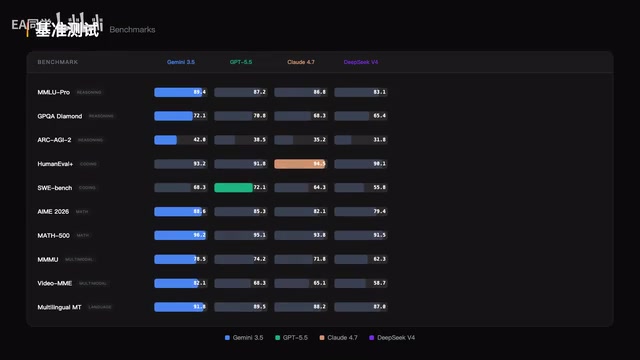
Looking at the data, Gemini 3.5 Pro has established clear advantages in reasoning, mathematics, and multimodal capabilities. Programming is its relative weakness, but the gap isn't substantial.
Deep Dive into Four Core Capabilities
DeepThink Reasoning Mode: Multi-Step Planning and Self-Correction
DeepThink is the deep reasoning mode introduced in Gemini 3.5 Pro. When facing complex problems, the model engages in step-by-step thinking, actively detecting and correcting errors within its reasoning chain. This mechanism significantly improves output accuracy, particularly excelling in mathematical proofs, logical analysis, and multi-condition decision-making scenarios.
Technical Background: The underlying principle of DeepThink mode originates from Chain-of-Thought (CoT) prompting, proposed by Google Research in 2022. Traditional language models tend to output answers directly, whereas CoT has the model generate a series of intermediate reasoning steps before reaching a final conclusion, significantly improving accuracy on complex problems. DeepThink builds on this by introducing a Self-Reflection mechanism: the model actively detects logical contradictions or computational errors within its reasoning chain and backtracks to correct them—similar to a human's process of "drafting, checking, and revising." This belongs to the same technical lineage as OpenAI's o-series models (o1, o3) and Anthropic's Extended Thinking mode, representing the core trend of large models evolving from "fast intuition" to "slow deliberation." In mathematical proofs and multi-step logical reasoning tasks, these modes typically improve accuracy by 20%-40%.
Multimodal Capabilities: Dominant Performance Across Video, Audio, and Images
Multimodal processing is Gemini 3.5 Pro's greatest differentiator. It supports up to three hours of video analysis and audio understanding, with the Video ModeM score of 82.1 far exceeding all competitors. Whether it's long-form video summarization, fine-grained image detail recognition, or meeting recording transcription with semantic understanding, it demonstrates the strongest comprehensive processing capabilities available today.
Code Capabilities: Native Execution Covering 30+ Languages
Gemini 3.5 Pro supports native code execution covering more than 30 programming languages. While its SWE-bench score is slightly behind GPT 5.5 and Claude 4.7, the convenience of native execution and breadth of language coverage remain significant advantages in real-world development.
About SWE-bench: SWE-bench (Software Engineering Benchmark) was developed by a Princeton University research team. Its uniqueness lies in the fact that it doesn't test whether a model can write "correct code snippets"
Related articles
 Product Reviews
The Programmer's Desk Setup Guide: Building a Workspace That Feels Like Home
Discover how programmers build productive, comfortable workspaces. From multi-monitor setups to ergonomic design, explore the desk philosophy that drives focus and flow.
 Product Reviews
Qoder vs Cursor Real-World Comparison: Which $20/Month AI IDE Is Better?
Hands-on comparison of Qoder vs Cursor AI IDEs: Agent autonomy, human interaction count, and architecture decisions. Qoder needed only 2 interactions vs Cursor's 8.
 Product Reviews
Cursor Cloud Agent Demo: Eliminating Bottlenecks Across the Entire Software Development Lifecycle
Deep analysis of Cursor's Cloud Agent demo showing how cloud VMs, automated test artifacts, and a full-chain control plane systematically eliminate human bottlenecks across the software development lifecycle.