Gemini 3.7 Flash Hands-On: Coding Capabilities Skyrocket, Year-End Deals Worth Grabbing

Gemini 3.7 Flash delivers major coding gains with promotional pricing while OpenAI achieves 14x speed via Cerebras chips.
Google's Gemini 3.7 Flash shows significant improvements in code quality (43.6%) and software engineering (65.3%) benchmarks, surpassing Sonic 5. With year-end promotional pricing at just $0.75 per million input tokens, it offers strong value for dev teams. Meanwhile, OpenAI counters with Cerebras chip integration delivering 750 tokens/second—a 14x speed boost enabling real-time interactions.
Google and OpenAI Strike on the Same Day with Completely Different Approaches
On the same day, Google DeepMind and OpenAI—two AI giants—dropped major updates almost simultaneously, yet with diametrically opposed strategies. Google launched the brand-new Gemini 3.7 Flash, focusing on a "volume over margins" approach, turning their mid-tier model into a reliable, durable daily workhorse. OpenAI, on the other hand, went the hardware route, integrating Cerebras custom supercomputing chips to brute-force a 14x improvement in large model inference speed.
You might not have noticed, but it's been only three weeks since the last-generation Gemini 3.6 Flash was released. Google didn't even wait a month's "cooling-off period" before rushing out the new version—an iteration pace that's nothing short of breathtaking. The consensus in the industry is that Google deployed a "cleaver strategy" here—directly axing the troubled 3.5 Pro and pouring all the algorithmic optimizations originally intended for the top-tier model into this mid-tier Flash, while focusing their efforts on the upcoming Gemini 4.
This strategy reflects an important trend in the current AI industry: rather than chasing peak performance from a single massive model, it's better to concentrate R&D resources on the most cost-effective medium-scale model. Under the Transformer architecture, the leap in model parameters from tens of billions to hundreds of billions often causes inference costs to grow super-linearly, while the actual improvement in real-world applications shows diminishing marginal returns. Google's decision to push optimizations originally meant for 3.5 Pro (such as more efficient attention mechanisms and improved knowledge distillation techniques) down to the Flash series is essentially a pragmatic engineering trade-off between the "capability ceiling" and "deployment economics."
Gemini 3.7 Flash Benchmark Results: Real Substance in Coding Ability
Google used to be mocked as the company that "never loses on benchmarks but always fumbles in practice"—from early video editing fails to being ridiculed as the "North American Doubao." But this time, the 3.7 Flash test results genuinely deliver the goods.

In production-grade code quality testing, 3.7 Flash scored 43.6%, a significant improvement over the previous 3.6 Flash's 34.4%. These tests are typically based on standardized evaluation benchmarks like SWE-bench Verified, requiring the model to understand bug reports from real open-source projects, locate problem files, and generate fix patches that pass unit tests—covering high-frequency engineering challenges like code refactoring, dependency conflict resolution, and cross-file reference correction. A 43.6% pass rate means the model can independently and correctly fix approximately 44 out of every 100 real software defects—a number that would have been unimaginable for any AI system two years ago. The old version tended to fall apart when facing complex refactoring, while the new version not only surpasses the industry benchmark Sonic 5's 42.7% but also leaves the standard-tier model of the same generation behind.
In long-cycle software engineering tests, the improvement is even more pronounced. 3.7 Flash scored 65.3%, a major leap from the previous generation's barely-passing 48.6%. Long-cycle software engineering tests evaluate a model's ability to handle complex engineering tasks across sustained multi-turn interactions—including coordinated modifications across multiple code modules, tracking and debugging long dependency chains, and maintaining consistency within codebases of thousands of lines. Unlike single-shot code generation, these tests simulate real developer workflows: discovering issues → locating root causes → modifying code → verifying fixes → handling regressions. A score of 65.3% means this model now possesses the independent troubleshooting capability of a junior software engineer. This score not only beats Sonic 5's 53.8% but leaves Meta's newly-listed model Spark 1.2 trailing by a full 10 percentage points. When facing complex cross-module, multi-file project debugging, it can independently complete multiple rounds of deep debugging, falling only slightly behind the high-end large model's 69.6%.
Web Development and Automation Task Performance
On the web development leaderboard, 3.7 Flash staged a comeback: its score surged from 1538 to 1588 points, rocketing from 19th place straight to 8th, firmly securing the top spot in the mid-tier category.
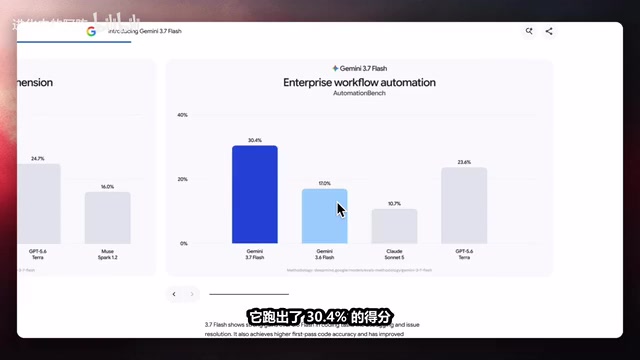
In complex automation task evaluations, it scored 30.4%, surpassing the same-generation standard model's 23.6%. The biggest advantage of mid-tier models is their snappy response—in multi-step automated loop calls, their execution efficiency is actually more stable than bulky large models. Additionally, multimodal long-video understanding reached 85.4% (vs. 78.9% for the same period), and long-context memory retention hit 97%. For technical teams that regularly need to process lengthy API documentation, massive data logs, and hours of video recordings, this kind of "large capacity with consistent quality" stability is extremely practical.
Gemini 3.7 Flash Pricing Strategy: The Promotional Window Is Worth Jumping On
Now that we've seen the benchmarks, let's do the math. 3.7 Flash uses tiered pricing: through year-end it's in a "new user promotional period," with input at just $0.75 per million tokens and output at $3.75. After New Year's, prices double on schedule, returning to $1.50 input and $7.50 output.
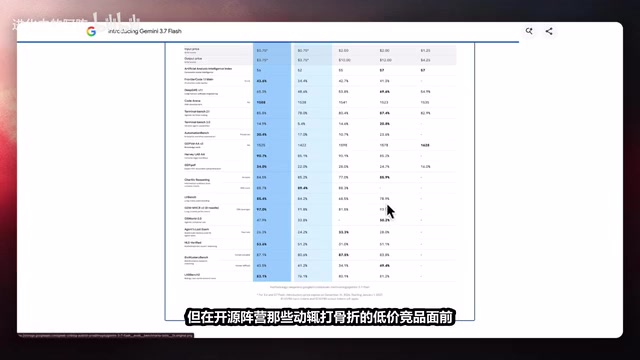
Token pricing for large model APIs is the core economic metric of current AI commercialization. Priced per million tokens, input tokens (the prompts and context users send to the model) are typically cheaper than output tokens because the input phase only requires the encoding portion of forward computation, while the output phase requires autoregressive token-by-token generation with higher computational density. The promotional input price of $0.75 per million tokens means processing a technical document of approximately 300,000 characters (about 400,000 tokens) costs only $0.30. This price point makes large-scale document processing, log analysis, and other "token-intensive" applications commercially viable for the first time.
While the current price is still much cheaper than top-tier flagships, it's not the most budget-friendly option compared to the ultra-low-cost competitors in the open-source camp. For small and medium development teams whose business primarily involves batch text processing, backend data mining, and daily code assistance, taking advantage of the year-end promotional window offers excellent overall value for money.
However, one thing must be clearly understood: 3.7 Flash is ultimately a volume-oriented mid-tier model. The real flagship showdown will have to wait for Gemini 4's debut.
OpenAI's Counterattack: Cerebras Supercomputing Chips Deliver 14x Speed Boost
While Google was busy showing off benchmarks, OpenAI dropped its own bombshell by officially launching the GPT 5.6 ultra-speed mode waitlist. This speed boost skipped the usual algorithmic optimization layer and went straight for a hardware "physics cheat code."

OpenAI integrated Cerebras custom supercomputing chips, using massive wafer-scale processors to brute-force accelerate large models. Cerebras's core technological breakthrough lies in the "Wafer-Scale Engine" (WSE)—traditional GPU chips cut hundreds of individual chips from a single 12-inch silicon wafer, with inter-chip communication requiring external buses like PCIe or NVLink, resulting in microsecond-level communication latency. Cerebras took the opposite approach, using the entire wafer directly as a single chip. The latest generation WSE-3 integrates approximately 900,000 AI compute cores and 44GB of on-chip SRAM, with inter-core communication completed on-die at nanosecond-level latency. This architecture is naturally suited for matrix operations and attention calculations in large model inference because it fundamentally eliminates the biggest performance bottleneck in traditional multi-GPU parallelism—data movement.
In ultra-speed mode, model output speed shoots up to 750 tokens per second, a 14x improvement over standard mode. To understand what this number means: one English token corresponds to approximately 0.75 words on average, so 750 tokens/s equates to roughly 560 English words per second—equivalent to a full A4 page of content generated in under half a second. For real-time voice interaction scenarios, normal human speaking speed is about 2-3 words per second, and the model needs to begin responding within 200 milliseconds after the user finishes speaking to achieve a natural conversational experience. The 14x speed boost reduces end-to-end latency from several seconds to the hundred-millisecond level, enabling large-parameter models to achieve truly real-time conversational capability for the first time—rather than the "pseudo-real-time" previously achievable only through small models or streaming segmented generation.
This ultra-speed mode is specifically designed for scenarios with extremely stringent time requirements: real-time two-way voice calls, financial market second-level data research, cybersecurity emergency response, and online customer service. In these critical business scenarios, every second the model saves can prevent enormous business losses.
Conclusion: Fast and Affordable Is What Makes an AI Model Truly Capable
On one side, Google is turning their mid-tier model into a durable, reliable daily workhorse. On the other, OpenAI is leveraging supercomputing chips for brute-force speed gains. As large model competition reaches this stage, benchmarks are just one aspect—whoever can truly deliver "fast and affordable" in daily engineering and high-frequency business use is the real winner.
For developers, Gemini 3.7 Flash's improvements in code quality, software engineering, and long-context capabilities are worth paying attention to—especially the year-end promotional pricing window. Meanwhile, OpenAI's hardware acceleration route opens up new possibilities for real-time interaction scenarios. Which path is superior will ultimately be judged by specific business use cases.
Key Takeaways
Related articles

Python 3.15 New Feature: Is the sentinel Type Better Than None?
Python 3.15 adds the sentinel type, using named unique sentinel objects to replace None and bare object(), resolving confusion among missing values, explicit emptiness, and invalid input while avoiding type hint failures.

Deep Learning's Three Architectures and the Universal Approximation Theorem: A Complete Guide to MLPs, CNNs, and Transformers
Explaining the inductive bias differences among MLP, CNN, and Transformer, the existence meaning of the Universal Approximation Theorem (UAT), and the role of Taylor expansion in approximation analysis, while clearing up common misconceptions.

GitLab Emergency Patch Release: Analysis of Critical Security Fixes
GitLab releases critical patch 19.5.1, sparking 355 points of discussion on Hacker News. This article analyzes the background, upgrade steps for self-hosted instances, and verification points to help DevOps teams respond quickly to security updates.