Gemini 3.8 Live Introduces Live Avatar: Google AI Now Has a Face That Talks

Google launches Live Avatar in Gemini 3.8 Live, giving AI a real-time animated face with lip-sync and expressions.
Google's Gemini 3.8 Live introduces Live Avatar, giving AI a real-time animated persona with lip-sync and dynamic facial expressions — extending human-computer interaction beyond audio into visual anthropomorphism. Currently exclusive to Gemini Enterprise customers for use cases like customer service and virtual reception, it supports switching between 97 avatar states. The move reflects heating competition in multimodal AI interaction, where experience differentiation is becoming the new frontier — though it also raises concerns around overtrust, emotional dependency, and privacy.
Google has brought a remarkably imaginative update to Gemini. The latest Gemini 3.8 Live release introduces a feature called "Live Avatar," allowing users to see a real-time animated AI persona during conversations. This marks Google's push beyond voice interaction toward a more anthropomorphic, visually expressive form of AI engagement.
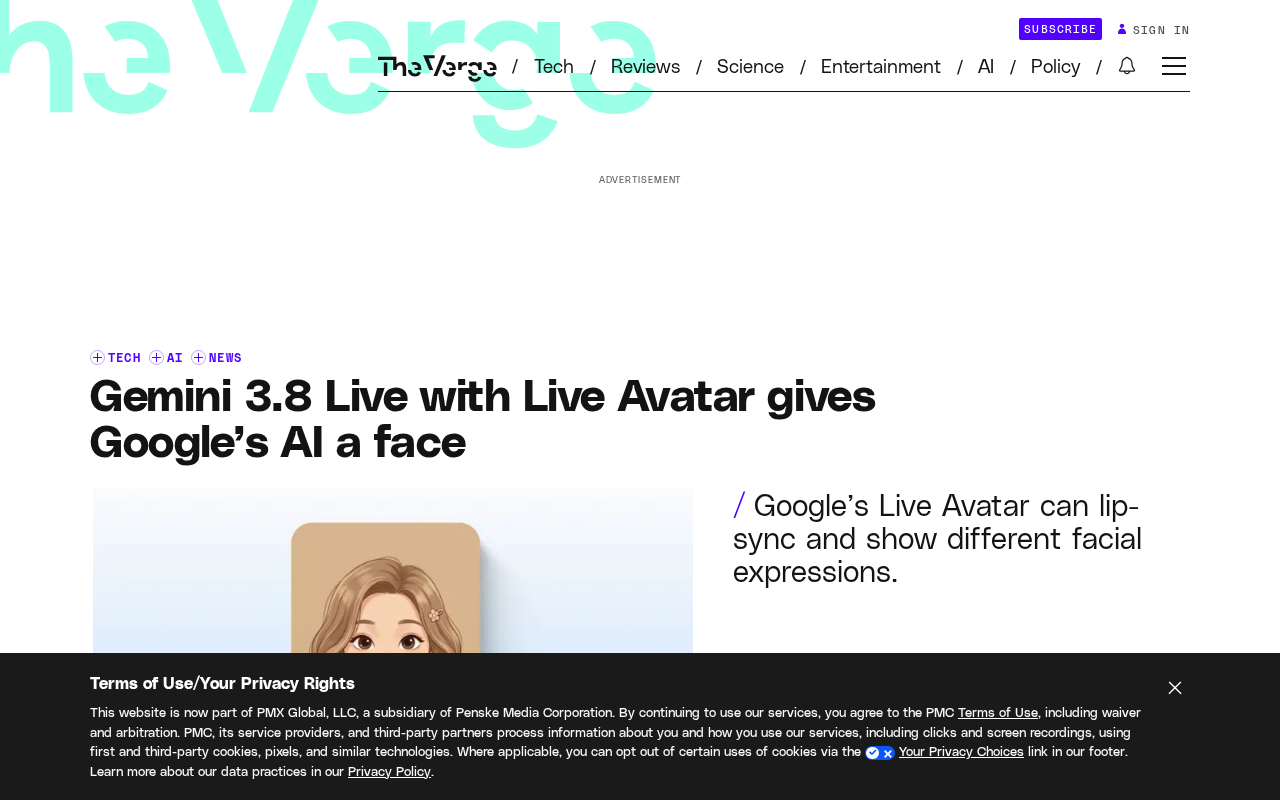
What Exactly Is Live Avatar
In short, Live Avatar is an animated AI character that reacts in real time during a conversation. It's not just a static profile picture — it performs lip-sync that matches the spoken content and displays varying facial expressions. In other words, when you talk to Gemini, the virtual figure on screen opens its mouth and changes expressions just like a real person, rather than simply playing back audio.
The core goal of this kind of anthropomorphic design is to reduce the emotional distance in human-computer interaction. Compared to pure text or voice alone, a visual presence with expressions and lip movement makes conversations feel more natural and approachable — especially in scenarios requiring extended dialogue or emotionally nuanced communication, where visual feedback can significantly enhance immersion.
Implementing lip-sync technology in AI typically relies on mapping a speech's phoneme sequence to corresponding facial muscle movements (known as "visemes," or visual phonemes). In traditional film post-production, this process required manual frame-by-frame adjustment. Modern AI-driven real-time lip-sync uses deep learning models to predict and render audio features into facial movements with millisecond-level latency. Google builds on this by layering dynamic emotional expressions on top, so the virtual figure doesn't just "move its mouth" — it can also frown, smile, and display emotional responses based on the tone and content of the conversation. This places significant demands on real-time inference and rendering capabilities.
Currently Limited to Enterprise Customers
It's worth noting that Live Avatar is not yet available to all users — it's currently exclusive to Gemini Enterprise (Google's enterprise-grade Gemini service) customers. This positioning reveals Google's strategy: validate the real-world value of such features in enterprise contexts first.
Enterprise scenarios have a natural demand for virtual personas — think customer service, virtual reception, training assistants, and internal knowledge Q&A. An AI figure that can respond in real time with facial expressions can take on communication tasks that traditionally required human agents. From a business logic standpoint, landing in the enterprise market first also makes it easier to establish a paid monetization loop, rather than rolling it out directly to a massive consumer base.
Switching Between 97 Different Avatars
According to Google, Live Avatar supports switching between 97 different avatars or states. While the original information is sparse on details, this number alone indicates that Google has built a remarkably rich set of visual dimensions into the feature — whether that means different character appearances or a wide range of expression and state transitions, the system clearly offers considerable visual flexibility.
This switching capability is especially meaningful for enterprise users. Different brands and different use cases may call for different avatar styles, and having a wide selection allows enterprises to customize configurations to suit their needs, helping the AI persona align more closely with brand identity and context.
Why "Giving AI a Face" Deserves Attention
Looking at industry trends, AI interaction is evolving from text to voice to visual anthropomorphism. Text interaction is efficient but lacks warmth; voice interaction is more natural but remains a one-way auditory experience; a virtual figure with expressions and lip-sync fills in the missing piece of visual and emotional communication.
Google's move also reflects intensifying competition among major players in multimodal interaction. As models' language capabilities gradually converge, the interaction experience — including how to make AI look more trustworthy and easier to communicate with — may become the next battleground for differentiation. Giving AI a talking face is both a demonstration of technical capability and a strategic bet on the product experience layer.
That said, anthropomorphic AI also comes with risks worth watching. When an AI has realistic expressions and a convincing appearance, users may more readily develop trust — or even emotional dependency — toward it. This raises new requirements around information authenticity, privacy boundaries, and usage norms. How to enhance the experience while striking the right balance with anthropomorphism will be a long-term challenge for Google and all other players in this space.
There's a relevant concept in psychology called the Anthropomorphism Effect: humans are naturally inclined to perceive objects with human characteristics (faces, voices, body language) as intentional, emotional social agents, and to extend higher levels of trust and emotional resonance toward them. Research shows that compared to text-only or voice-only assistants, virtual agents with human faces significantly boost user compliance and satisfaction — but also more readily trigger "overtrust," where users may overestimate an AI's capabilities or reliability based on how realistic it looks. This represents a risk dimension worth watching beyond the "Uncanny Valley": it's not that being too human-like causes discomfort, but that being too human-like causes people to let their guard down and suspend the critical scrutiny they should maintain.
Takeaway
The Live Avatar feature in Gemini 3.8 Live moves Google's AI from "listen and speak" to "face and expression." Currently limited to enterprise customers, it supports up to 97 avatar states and delivers real-time lip-sync with dynamic facial expressions. The significance of this update lies not only in the feature itself, but in the direction it reflects: AI interaction is accelerating toward visual anthropomorphism, and the competition at the experience layer is only just beginning.
Related articles

JobRunner MCP Server: AI Agents Can Now Fix Failed Java Jobs
JobRunner launches an open-source MCP server enabling AI agents to view cluster status, diagnose failures, and recover Java jobs—incident response from any cloud coding environment or existing agent.

MLAI Digital Launches 9 Security Agents: MCP Server Safeguards the Full Lifecycle of Agentic AI
MLAI Digital launches Security MCP Server with nine built-in specialized security agents covering vulnerability discovery, attack simulation, prompt injection detection, API and infrastructure assessment, and accelerated remediation—embedding security validation across the full Agentic AI lifecycle from development to production.

Running Isaac Lab on H100 GPUs: Exploring Better Approaches
Exploring optimization methods for running Isaac Lab on NVIDIA H100 GPUs, including MIG configuration, mixed precision, TensorRT acceleration, and community experience to improve robotics simulation and reinforcement learning efficiency.