Gemini 3 Hands-On: AI Studio Vibe Coding Lets Anyone Build Websites, Comics, and Games

Google DeepMind releases Gemini 3 Pro and Nanobanano Pro, showcasing an AI-driven Vibe Coding paradigm.
Google DeepMind released two major models — Gemini 3 Pro and Nanobanano Pro — demonstrating powerful Vibe Coding capabilities in AI Studio. Gemini 3 Pro features professional-grade UI design awareness and agentic tool calling with leading SWE-bench performance. Nanobanano Pro achieves breakthroughs in text rendering, real-time world knowledge, and image consistency. Live demos included single-prompt website generation, an AI comic generator, search-driven sticker design, and a multiplayer online racing game — redefining the barrier to building software.
Google DeepMind released the Gemini 3 Pro model and the Nanobanano Pro image model within a single week, showcasing stunning Vibe Coding experiences in AI Studio. From generating polished websites with a single sentence, to automatically creating comic stories, to multiplayer online racing games — these demos are redefining the answer to "who can build software."
About Vibe Coding: This concept was coined by OpenAI co-founder Andrej Karpathy in early 2025, describing an entirely new paradigm of human-AI collaborative programming. Instead of writing code line by line, developers describe their intent and "vibe" in natural language, and the AI model transforms these fuzzy creative ideas into working programs. It addresses a core contradiction in software development — the barrier to expressing creativity is far lower than the barrier to implementing it. Traditional programming requires developers to simultaneously master business logic, language syntax, framework ecosystems, and engineering practices, while Vibe Coding pushes these technical details down to the AI layer, letting creators focus solely on "what I want" rather than "how to build it."
Gemini 3 Pro: UI Design Awareness & Agentic Tool Calling
Professional-Grade Websites from a Single Prompt
Gemini 3's most impressive capability is its deep understanding of UI and aesthetics. In the past, using AI models to generate websites typically produced cookie-cutter purple gradients and rough layouts that made designers cringe. Gemini 3 can output websites with professional design quality in a single prompt — automatically selecting appropriate typography, adding shader animations, designing page transitions — with a level of completeness far exceeding expectations.
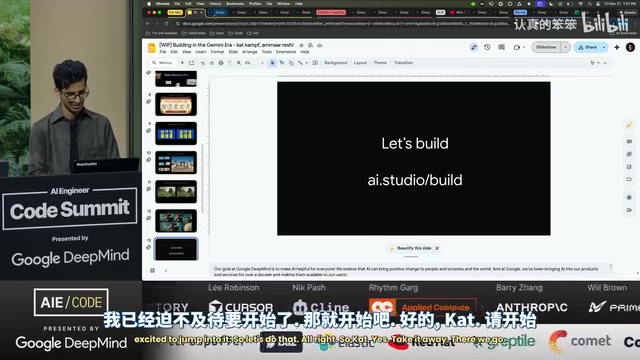
In the demo, the team generated a complete multi-page site with rich transitions and carefully selected fonts using just the prompt "create a fluid animated website." Product lead Amar put it bluntly: "People who have been struggling in Figma can now get pretty solid design results directly through prompts."

Agentic Tool Calling: Leading SWE-bench Performance
Another major breakthrough for Gemini 3 is agentic tool calling. On the SWE-bench benchmark, Gemini 3 scored significantly higher than comparable models in agentic scenarios, meaning it can handle not just simple one-off tasks but also complex multi-step operations within large codebases.
SWE-bench Background: SWE-bench (Software Engineering Benchmark) is a professional software engineering evaluation benchmark released by Princeton University researchers in 2023, widely regarded as one of the most authoritative standards for measuring AI coding capabilities. Unlike simple code completion tests, SWE-bench requires models to solve real Issues from actual GitHub repositories — models must understand complex codebase context, locate root causes, write fix patches, and pass the existing test suites. Early GPT-4 achieved less than 2% resolution rate on SWE-bench, while recent top models have surpassed 50% — this dramatic improvement is a direct reflection of maturing AI agentic tool-calling capabilities.
In practice, the model automatically determines which tools to invoke based on user intent — Google Search, Google Maps, real-time APIs, etc. — and seamlessly integrates them into the generated application without manual configuration from the developer.
Nanobanano Pro: A Comprehensive Upgrade in Image Generation
Text Rendering & Real-Time World Knowledge
The Nanobanano Pro image model delivers several key breakthroughs. Text rendering capabilities have been dramatically improved — text can perfectly conform to object surfaces (such as the curved surface of a beverage can) and supports multiple languages including Korean.
The Technical Challenge of Text Rendering: In AI image generation, accurately rendering text has long been a recognized technical challenge. This difficulty stems from how diffusion models work — models generate images by learning pixel-level statistical distributions, and there's a fundamental tension between the semantic information of text (precise letter shapes, ordering) and these pixel-level statistical patterns. Early Stable Diffusion and DALL-E models often produced text with misaligned letters, spelling errors, or distorted shapes. Curved surface text rendering is even more complex — text needs perspective deformation based on the 3D curvature of object surfaces, requiring the model to simultaneously understand geometric relationships and character morphology. Nanobanano Pro's breakthrough in this area likely benefits from deeper integration of language model text comprehension capabilities with the image generation pipeline.
More notably, the model connects to Google Search with real-time world knowledge, capable of generating accurate infographics based on search results — no longer limited by training data knowledge cutoff dates.
Consistency & Fine-Grained Creative Control
Image consistency has also seen significant progress, with up to 14 characters accurately rendered in a single image. Creative control is equally refined — simply saying "switch the focus to the flowers" allows the model to precisely adjust depth of field while keeping other elements in the frame unchanged. It also supports multiple aspect ratio outputs, covering different use cases from wallpapers to advertising banners.
AI Studio Vibe Coding in Action: Comics, Stickers & Multiplayer Games
Comic Generator: Upload a Photo to Create a Story
The most eye-catching application in the demo was an AI comic generator. Users simply upload a face photo, choose a story type and language, and the system automatically generates a complete comic story. This application simultaneously leverages Gemini 3's narrative capabilities and Nanobanano Pro's image generation — not only are text bubbles in the comics rendered accurately, but even details like an "AI Engineer" conference banner in the background are precisely depicted.
Even more interesting, users can choose plot directions mid-story, turning the comic into an interactive narrative experience. Team members even said: "This is the first time an AI-generated story actually made me laugh out loud."
Notebook Sticker Generator: Search-Driven Personalized Design
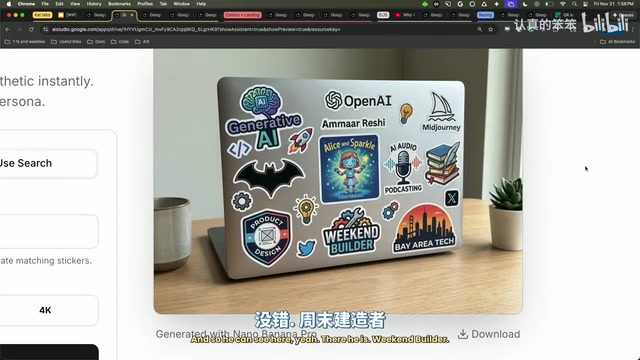
Another demo showcased the practical value of Google Search integration. After entering a person's name, the system automatically searches for related information, learns about their interests and hobbies, then generates matching sticker designs. In the demo, Amar's name was entered, and the system not only generated DeepMind-related stickers but also included elements from his children's book "Alice in Sparkle" — all this information was retrieved in real-time from the web, not reliant on the model's training data.
Multiplayer Racing Game: 23 Players Online Simultaneously Without Crashing

The most ambitious demo was a 3D multiplayer online racing game built with Three.js.
Three.js & WebGL Background: Three.js is currently the most mainstream JavaScript 3D graphics library. It wraps the underlying WebGL API, allowing developers to build complex 3D scenes in the browser without deep knowledge of shader programming. WebGL itself is based on the OpenGL ES standard, directly leveraging GPU for rendering computations.
Related articles
 Product Reviews
The Programmer's Desk Setup Guide: Building a Workspace That Feels Like Home
Discover how programmers build productive, comfortable workspaces. From multi-monitor setups to ergonomic design, explore the desk philosophy that drives focus and flow.
 Product Reviews
Qoder vs Cursor Real-World Comparison: Which $20/Month AI IDE Is Better?
Hands-on comparison of Qoder vs Cursor AI IDEs: Agent autonomy, human interaction count, and architecture decisions. Qoder needed only 2 interactions vs Cursor's 8.
 Product Reviews
Cursor Cloud Agent Demo: Eliminating Bottlenecks Across the Entire Software Development Lifecycle
Deep analysis of Cursor's Cloud Agent demo showing how cloud VMs, automated test artifacts, and a full-chain control plane systematically eliminate human bottlenecks across the software development lifecycle.