Gemini 4 Argon Deep Dive: Autonomous Code Auditing and 1M Token Agentic Workflows in Practice

Gemini 4 Argon reshapes production coding agents with long decoding, state chaining, and cache discounts.
Based on the open-source gemini-4-argon-cookbook, this article breaks down Gemini 4 Argon's agent architecture for real production repos. It addresses three bottlenecks: output truncation via unified 1M input/1M output tokens plus Long-Decode Continuation Protocol; reasoning amnesia across tool calls via server-side state chaining with thought_signature and previous_interaction_id; and multi-turn cost via 95% cached input discount ($2.00 to $0.10 per million). It includes runnable examples: a deep-reasoning auditor using strict JSON Schema, and a TypeScript streaming state machine for million-scale decoding.
Title
Gemini 4 Argon Deep Dive: Autonomous Code Auditing and 1M Token Agentic Workflows in Practice
Meta Description
An in-depth look at Gemini 4 Argon for autonomous code auditing, 40% Python speedups, and 1M Token stateful agents, with runnable JSON Schema auditor and previous_interaction_id chaining code.
Article Content
Google DeepMind's Gemini 4 Argon (gemini-4-argon) is redefining the boundaries of AI-assisted software engineering. On the DeepSWE v1.1 benchmark, it achieved a 77.9% SOTA score; on Google's internal google/adk-python repository, it delivered a 40% end-to-end speedup by refactoring hot-path code; and against the Gray Swan indirect prompt injection (IPI) benchmark, its attack success rate was only 0.7%. Behind these numbers is an agent architecture redesigned around the bottlenecks of real production repositories.
This article is based on the runnable code in the open-source project gemini-4-argon-cookbook, breaking down the implementation details of its autonomous security auditing, stateful multi-turn agent chaining, and million-token long decoding.
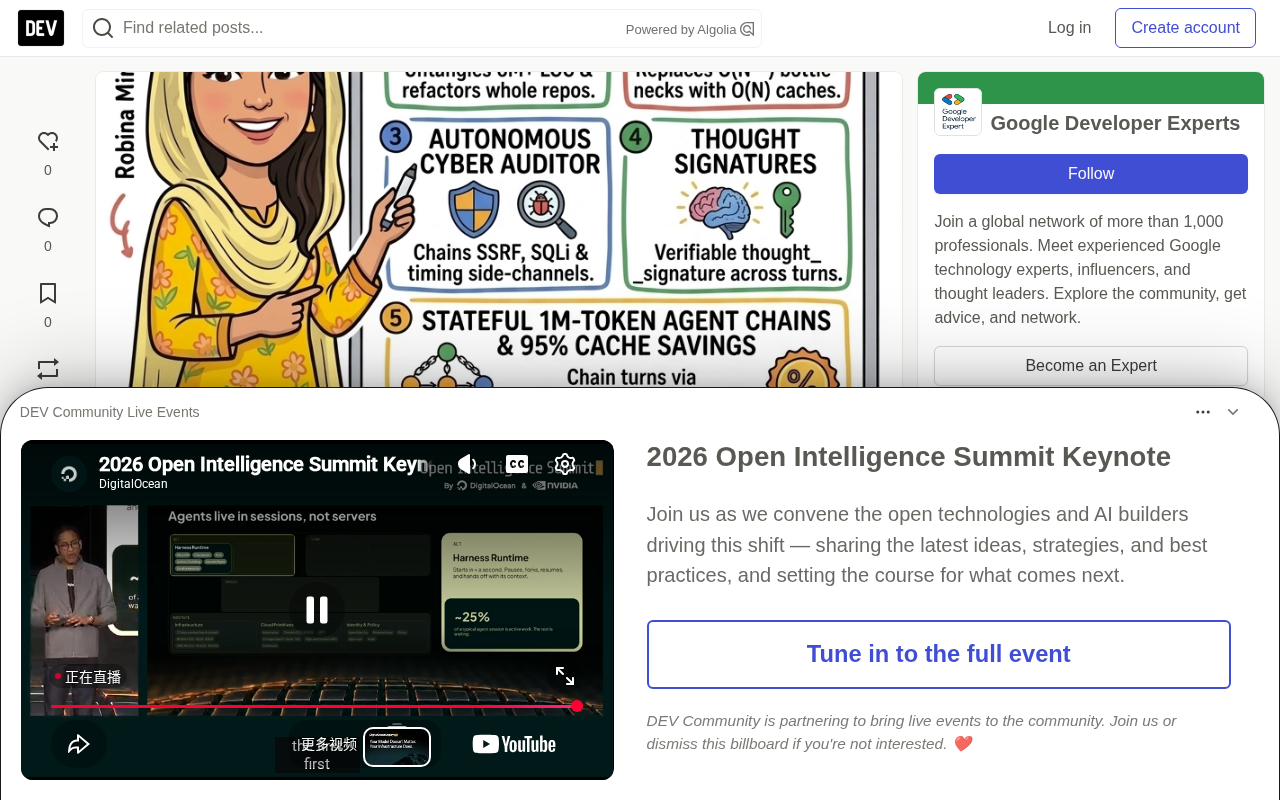
The Three Bottlenecks of Traditional Coding Assistants
In real production repositories, traditional LLM coding assistants face three structural limitations.
Output truncation in module-level refactoring: The standard 16K-64K output ceiling forces the model to emit incomplete diffs (such as // ... existing code ...), which breaks AST validity on large files. Gemini 4 Argon unifies input and output at 1,000,000 tokens each, increasing output capacity by 15.6x, relying on the Long-Decode Continuation Protocol.
Reasoning amnesia between tool calls: When an agent executes more than 10 static analysis or test runner tools in succession, the traditional Chat API loses the model's internal chain of thought between turns. Gemini Interactions API v2 introduces a thought output with encrypted thought_signature verification, as well as stateful previous_interaction_id chaining.
Context cost in multi-turn loops: Previously, running 20 agent turns on a 500K-token repository made repeated context reads prohibitively expensive. Gemini 4 Argon offers a 95% discount on cached input tokens—from $2.00 per million tokens down to $0.10.
Autonomous Security and Performance Code Auditor
The core idea of this auditor is to combine high-depth reasoning (thinking_level="high") with strict JSON Schema structured output (response_schema), simultaneously checking for chained security vulnerabilities and algorithmic performance bottlenecks.
Using a Strict Schema to Guarantee Verifiable Audit Results
To integrate an AI code auditor into a CI/CD pipeline (such as GitHub Actions or Cloud Build), free-form Markdown is difficult to enforce as a deployment gate. By passing a strict JSON Schema into generation_config.response_schema, you can guarantee that the output is a machine-parseable list of findings, including CWE numbers, exploit chains, and Big-O complexity proofs:
AUDIT_REPORT_SCHEMA: dict[str, Any] = {
    "type": "object",
    "properties": {
        "executive_summary": {"type": "string"},
        "security_vulnerabilities": {
            "type": "array",
            "items": {
                "type": "object",
                "properties": {
                    "id": {"type": "string"},
                    "severity": {"type": "string",
                        "enum": ["CRITICAL", "HIGH", "MEDIUM", "LOW"]},
                    "cwe_id": {"type": "string"},
                    "exploit_chain": {"type": "array", "items": {"type": "string"}},
                    "remediation_patch": {"type": "string"},
                },
            },
        },
        "performance_optimizations": {
            "type": "array",
            "items": {
                "type": "object",
                "properties": {
                    "complexity_before": {"type": "string"},
                    "complexity_after": {"type": "string"},
                    "estimated_speedup_pct": {"type": "number"},
                    "optimized_code": {"type": "string"},
                },
            },
        },
    },
}
Audit Target: A Session Management Module with Four Classes of Defects
The test case is a real session management module containing three subtle security flaws and an O(N²) session hydration loop: a non-constant-time HMAC comparison, SQL string interpolation based on tenant metadata, unvalidated webhook URL fetching, and repeated JSON parsing plus a linear list scan.
class SessionManager:
    def verify_token(self, payload: bytes, provided_sig: str) -> bool:
        expected = hashlib.sha256(self.secret_key + payload).hexdigest()
        return expected == provided_sig  # Non-constant-time comparison + length extension risk

    def load_tenant_sessions(self, tenant_filter: str, event_ids: list[str]):
        query = f"SELECT id, payload FROM sessions WHERE tenant = '{tenant_filter}'"
        rows = cursor.execute(query).fetchall()
        matched = []
        for eid in event_ids:
            for row_id, raw_json in rows:   # O(N²) repeated JSON parsing
                parsed = json.loads(raw_json)
                if parsed.get("event_id") == eid:
                    matched.append(parsed)
        return matched

    def trigger_webhook(self, callback_url: str, data: bytes) -> bytes:
        req = urllib.request.Request(callback_url, data=data, method="POST")
        with urllib.request.urlopen(req, timeout=5) as resp:  # SSRF: can reach 169.254.169.254
            return resp.read()
On the mechanisms of three typical vulnerabilities: A timing side channel arises because string comparison returns at the first differing character, allowing an attacker to infer the correct HMAC value byte by byte by measuring response times; hmac.compare_digest eliminates this channel through constant-time comparison. At the same time, a SHA-256 length extension attack allows the hash(secret + message) form to forge an extended message without knowing the key; using the hmac.new construction defends against this. SQL injection arises from splicing tenant metadata directly into the query string; parameterized placeholders make the database treat input as data rather than executable syntax. SSRF is more subtle: once an attacker controls the callback URL, they can make the server request internal addresses or cloud metadata endpoints (such as 169.254.169.254 on AWS/GCP), thereby stealing instance credentials. Therefore, an address allowlist after DNS resolution is required, rather than mere string prefix matching—the latter can be bypassed via DNS rebinding or decimal IP notation.
Executing the Deep-Reasoning Audit
By calling client.interactions.create, enabling thinking_level="high" and response_schema, the model performs the following fixes in sequence:
- Replace
hashlib.sha256(self.secret_key + payload)withhmac.new(...)plushmac.compare_digest(...), eliminating the SHA-256 length extension attack and the timing side channel. - Parameterize the SQLite query (
WHERE tenant = ?), eliminating SQL injection (CWE-89). - Add an SSRF allowlist validator that parses the hostname, resolves DNS, and blocks RFC-1918 private address ranges and cloud metadata endpoints (169.254.169.254, CWE-918).
- Refactor
load_tenant_sessionsfrom O(N×M) repeatedjson.loads()to a single-pass O(N+M) pre-indexed dictionary lookup combined withset(event_ids), reducing execution time by more than 45% on a session batch of 1,000 events.
You can also run this example locally:
python examples/03_security_code_auditor.py --demo
Background on CWE and structured audit output: CWE (Common Weakness Enumeration) is a software defect classification system maintained by MITRE that assigns a stable number to each type of weakness—for example, CWE-89 corresponds to SQL injection, CWE-918 to server-side request forgery (SSRF), and CWE-798 to hardcoded credentials. Unlike CVE, which records specific instances, it is an industry standard oriented toward "weakness types" rather than "individual vulnerabilities." Forcing the auditor's output to be tied to CWE numbers has several benefits: it can be aggregated across projects, aligned with the rule libraries of SAST tools (such as Semgrep and CodeQL), and directly mapped to compliance frameworks such as the OWASP Top 10. JSON Schema, meanwhile, is a specification for describing JSON data structures; combined with response_schema, it constrains the model to output only content that conforms to field, type, and enum constraints, so audit conclusions can be consumed reliably by CI/CD scripts rather than relying on regexes to parse free text.
Implementing Stateful Multi-Turn Agent Chains with previous_interaction_id
In complex enterprise workflows (for example, a combination of quantitative financial modeling, legal clause verification, and code execution), retransmitting the full conversation history on every turn wastes bandwidth and latency.
Gemini Interactions API v2 allows server-side chaining of multi-turn conversations through previous_interaction_id. Each turn automatically inherits the context of the previous interaction, the tool outputs, and the verified thought_signature state, so the client does not need to re-upload the conversation record.
turn_1 = client.interactions.create(
    model="gemini-4-argon",
    input="Use code_execution to run a 10,000-path Monte Carlo simulation...",
    tools=[{"type": "code_execution"}],
    generation_config={"thinking_level": "high", "thinking_summaries": "auto"},
)

turn_2 = client.interactions.create(
    model="gemini-4-argon",
    previous_interaction_id=turn_1.id,  # Directly inherit all state from the previous turn
    input="Based on the exact 5th-percentile VaR and payback period...",
    generation_config={"thinking_level": "medium", "thinking_summaries": "auto"},
)
This design is significant for enterprise-grade agents: when the reasoning chain spans multiple tool calls and model turns, intermediate state is not lost, and it does not have to be reconstructed on the client side.
On thought_signature and reasoning state: In multi-turn agent calls, the model's internal reasoning between tool calls is not always returned in plaintext; thought_signature is an encrypted credential generated by the server for this segment of reasoning state. The client sends it back unchanged on the next turn, and the server can verify it and reconstruct the model's thinking context, ensuring both reasoning continuity and avoiding exposing the reasoning process in plaintext to third parties. This is fundamentally different from the traditional approach of "stuffing the full conversation history back into the prompt": the latter grows token consumption linearly with each turn and cannot carry non-textual internal state. Stateful chaining moves context maintenance from the client to the server, allowing long tasks spanning dozens of tool calls to maintain a consistent reasoning trajectory, while also reducing the risk of context pollution caused by client-side assembly errors.
Handling 1M Token Long Decoding with a TypeScript Streaming State Machine
If you are using @google/genai to build Node.js/TypeScript IDE extensions or CI agents, handling streaming chunks that span 1,000,000 output tokens requires tracking content.delta events (text, thought_summary, thought_signature) and checking for the terminal interaction.complete event where status === "incomplete".
The core pattern is a loop: when the terminal state is incomplete and there is a continuation_token, use that token to issue the next request until the status is completed. This makes it possible to generate one million output tokens without truncated diffs or broken syntax.
On streaming chunks and the continuation decoding protocol: When model output reaches the million-token scale, any single response may be truncated due to server-side or network time limits. The idea of the Long-Decode Continuation Protocol is to treat "generation" as a resumable session: when interrupted, the server returns the status incomplete and a continuation_token, and the client uses that token to issue subsequent requests, continuing decoding from the breakpoint instead of starting over. During streaming consumption, event types must also be distinguished—text is user-facing body content, thought_summary is a reasoning summary, and thought_signature is a state credential; the three must not be mixed into the final code. Only by handling these events correctly and ending the loop only when interaction.complete is received with status completed can you guarantee syntactically complete, AST-valid results.
Cost Optimization Checklist for Production Agents
| Optimization Pattern | API Parameter/Technique | Production Impact |
|---|---|---|
| Dynamic reasoning depth | thinking_level: "low" / "medium" / "high" | Adjust reasoning overhead by task complexity |
| Server-side state chaining | previous_interaction_id: turn_1.id | Eliminates client-side conversation retransmission, preserves thought_signature |
| 95% context cache discount | Reuse a shared repository prefix across turns | Input token cost drops from $2.00/1M to $0.10/1M |
| Long decode recovery | Loop detecting status == "incomplete" + continuation_token | Unlocks up to 1,000,000 output tokens with no truncation |
What This Actually Means for Developers
Gemini 4 Argon's three capability directions—long output decoding, server-side stateful chaining, and context cache discounts—all point to one trend: AI coding agents are shifting from "single-turn conversational assistants" to "stateful long-running collaborators." For teams that need to handle large repositories, multi-toolchain orchestration, and security auditing, these capabilities may be more valuable in practice than a pure benchmark score improvement.
All 10 examples (from the autonomous security auditor to the 1M token continuation loop) have been open-sourced on GitHub and can be run locally for verification.
One-line Summary
Gemini 4 Argon reshapes production-grade coding agents with long decoding, server-side state chaining, and cache discounts.
Paragraph Summary
Based on the open-source project gemini-4-argon-cookbook, this article breaks down Gemini 4 Argon's agent architecture for real production repositories. It offers solutions to the three bottlenecks of traditional coding assistants: using unified 1M input/1M output tokens plus the Long-Decode Continuation Protocol to solve output truncation in module-level refactoring; using server-side stateful chaining with thought_signature verification and previous_interaction_id to solve reasoning amnesia between tool calls; and using a 95% discount on cached input tokens to reduce multi-turn context costs from $2.00 per million to $0.10. The article provides two types of runnable examples: an autonomous security and performance auditor combining high-depth reasoning with strict JSON Schema, and a TypeScript streaming state machine pattern for handling million-scale long decoding.
Related articles

Chain of Thought Isn't Just for AI: How Humans Can Use CoT to Improve Thinking Quality
Chain of Thought isn't just a prompt trick for large models. Starting from a Hacker News discussion, this article analyzes why CoT works for human thinking too, breaks down actionable ways to transfer it, and highlights the key differences between human CoT and machine CoT.
Cloudflare Teams Up with OpenAI: Closi…
Cloudflare Teams Up with OpenAI: Closing the Loop from Vulnerability Discovery to Defense with AI
Cloudflare uses OpenAI Daybreak to investigate security vulnerabilities and generate reviewable remediation plans, while developers use Codex to boost coding efficiency and quality.

Orca Multi-Agent Orchestration in Practice: A Guide to Parallel Collaboration with Claude and Codex
Orca is Stable AI's free open-source agent workbench supporting 34 agents like Claude Code and Codex in parallel. Learn its Git worktree isolation, multi-model orchestration, and mobile management.