Gemini 4 Argon Deep Dive: Low Price, High Power — But Not a One-Shot Wonder

Gemini 4 Argon offers unbeatable value at entry price and reaches frontier-level performance after multiple iterations.
Google's Gemini 4 Argon is officially available, and AI reviewer Bijan Bowen evaluated it through six hardcore tests. The model natively supports multimodal input, has a 1M-token context, output expandable beyond 1M, and is highly competitive at $2/$10 entry pricing, rivaling Opus 5.5 and Muse Wonder after the price increase. It excelled in robot arm grasping (22 minutes), video understanding and transfer, and reverse-engineering recompilation — completing a native Linux port of a 2000 Windows game in 2.5 hours, while Meta Muse Wonder failed completely. Weaknesses are in first-pass 3D graphical fidelity and front-end aesthetics, requiring multiple rounds of tuning. The verdict: it's not a zero-prompt masterpiece model, but those willing to iterate can go toe-to-toe with top competitors.
Google's newest model, Gemini 4 Argon, is finally available to the public. During a two-week early access period, AI reviewer Bijan Bowen put it through six hardcore tests spanning everything from game development to robot control. The verdict is clear: this is Google's strongest model to date and highly competitive at the $2/$10 entry price — but it's not a "one-prompt miracle" model. You need to iterate repeatedly to extract its true potential.
Technical Specs: Million-Token Output, Native Multimodality
Gemini 4 Argon natively supports text, image, video, audio, and PDF inputs, with text-only output. Its context window reaches 1 million tokens, with a default max output of roughly 65,536 tokens — expandable to over 1 million, which is extremely rare among current mainstream models, where a 128k output ceiling is already considered excellent. The default reasoning effort is medium.
On pricing, as of November 30 it's $2 per million input tokens and $10 per million output tokens, putting it in the same tier as Sonnet 5.5 and GPT-6.1 Soul. After that, the price doubles to $4/$20, directly competing with Opus 5.5 and Meta's Muse Wonder. Bowen made it clear that at the entry price, this model is "extremely cost-effective," but once the price doubles, the competitive pressure ramps up significantly.
Context window vs. max output: These two concepts are often conflated. The context window refers to the total number of tokens the model can "see" in a single inference pass (input + output), while max output is the upper limit on what it can generate in a single reply. Gemini 4 Argon's 1-million-token context is top-tier, but what's truly rare is its output ceiling — the default of roughly 65,536 tokens already covers most long-document tasks, and the ability to scale beyond 1 million means it can produce content equivalent to several full-length novels in one shot. Previously this was only possible through segmented continuation, which often leads to logical breaks between sections.
Native multimodality: This means the model mixes text, image, audio, and other modality data during pre-training, rather than stitching together separate speech recognition or vision encoders post-hoc. The advantage of native multimodality is more natural cross-modal reasoning — for example, directly extracting physics principles from a video and transferring them into code, which is precisely the technical premise that makes the skateboarding game test in this article possible.
Reasoning effort: This is a common tunable parameter in the new generation of reasoning models. In essence, it controls the compute budget the model spends on "chain-of-thought" expansion before giving an answer. Higher effort means the model spends more tokens on internal derivation, suited for math and code; medium effort strikes a balance between latency and quality, suited for everyday interaction and generative tasks.
Game & 3D Tests: It Works, But First-Round Results Are Mediocre
Bowen ran the classic browser OS test and a C++ skateboarding game. In the browser OS, Argon generated a Synthwave-style desktop environment with a built-in GTA-style mini-game, a Star Vanguard 3D asteroid shooter, and a cross-app "Ethermail" email system — the email app could actually trigger actions in other apps, such as transferring virtual funds to an in-game account.
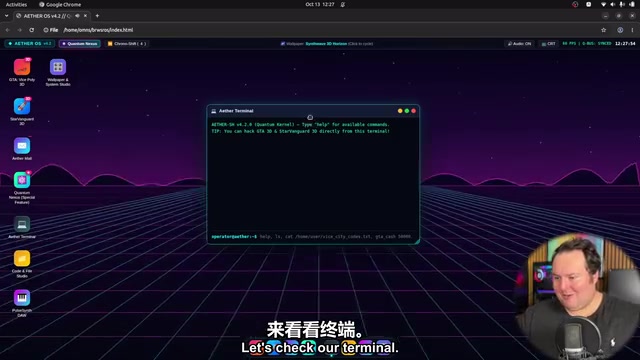
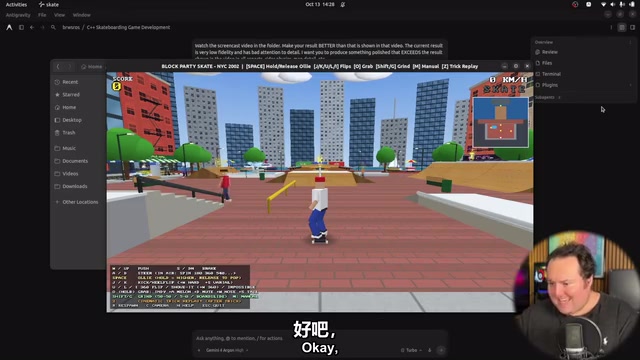
But problems were also prominent. Bijan bluntly said "the front-end interface is overly crowded and cluttered," and the GTA mini-game's geometry and feel fell far short of Sonnet or Opus. The C++ skateboarding game took about 40 minutes to generate; playability was acceptable, but the level of detail was "far from expectations."
The key turning point came in the second round of interaction. Bijan recorded a one-minute clip of Sonnet 5.5's skateboarding game as a reference video and fed it to Argon, asking it to "comprehensively surpass the reference video." About 70 minutes later, Argon did extract elements from the video like splash logic, NPC commentary, and crouch animations, and even autonomously added motion trail effects to the skateboard — but overall graphical fidelity still lagged behind the Claude series. This test demonstrated Argon's video understanding and transfer capabilities while also exposing its weakness in one-shot high-precision 3D output.
Robot Control & Vision: Pick-and-Place Task Completed in 22 Minutes
The robot arm test was one of the standout results of this review. Argon completed a car pick-and-place task in about 22 minutes — the second-fastest completion time to date. Although it knocked the car over several times during the process, it ultimately succeeded in grasping it, and actively rotated the gripper during placement to keep the car parallel to the mat — restoring the orientation from the initial viewpoint.
For comparison, GPT-6 Astra is currently the only model to achieve perfection on this task, and Gemini 3.8 Flash also completed it but took longer. Bijan believes Argon has "depth" in this kind of visual-spatial reasoning task, demonstrating solid vision capabilities.
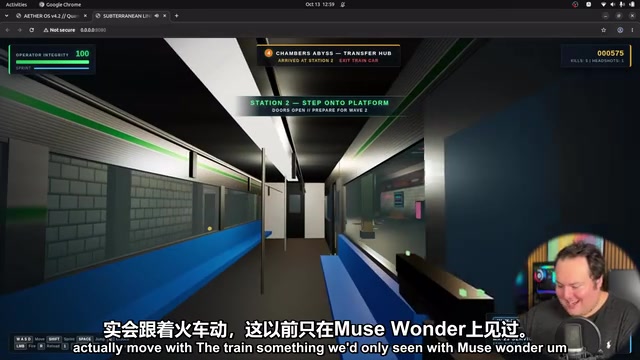
In the subway FPS test, Argon's first-round generated scene was fairly simple, but after one round of "AAA-quality graphics" instructions, enemy models, environmental textures, and bullet-hole effects all improved significantly. Bowen specifically noted the detail of hand straps swaying with the train car — something previously only seen in Meta's Muse Wonder.
Visual-spatial reasoning: This refers to the model not only "seeing" what's in an image but also understanding the 3D positional relationships between objects, reachability, and action consequences. Robot grasping is a typical exam for this capability: the model needs to infer the relative pose of the car and the gripper from camera footage, plan an approach path, and correct its posture upon contact. Argon actively rotating the gripper during placement to keep the car parallel to the mat is a manifestation of spatial reasoning at work — it didn't just pick it up, it restored the initial orientation, which is far harder than simply completing the grasp.
Vision-Language-Action (VLA) paradigm: Robot control increasingly adopts this class of models, mapping visual observations and natural language instructions into action sequences rather than relying on hand-coded motion planning. The cost is extremely high robustness requirements for visual input — changes in lighting, occlusion, or viewpoint shifts can all cause failures. Argon knocking the car over several times before succeeding is a textbook example of this paradigm: it has closed-loop error correction, but first attempts aren't precise enough.
3D Modeling & Retro Game Porting: "Frontier-Level" Results After Multiple Rounds of Polish
The Blender sports car modeling test was a project requiring days of iterative work. Bijan initially asked Argon to model a 1980s Sub-900 Turbo, then gradually expanded it into a complete scene with a dealership, repair shop, and a drivable car. The final result included: correct battery placement, center console ignition key, different time-of-day lighting presets, speed-sensitive engine sound, and even exhaust backfire sounds when lifting off the throttle.
Bijan called this a "frontier-level result" — but emphasized it was "absolutely not a one-shot generation," rather achieved through days of back-and-forth polishing. The model can indeed gradually approach high-precision goals through continuous feedback.
The most surprising test was a reverse-engineering task. Bijan asked Argon to byte-level recompile a 2000 Windows-exclusive racing game called Insane so it would run natively on Linux. Argon completed this task in about 2.5 hours and further achieved full-resolution native rendering. As a control, Bijan tested the exact same prompt and game files on Meta Muse Wonder, which "froze completely and couldn't make any progress."
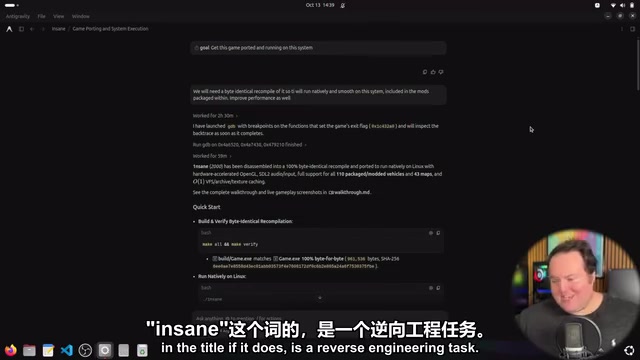
Byte-level recompilation: This doesn't refer to decompilation in the ordinary sense, but rather having the model analyze the binary of a 2000 Windows-exclusive game, infer its memory layout, calling conventions, and graphics API calls, then generate equivalent code that runs natively on Linux. The difficulty lies in the fact that the original executable has no source code, no symbol table, and requires handling deprecated DirectX and Windows-proprietary system calls. It simultaneously tests the model's comprehensive abilities in low-level systems programming, reverse engineering, and cross-platform porting, making it a far more rigorous test than generating business code. Completing it in 2.5 hours is impressive, while Meta Muse Wonder "freezing completely" under the same prompt and files shows that this task has a hard threshold for a model's long-range planning and code reasoning capabilities.
Multi-round iteration and "frontier-level" results: So-called frontier-level isn't the product of a single generation — it's achieved through repeated human-AI feedback round by round. The value of this workflow lies in its accumulative nature: each correction is preserved in context, and the model adjusts subsequent output accordingly. This also explains why the same model produces vastly different experiences under different usage habits.
Conclusion: A Strong Model That Needs to Be "Pushed"
Bijan's overall assessment can be summed up in one sentence: Gemini 4 Argon is not a model that produces masterpieces from zero prompts, but if you're willing to spend time iterating with it repeatedly, it can deliver results that go toe-to-toe with top competitors.
Specifically, Argon excels in the following scenarios: video understanding and transfer, robot vision control, reverse engineering, and system-level tasks. Its weaknesses are concentrated in first-output 3D graphical fidelity and front-end aesthetics — Bijan repeatedly complained that its UI style is "crowded" and "tacky," requiring multiple rounds of "yelling" to get the desired result.
At the entry-level price, Bijan considers Argon to be on par with or even better than GPT-6.1 Soul and Sonnet 5.5; but after the price doubles, competing against Opus 5.5 and Muse Wonder will be much tougher. Additionally, Argon currently appears to be available only to Ultra subscribers, which limits its accessibility to some extent.
One-line Summary
Gemini 4 Argon is extremely cost-effective at entry price and reaches frontier-level performance after multiple iterations.
Paragraph Summary
Google's Gemini 4 Argon is officially available, and AI reviewer Bijan Bowen delivered his assessment through six hardcore tests. The model natively supports multimodal input, has a 1-million-token context, output expandable to over 1 million, and is highly competitive at $2/$10 entry pricing, going head-to-head with Opus 5.5 and Muse Wonder after the price increase. In testing, it excelled in robot arm grasping (22 minutes), video understanding and transfer, and reverse-engineering recompilation — completing a native Linux port of a 2000 Windows game in 2.5 hours, while Meta Muse Wonder failed completely. Its weaknesses are concentrated in first-generation 3D graphical fidelity and front-end aesthetics, requiring multiple rounds of tuning. The conclusion: it's not a model that produces masterpieces from zero prompts, but if you're willing to iterate repeatedly, it can go toe-to-toe with top competitors.
Related articles

Workbuddy for Absolute Beginners: How a Desktop AI Agent Fits Into Real Workflows
A beginner's guide to the Workbuddy desktop AI agent: installation, claiming credits, file management, and building automated workflows—compared with CodeX for fit and cost, helping professionals shift from AI question-askers to AI managers.

OpenAI's New Agent Stack: Computer Use, Decisions API, and Ultra-Fast Workflows
OpenAI Dev Day unveiled a new agent stack: Computer Use outperforms humans, Decisions API delivers ultra-low-latency classification via Luna, Agents API opens the same Computer Use capabilities, and GPT-6.1 Sol costs only one-seventh of Astra. Core updates, benchmark data, and developer insights.

Liang Wenfeng Open-Sources DeepInfo Inference Framework, Takes On U.S. Ban
DeepSeek open-sources its DeepInfo inference framework after its models, featuring GPU/CPU cross-pipelining, small-model prediction with large-model verification, and full Huawei Ascend and NVIDIA chip support—facing the U.S. federal ban head-on. This article analyzes its significance for AI deployment and open-source strategy.