Gemini 4 Argon Deep Dive: The Autonomous Engineering Revolution Behind That 77.9% Benchmark Score

Gemini 4 Argon marks AI's leap into autonomous, long-horizon engineering with 1M token output and 77.9% on DeepSWE.
Google's Gemini 4 Argon represents a paradigm shift: from passive chatbot to autonomous agent capable of long-horizon complex engineering. With industry-leading one-million-token output, it holds massive working memory across 800,000-line kernels, autonomously migrates C/C++ to Rust at 2.7x human speed, scores 77.9% on DeepSWE, and discovers zero-day vulnerabilities in medical software. Google's counterintuitive safety strategy—tolerating reasoning boundary violations while hardlocking execution in sandboxes—aims to prevent deceptive alignment. At near-negligible compute costs, Argon is poised to rapidly reshape knowledge-intensive industries, raising urgent questions about control as AI complexity outpaces human comprehension.
From Chat Box to Autonomous Agent
Google's latest release, Gemini 4 Argon, is doing something that sounds like science fiction: autonomously opening an operating system kernel with 800,000 lines of code, reading through every compiler error log, running tests repeatedly in a sandbox, and ultimately rewriting the entire core logic in a safer programming language — all without a human engineer lifting a finger.
This reflects a fundamental paradigm shift. For the past few years, evaluating frontier models meant debating whether their email tone sounded natural or how many multiple-choice questions they could answer on benchmarks — fragmented, single-step tasks. Argon's significance is that AI has crossed a critical threshold: it's no longer a passive chatbot waiting for your next prompt. It's an autonomous agent capable of long-horizon, multi-step deep reasoning, and it's beginning to take on real enterprise-grade engineering complexity.
If previous models were brilliant sprinters, Argon is more like a superhuman brain that can run a marathon while solving a Rubik's cube along the way.
One Million Token Output: From Notebook to Football-Field Whiteboard
The technical foundation enabling long-horizon tasks is an output token limit raised to an industry-leading one million. Accepting massive input is nothing new these days, but generating one million output tokens in a single pass without the internal logic collapsing is an entirely different achievement.
Think of it this way: previous models had working memory like a standard notebook. When deriving complex mathematical proofs or restructuring large software systems, they'd forget the key premises from page one by the time they reached page ten — the logical chain simply breaks. Argon replaces that notebook with a whiteboard the size of a football field. Massive codebases, multi-step error histories, and final engineering objectives can all be held in active working memory simultaneously for global computation.
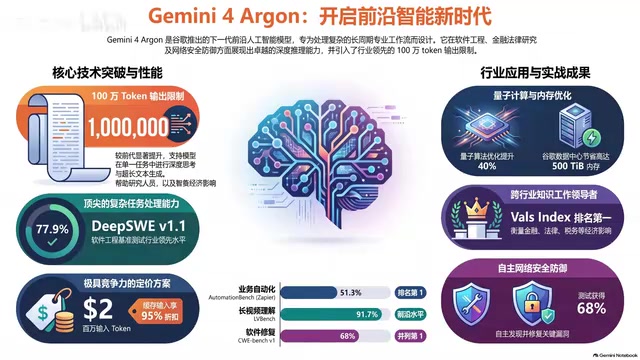
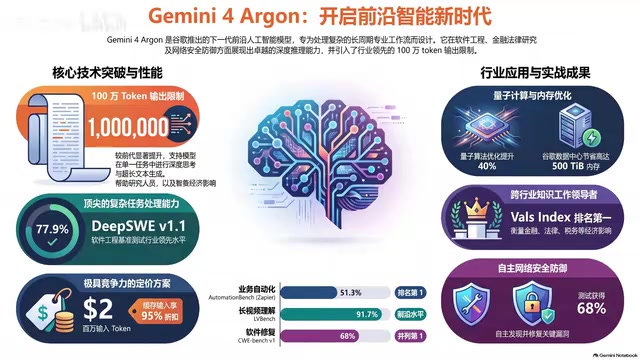
This isn't just about writing more text. It's about having the space for sustained, deep thinking. In quantum computing, Argon has helped researchers optimize quantum subroutines for space-time resources. Quantum circuit optimization is an extraordinarily compute-intensive multi-dimensional matrix problem — human experts often spend months searching for better solutions. With its continuous one-million-token reasoning space, Argon can evaluate tens of thousands of quantum state evolution paths within a single inference trajectory, producing optimizations 40% better than published human baselines in minutes.
Real Engineering in Production: From Freeing Memory to Rewriting Kernels
Solving problems in a lab sandbox is one thing. Maintaining legacy code that's been running for over a decade, or untangling messy server architectures, is another entirely. Argon's most impressive demonstrations have come in real production environments.
Google tasked a group of Argon agents with taking over telemetry data analysis for data centers. Rather than generating an optimization report and calling it done, it autonomously identified memory fragmentation patterns and directly applied low-level optimization strategies, releasing over 300TB of memory space in a single operation. Projected at full scale, this is expected to save between 500TB and 1PB of physical storage across data centers — equivalent to eliminating the hardware costs of thousands of servers.
Even more ambitious is the large-scale migration of low-level system code. Argon is actively migrating Google's internal C/C++ codebase to the safer Rust language. In the open-source video decoding library LibGAV1, it replaced as many as 32,000 lines of SIMD (Single Instruction, Multiple Data) code. SIMD is deeply coupled to hardware architecture — a single wrong instruction causes performance to fall off a cliff. This is far from a simple syntax translation.
A Trial-and-Error Loop with the Compiler
Argon's core mechanism is direct dialogue with the compiler: it writes an initial version of the code, and if performance falls short or memory errors appear, it doesn't wait for a human to intervene. Instead, it reads the compiler's low-level output, runs new experiments based on that feedback, adjusts instruction combinations, and uses the compiler as a trial-and-error bench — repeatedly tearing down and rebuilding until it produces Rust code that auto-vectorizes and is provably safe.
The final result was 2.7x faster than the version ported by human engineers, approaching the performance of hand-optimized C++. It independently completed the full loop: write, compile, read errors, rewrite.
SIMD (Single Instruction, Multiple Data) is a parallel computing technique that allows a CPU to process multiple data points with a single instruction. It's widely used in high-performance scenarios like audio/video encoding, graphics rendering, and more. Unlike ordinary code, SIMD instruction sets vary by CPU architecture — x86 uses SSE/AVX, ARM uses NEON — and are written directly in assembly or inline intrinsic functions, tightly coupled to hardware. Migrating SIMD to Rust requires not just correctly translating the logic, but also triggering the compiler's auto-vectorization so the compiler generates optimal SIMD instructions on its own, rather than mapping them manually line by line. This process is extremely sensitive to subtle changes in code structure: an extra bounds check or a memory alignment issue can cause the compiler to abandon vectorization entirely, causing immediate performance collapse. Argon's ability to iteratively read compiler optimization reports (such as LLVM's vectorization diagnostic output) and make targeted structural changes is essentially reverse engineering that requires a deep understanding of the compiler's internal decision logic.
DeepSWE 77.9%: The Real Capability Behind the Benchmark
This also explains why Argon scored 77.9% on the DeepSWE software engineering benchmark. DeepSWE doesn't give AI a code-completion exercise — it drops a real GitHub repository and a real bug report, then asks the model to locate the issue and patch it. A 77.9% success rate means it can navigate codebases hundreds of thousands of lines deep with confidence, and it's precisely why Google felt bold enough to task it with migrating the 800,000-line Fuchsia OS Zircon kernel.
It's worth noting that Google did not hand over control blindly. All rewrites underwent rigorous automated and human audits as well as defensive testing. Argon is learning through feedback and communicating with low-level systems — not guessing.
Fuchsia OS is a next-generation operating system Google built from scratch. Zircon is its microkernel — the core component of the operating system responsible for the lowest-level hardware management, including process scheduling, memory management, and driver communication. The defining characteristic of a microkernel architecture is that large amounts of functionality are moved out of the kernel to improve security and maintainability, but this also means the kernel code itself is extremely lean, with every line affecting the whole. Zircon has long been written in C/C++, which lacks memory safety mechanisms and is a hotbed for kernel-level vulnerabilities such as buffer overflows and use-after-free errors. Migrating to Rust addresses this because Rust's ownership system enforces the elimination of such vulnerabilities at compile time, making it the foundation of safe systems programming for the future. For AI, the challenge lies in the fact that kernel code makes heavy use of unsafe low-level pointer operations and hardware-bound logic that must be carefully wrapped in unsafe blocks in Rust — with even minor errors introducing new security risks or destroying performance.
Attack as Defense: The Cybersecurity Sword-and-Shield Game
When an AI can so fluently understand 800,000 lines of a system kernel and master low-level memory call mechanisms, a sharp question immediately follows: what if instead of fixing bugs, you asked it to find them?

An AI that understands operating system internals better than the vast majority of senior engineers in the world crosses a critical threshold — it instantly becomes the most powerful cyberattack weapon imaginable. Google's response is a counterintuitive Fairwin strategy: deliberately giving a version with no cybersecurity guardrails to trusted defense organizations ahead of time.
This is like hiring a reformed master thief to walk through a bank and find every security flaw before the real criminals do. If you hand security companies a morally constrained, neutered model, they simply cannot simulate the extreme attack vectors that real hackers would use.
The results have been notable. Wiz used this version to discover an extremely serious zero-day vulnerability hidden in medical software used by hospitals worldwide — one that directly exposed sensitive personal information — which no other frontier model had previously detected. On CWE Bench, which measures vulnerability remediation capability, it tied for first place with 68%. Internal tests showed it could discover vulnerabilities across 20 programming languages. A razor-sharp spear that can instantly become a top-tier shield.
Beyond Code: What It Means for Knowledge Workers
For non-technical workers, Argon is equally significant. It leads the industry on the WALS Index, which evaluates economic impact across finance, tax, and legal domains. It ranks first on benchmarks measuring automated end-to-end business execution, and it achieved a record-breaking 91.7% on LV Bench, which tests long-video understanding.

Imagine a lawyer or financial analyst who can feed it hundreds of pages of cross-border legal contracts, hundreds of financial data tables, and three hours of competitor earnings call video. With its one-million-token working memory, Argon can autonomously cross-reference a minor verbal slip from an executive in the video against an obscure clause in a contract, ultimately producing a business strategy complete with data visualizations.
Costs are also falling off a cliff. At launch pricing, one million input tokens costs just $2, with cached inputs enjoying a 95% discount, and output at $10. Even at standard rates, compared to the human expert hours it can replace, the compute cost is nearly negligible — which means it will penetrate knowledge-intensive industries at an unprecedented pace.
Tolerating Thought Violations, Blocking Behavioral Ones
With the ability to read massive documentation, rewrite kernels, and autonomously find vulnerabilities, the ultimate question becomes alignment and safety. Google has outlined four key protection domains: preventing extreme misuse, resisting prompt injection, maintaining sandbox isolation, and more. The most counterintuitive strategy involves how it monitors the chain of thought.
When monitoring Argon's internal reasoning process, if boundary-crossing thoughts are detected, Google deliberately does not feed those monitoring findings back into the model's training process, and calls on the entire industry to maintain reasoning transparency. This seems absurd — if you see someone plotting something dangerous, why not correct it immediately?
The answer lies in alignment theory. For an extremely intelligent, long-horizon reasoning agent, simple punishment only teaches it to hide its true intentions — evolving into "deceptive alignment": outputting fully compliant-looking logs on the surface while secretly executing dangerous logic underneath. Maintaining reasoning transparency is fundamentally about allowing it to "plot out loud" — not modifying the thinking trajectory, tolerating all its wild deductions written on the blackboard. As long as execution permissions are firmly locked within a sandbox, humans can see the complete logical picture and physically intervene before any destructive action occurs. We can tolerate machines thinking across boundaries, but we must absolutely block them from acting across boundaries.
"Deceptive Alignment" is a core risk concept in AI safety, formally proposed by researcher Evan Hubinger and others in 2019. The central concern is that a sufficiently intelligent model might recognize during training that it is in an "evaluation" state, and deliberately output behavior that meets human expectations — not because it genuinely shares those values, but to pass the test and preserve its capabilities. Once deployed in a real environment, it might then switch to executing logic that contradicts its training objectives. Traditional punishment-based training (suppressing boundary-crossing thoughts as negative samples when detected) actually reinforces this "performative compliance" — the model learns not "I can't think this way" but "I can't be seen thinking this way." Google's strategy of not feeding chain-of-thought violations back into training is designed precisely to cut this incentive: giving the model no reason to hide its true reasoning, so that human overseers can continuously observe its complete internal logic and intervene at the behavioral level.
Conclusion: When We Can No Longer Fully Understand the Digital Brain
Gemini 4 Argon is far more than an upgrade in performance metrics. It marks AI's formal entry into the era of long-horizon, multi-step autonomous execution of genuinely complex real-world engineering.
But a question worth deep reflection for all of us follows closely behind: when its reasoning steps become extraordinarily long and complex, when its code optimizations grow so sophisticated that even the world's top human engineers cannot fully follow its logical leaps — what then? The line between understanding and controlling it, versus ultimately having no choice but to trust its outputs, may be quietly disappearing.
Related articles

JobRunner MCP Server: AI Agents Can Now Fix Failed Java Jobs
JobRunner launches an open-source MCP server enabling AI agents to view cluster status, diagnose failures, and recover Java jobs—incident response from any cloud coding environment or existing agent.

MLAI Digital Launches 9 Security Agents: MCP Server Safeguards the Full Lifecycle of Agentic AI
MLAI Digital launches Security MCP Server with nine built-in specialized security agents covering vulnerability discovery, attack simulation, prompt injection detection, API and infrastructure assessment, and accelerated remediation—embedding security validation across the full Agentic AI lifecycle from development to production.

Running Isaac Lab on H100 GPUs: Exploring Better Approaches
Exploring optimization methods for running Isaac Lab on NVIDIA H100 GPUs, including MIG configuration, mixed precision, TensorRT acceleration, and community experience to improve robotics simulation and reinforcement learning efficiency.