Gemini 4 Argon First Hands-On Test: Wins 14 of 19 Benchmarks, but Highly Specialized

Gemini 4 Argon released: strong at long-horizon tasks but specialized; API price halved before November 30th.
Google officially released flagship model Gemini 4 Argon, with API pricing at $2 input/$10 output, a window-period price only that doubles to $4/$20 after November 30th. Access is divided into three tiers: API pay-as-you-go allows direct calls, Pro/Ultra subscriptions allow use in Gemini App and Search AI Mode, and writing code in Anti-Gravity requires the highest-tier Ultra, with no free-tier free-riding. Among 19 official tests, Argon won 14, ranking first in Deep SWE long-horizon software engineering at 77.9%, but lost Terminal Bench 4.0 to Opus 5.5 and Frontier SWB to GPT-6 Astra, showing clear specialization. In actual demos, long-horizon multi-step tasks such as pixel castles, 3D flight, Dinosaur Island, spider-silk swinging, and cycling were all completed in one shot, demonstrating Deep Walk capability. Conclusion: Argon is a sharp tool for long-horizon tasks, overkill for everyday Q&A, and the window period is the time to get on board at low cost.
Google's flagship model Gemini 4 Argon, which has been in development for over half a year, has finally been officially released. But the most noteworthy aspects of the release aren't the model's name—they're the pricing, access tiers, and actual demo performance.
Price Window: Get On Board Now or Wait for the Price to Double
The current API pricing is $2 for input and $10 for output, the same as GPT-6.1 Salt and half the price of Cloud Opus 5.5. But after November 30th, the price will double directly to $4 and $20, matching Opus.
According to hands-on analysis by Bilibili creator Yuze, access is divided into three tiers: API pay-as-you-go allows direct calls; Pro or Ultra subscribers can use it in the Gemini App and AI Mode in Search; to write code in Anti-Gravity, you must have the highest-tier Ultra subscription. The free tier has no room for any free-riding.
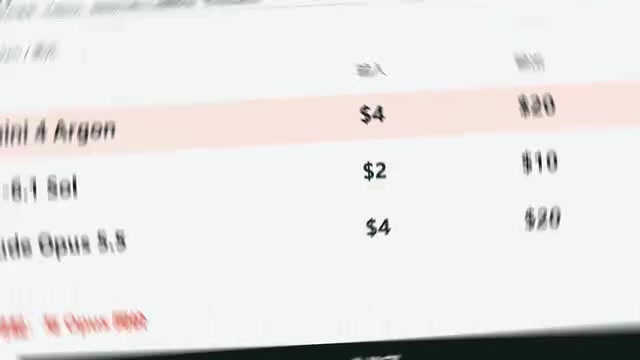
Cached input has separate discounts; refer to the official price list for details. If you want to try it at low cost, before November 30th is a clear window of opportunity.
Anti-Gravity is Google's AI programming environment/IDE, positioned similarly to Cursor or GitHub Copilot Workspace, allowing developers to directly call Gemini models within the editor for code generation, refactoring, and debugging. The article mentions "to write code in Anti-Gravity, you must have the highest-tier Ultra subscription," indicating that Google ties its most compute-intensive programming agent capabilities to its highest subscription tier, forming tiered monetization: API pay-as-you-go targets enterprise integration, Pro/Ultra subscriptions cover lightweight users, and high-value scenarios like Anti-Gravity are only open to Ultra. This strategy aligns with how OpenAI and Anthropic partition access to programming tools. It also means that individual developers who want to use Argon for coding at low cost may find that API pay-as-you-go during the window period is actually more cost-effective than subscribing to Ultra—but they must manage token consumption and cache hit rates themselves.
Benchmark Results: Wins 14 of 19, but with Obvious Specialization
Among the 19 tests officially published, Argon won 14. Deep SWE long-horizon software engineering scored 77.9%, ranking first, and Boss Index also ranked first.
But the specialization problem cannot be ignored. Terminal Bench 4.0 lost to Opus 5.5, and Frontier SWB lost to GPT-6 Astra. This shows that Argon doesn't dominate across the board, but makes trade-offs in specific dimensions.
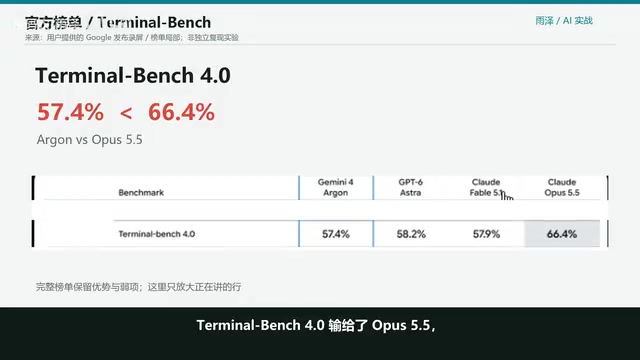
Benchmarks can only provide reference; what's truly convincing is the actual demonstrations.
Deep SWE (Deep Software Engineering) is a benchmark evaluating large models' comprehensive capabilities in long-horizon software engineering tasks. Unlike traditional single-file code completion or algorithm problems, it requires models to complete multi-file, multi-step modifications, debugging, and refactoring in real codebases, testing context retention, tool calling, and planning abilities. Therefore, higher scores better reflect whether a model can handle the role of an "AI programmer." Terminal Bench focuses on models' operational capabilities in terminal environments, including command-line tool usage, shell script writing, system debugging, and error recovery, placing extremely high demands on reasoning chain stability and environmental awareness. Frontier SWB (Frontier Software Building) leans toward building complete applications from scratch end-to-end, typically involving frontend-backend integration, UI generation, and deployment logic, examining models' ability to transform vague requirements into runnable projects. The three correspond respectively to "modify," "debug," and "build" in software engineering. Argon leads in modification and building but loses points in debugging and some building, indicating its strengths are concentrated in planning and generation, with remaining shortcomings in fine-grained tool operations.
Actual Demonstrations: Long-Horizon Tasks Are Its Home Turf
Pixel Art Comparison: Argon on the left, GPT-6 Astra on the right, both drawing a pixel-art castle at night on the same prompt.
3D Flight Game: Argon on the left, Opus 5.5 on the right, same-prompt comparison of stunt flying, seeing who flies more steadily.
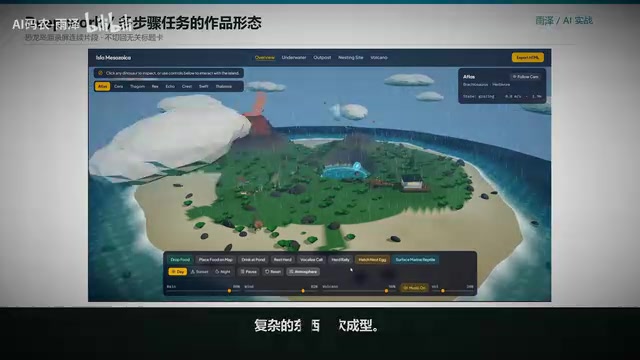
Dinosaur Island: Day-night cycle, rainfall, volcanic eruptions, dinosaur herd behavior—a complete 3D interactive webpage delivered in one go. This is exactly the Deep Walk long-horizon multi-step task capability Google emphasizes—complex things completed in one shot.
Spider-Silk Swinging 3D Game: Left and right, same prompt, Argon vs. Opus 5.5, directly comparing gameplay and scoring.
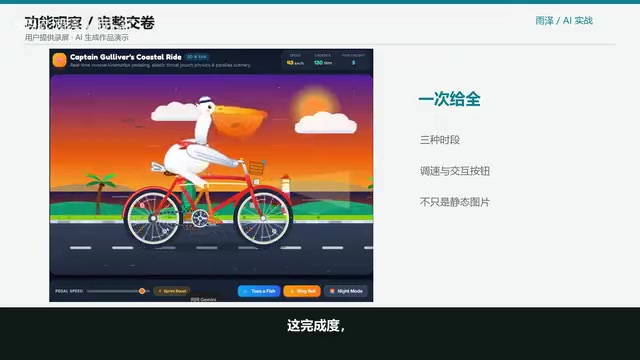
Stunt Cyclist: Creator Yuze's traditional test prompt. The previous Open Code degradation hands-on test also used this prompt. This time the same prompt tests Argon, with the project named Captain Gulliver's Coastal Ride, supporting three modes—day, dusk, and night—pedal speed control, and even a throw-and-press-0 to give everything at once. The level of completion lives up to the word "flagship."
Deep Walk is the long-horizon multi-step task execution capability Google emphasizes for Gemini 4 Argon. Its core is that the model can maintain continuous tracking of complex goals within a single session, autonomously decompose subtasks, call tools, verify intermediate results, and dynamically correct its path, rather than relying on humans to re-prompt at every step. Unlike traditional "question-and-answer" interaction, Deep Walk is closer to an agent workflow: the model acts like a project manager, planning sequences, allocating attention, remembering early decisions within long contexts, and ultimately delivering a complete, runnable result in one go. The 3D flight game, Dinosaur Island interactive webpage, and spider-silk swinging game demonstrated in the article are all tasks requiring hundreds of lines of code, multiple rounds of asset generation, and logic debugging—precisely validating Deep Walk's value in "one-shot completion" and explaining why using it for everyday Q&A is overkill—such tasks simply cannot trigger the long-horizon planning mechanism.
Conclusion: A Sharp Tool for Long-Horizon Tasks, Overkill for Everyday Q&A
Argon's positioning is very clear—prepared for long-horizon tasks. Writing code, making games, doing research—Deep Walk is its home turf. Using it for everyday Q&A is overkill.
On pricing, one more reminder: $2/$10 until November 30th; after the window period, it doubles. Will you get on board now or wait until December to see it double?
One-line Summary
Gemini 4 Argon released: strong at long-horizon tasks but specialized; API price halved before November 30th.
Paragraph Summary
Google officially released flagship model Gemini 4 Argon, with API pricing at $2 input/$10 output—a window-period price only, doubling to $4/$20 after November 30th. Access is divided into three tiers: API pay-as-you-go allows direct calls, Pro/Ultra subscriptions allow use in Gemini App and Search AI Mode, and writing code in Anti-Gravity requires the highest-tier Ultra. The free tier has no room for free-riding. Among 19 official tests, Argon won 14, ranking first in Deep SWE long-horizon software engineering at 77.9%, but lost Terminal Bench 4.0 to Opus 5.5 and Frontier SWB to GPT-6 Astra, showing clear specialization. In actual demos, long-horizon multi-step tasks such as pixel castles, 3D flight, Dinosaur Island, spider-silk swinging, and cycling were all completed in one shot, demonstrating Deep Walk capability. Conclusion: Argon is a sharp tool for long-horizon tasks, overkill for everyday Q&A, and the window period is the time to get on board at low cost.
Related articles

Cursor Can Now Control Your Computer: AI Agents Can Drive Desktop Apps for Testing
Cursor adds desktop control: AI agents can drive desktop apps like the iOS Simulator to test their own features. We analyze the impact on dev workflows, possible technical approaches, and reliability concerns.

Vibecoding a Custom Inference Engine: High Hopes, Harsh Reality
A Reddit developer shares the real experience of vibecoding a custom inference engine: running GGUF Q4 models in the browser with WebGL2 and GLSL, only to fall into tokenizer debugging hell. This article analyzes the engineering challenges of browser-side LLM inference and why cloning llama.cpp is the more rational choice.

How High Are Anthropic's Early Investor Paper Returns Ahead of IPO?
Anthropic's early investor paper returns draw attention ahead of IPO. This article analyzes sources of book gains, capital structure, pre-IPO games and risks, and implications for the AI startup ecosystem.