Gemini 4 Argon for Robotics: Google AI's New Move in Embodied Intelligence

Hacker News reveals Gemini 4 Argon for Robotics, hinting Google is injecting Gemini's general intelligence into robot bodies.
The article analyzes a brief Hacker News discussion titled "Gemini 4 Argon for Robotics." It argues the "Argon" suffix follows Google's habit of using element codenames for vertical-scenario versions, implying a dedicated Gemini branch for robotics with structural adjustments for physical-world perception and action output. Key challenges include mismatching discrete tokens with continuous action spaces, real-time constraints, and on-device inference. It compares the effort with NVIDIA GR00T, RT-2, and OpenVLA, noting Gemini's edge in native multimodal understanding.
Original title: Gemini 4 Argon for Robotics Source: Hacker News (rss)
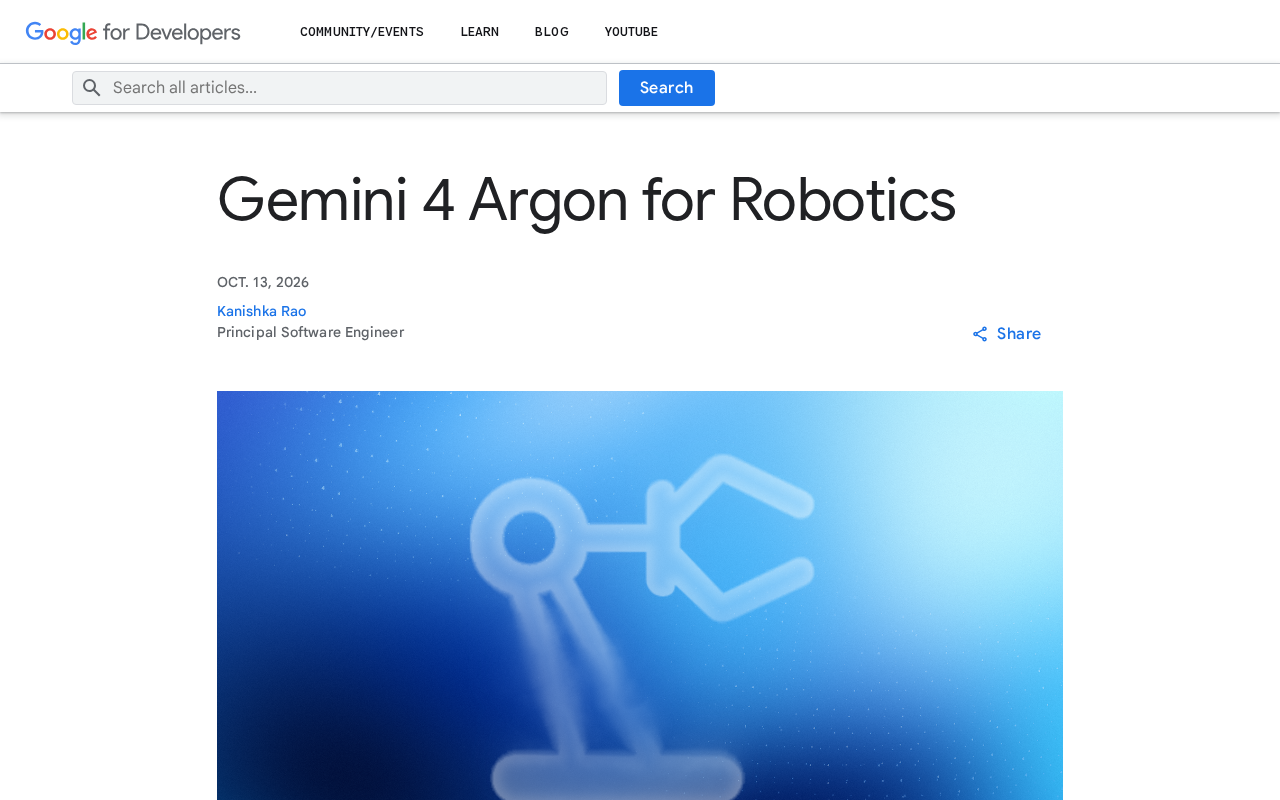
A brief but weighty discussion appeared on Hacker News: "Gemini 4 Argon for Robotics." There was no lengthy official blog post, no detailed technical whitepaper — just a topic pointing to a comment thread. But anyone familiar with Google AI's naming logic will immediately recognize that this is most likely another important branch of the Gemini model series aimed at robotics.
Why "Argon" Itself Is a Signal
Google has long favored using elements or codenames to mark specialized versions for vertical scenarios, beyond the model generation itself. The main Gemini model handles general reasoning and multimodal understanding, and when it's tagged with the "Argon" suffix and paired with Robotics, it typically means two things: the model has undergone structural adjustments for perception and action output in the physical world, and Google is pulling large model capabilities out of the screen and onto real hardware.
This isn't an isolated move. Over the past year, Google's activity in embodied intelligence has clearly intensified, from vision-language-action models to exploration of robot foundation policies, all welding together the two chains of "understanding the world" and "changing the world." The emergence of Argon looks more like an engineering attempt to inject Gemini's general intelligence directly into robot bodies.
Embodied AI refers to the research direction in which agents interact with the environment through a physical body to acquire information, learn skills, and complete tasks. Its fundamental difference from traditional pure-software AI lies in the "closed loop": the model's output changes the environment state, and the environment state in turn becomes the input for the next moment. This closed loop brings several unique challenges. First is data scarcity — there aren't enough robot manipulation trajectories available on the internet for learning, so methods like teleoperation data collection, simulation synthesis, and cross-embodiment data transfer are needed. Second is distribution shift — objects, lighting, and layouts at training time will almost inevitably change in real environments, so models must have online adaptation capabilities. Third is safety and irreversibility — errors in virtual environments can be rolled back, but collisions in the physical world can cause hardware damage or personal injury. Google extending Gemini's capabilities to robots is essentially about solving how general semantic understanding can coexist with the above physical constraints.
What's Actually Hard About a Robotics Version of Gemini
Cramming a large model into a robot sounds like just interface adaptation, but the actual challenges are far greater. Language models process discrete tokens, while robots need continuous force control, joint angles, and real-time feedback. Latency tolerance is also completely different — cloud inference being a few hundred milliseconds slow is harmless in conversation, but a robotic arm may have already hit the table.
Judging from the discussion atmosphere on Hacker News, developers' main concerns center on a few points: whether Argon provides native robot action space support, whether inference runs on-device or relies on the cloud, and whether Google will open up fine-tuning capabilities so teams can integrate their own hardware. The answers to these questions determine whether it's a demo-level showcase or a deployable toolchain.
Real-time performance is a hard constraint for deploying robot foundation models, rooted in the mismatch between control frequency and inference latency. Typical robotic arms have closed-loop control frequencies between 100Hz and 1kHz, meaning each control cycle has only a 1 to 10 millisecond budget; while a large model with billions of parameters, even after quantization and distillation, often still requires tens to hundreds of milliseconds for a single forward inference. A common compromise is a hierarchical architecture: the large model outputs high-level subgoals or action chunks at low frequency (e.g., 1 to 5Hz), and then a lightweight low-level controller executes at high frequency with real-time corrections. Another path is on-device deployment, moving inference onto the robot body through model quantization, pruning, and specialized accelerators, sacrificing some capability for latency and privacy. Therefore, to judge whether Argon is usable, the key metrics are not model parameter count or benchmark scores, but end-to-end latency, control frequency, and whether it supports action chunking output.
Its Competitive and Cooperative Relationship with Existing Robot Stacks
The robotics field is not lacking in foundation models. NVIDIA has the GR00T series, and open-source community VLA models like RT-2 and OpenVLA are also iterating rapidly. If Gemini 4 Argon is merely a "stronger large model + robot API," it will be hard to form a generational gap. Its potential advantage lies in Gemini's native multimodal understanding — the ability to handle complex scenes, ambiguous instructions, and multi-turn task decomposition, which is precisely the weakest link in traditional robot planning modules.
Another variable is Google's own hardware ecosystem. If Argon can form a closed loop with Google's robot bodies, simulation environments, and cloud inference infrastructure, it may carve out a path of "models defining hardware," rather than just providing a brain for third-party robots.
VLA (Vision-Language-Action) models are currently the most closely watched technical paradigm in embodied intelligence, first systematically proposed by Google DeepMind's RT-2 work. Its core idea is: take visual observations and natural language instructions as input, and directly output robot-executable action sequences, thereby skipping the traditional layered pipeline of "perception → planning → control." RT-2, through joint training on internet-scale image-text data and robot demonstration data, gives the model a certain degree of semantic generalization and commonsense reasoning ability, such as understanding abstract instructions like "hold up the thing that's about to fall." OpenVLA is the open-source community's reproduction and advancement of this idea, using an open-source vision-language model of about 7 billion parameters as the backbone, fine-tuned on the Open X-Embodiment dataset, and providing downloadable weights so academic teams don't have to train from scratch. NVIDIA's GR00T places more emphasis on the combination of "foundation model + simulation data + hardware platform," relying on the Isaac simulation environment to generate large-scale synthetic trajectories. Only by understanding these differences can one judge whether Gemini 4 Argon is taking a closed-source integrated route or trying to enter the general VLA track through multimodal understanding capabilities.
What Developers Should Watch Now
For teams working on robot applications or embodied intelligence research, the value of this kind of news is not in immediately getting hands-on, but in judging the direction of technology trends. If Gemini 4 Argon truly makes action output a first-class citizen of the model, then the engineering paradigm built around "large models directly driving robots" will accelerate to maturity, and traditional planning and control code in the middle layer may be gradually compressed.
It's recommended to continuously track several specific signals: whether the official API or SDK is released, the supported action spaces and hardware list, measured inference latency data, and whether open-source reproductions based on Argon appear in the community. Before these deployment details are clear, staying attentive is more prudent than rushing to migrate.
This article analyzes based on Hacker News discussion leads and the public naming lineage of Google's Gemini series. Specific technical details are subject to official subsequent disclosures.
One-line Summary
Hacker News reveals Gemini 4 Argon for Robotics, suggesting Google is injecting Gemini's general intelligence into robot bodies.
Paragraph Summary
The article analyzes a brief discussion that appeared on Hacker News, "Gemini 4 Argon for Robotics." The author believes the "Argon" suffix continues Google's habit of using element codenames to mark specialized versions for vertical scenarios, suggesting this is a dedicated branch of Gemini for robotics, meaning the model has undergone structural adjustments for physical world perception and action output. The core difficulties of putting large models into robots lie in the mismatch between discrete tokens and continuous action spaces, real-time constraints, and on-device inference capability. Developers are most concerned about action space support, cloud or on-device deployment, and the degree of fine-tuning openness. The article further compares it with VLA models such as NVIDIA GR00T, RT-2, and OpenVLA, pointing out that Gemini's potential advantage is native multimodal understanding for handling complex scenes and ambiguous instructions, and suggests developers watch for deployment signals such as official APIs, supported hardware lists, and measured inference latency.
Related articles

How Big Can Stars Really Get? The Physical Limits of the Largest Stars
Red supergiants are the largest stars by volume, with radii up to 2,000 times the Sun, engulfing the inner solar system. But there is no precise upper limit on stellar size—models predict up to 15,000 solar radii. The most massive blue stars are far smaller than red supergiants—biggest and heaviest are two different things.

Apple HomeView Smart Display Full Feature Breakdown: Wall-Mount or Desktop, $299
Apple launches HomeView, a $299 smart display with wall-mount and desktop options, 12MP camera for facial recognition, smart home control, music playback, and recipe step-by-step cooking. Full breakdown of watch faces, apps, privacy, and cooking integration.

Where Did the Promised New Studio Go? Craft Computing Answers After Five Years
Craft Computing's host responds to viewer questions: the new studio promised five years ago was shelved as construction costs soared from $30,000 to $75,000, and was replaced by a 168-square-foot garage conversion.