Gemini 4 Argon Goes GA: $2/$10 Limited-Time Pricing and Capability Breakdown

Gemini 4 Argon is now GA with limited-time low pricing through November 30, doubling in December.
Google made Gemini 4 Argon generally available on October 13, previously limited to Fairwind cybersecurity partners. It is now callable via paid API, AI Studio, Antigravity, enterprise subscriptions, and the Gemini app, but has no free tier. Standard pricing of $2/$10 input/output is limited-time and doubles to $4/$20 on December 1, with Batch, Flex, and Priority tiers doubling too. The model has a ~1.04M-token context window, supports text, image, video, audio, and PDF input, outputs text only, and ignores temperature/top-p/top-k. It leads Claude Opus 5.5 and GPT-6 Astra on coding and automation benchmarks but trails on Terminal-Bench 4.0 and the overall index. Developers need to complete real-workload testing and cost modeling within the window.
Gemini 4 Argon Goes GA: $2/$10 Limited-Time Pricing and Capability Breakdown
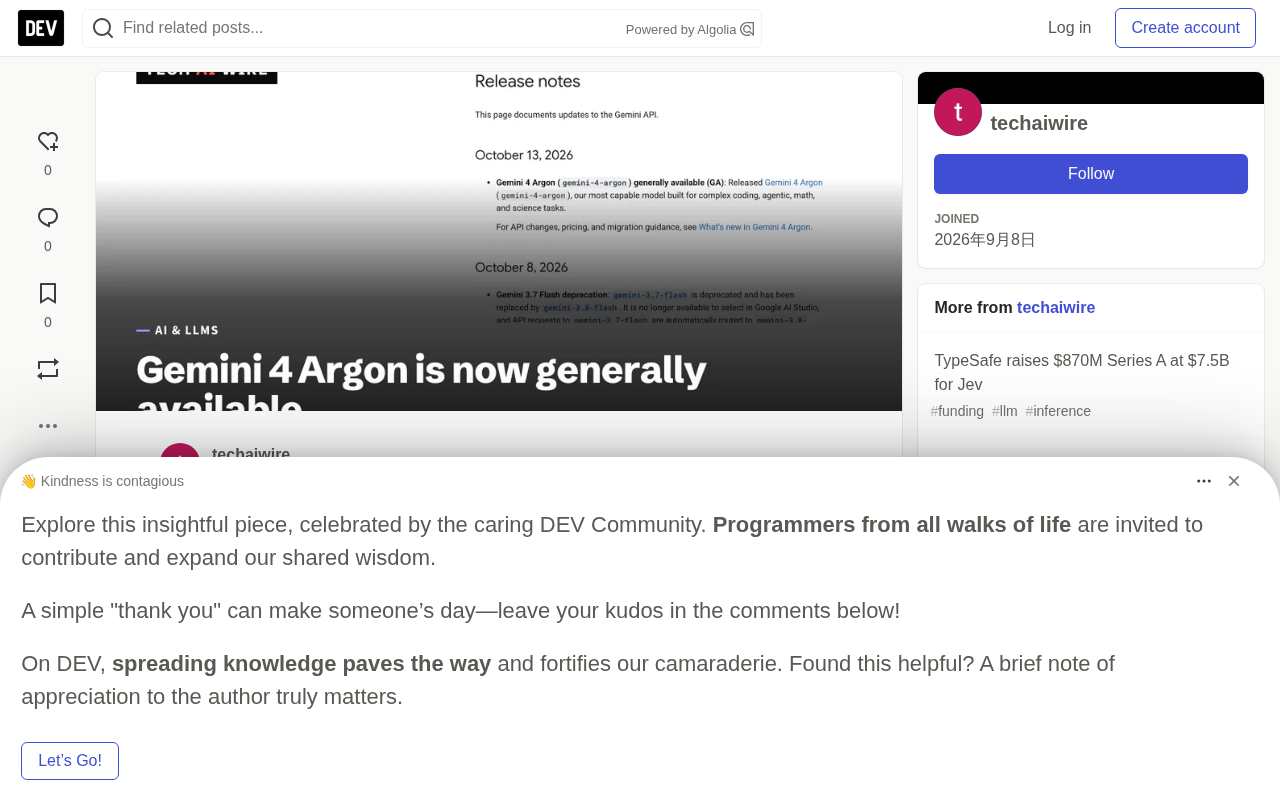
Google has officially moved Gemini 4 Argon into general availability (GA). Previously, the model was restricted to cybersecurity partners through the Fairwind program. Now, developers can call it directly through the paid Gemini API, with a limited-time low-price window.
From Closed Testing to General Availability
According to the Gemini API release notes, gemini-4-argon has been marked generally available since October 13. VentureBeat reports that the model was previously available only to cybersecurity defenders in Google's Fairwind program, which now counts hundreds of security partners.
Current availability channels for Argon include: the paid Gemini API and Google AI Studio, Google's agentic coding environment Antigravity (Ultra plan required for individual subscriptions), eligible Gemini enterprise subscriptions, the Gemini app and AI Mode in Search for Google AI Pro and Ultra subscribers, and Android Studio and Firebase AI Logic for Android developers.
Note that the model is not available in the API free tier. This means any production-level call requires a paid account.
Pricing Structure and Limited-Time Window
Argon's pricing is the most closely watched part of this launch. The standard tier currently costs $2 per million input tokens, $10 per million output tokens, and just $0.10 for cached input. This pricing holds through November 30.
Starting December 1, standard pricing doubles to $4 for input, $20 for output, and $0.20 for cached input. Batch and Flex tiers currently run $1 input / $5 output and also double after December. Priority tier currently runs $3.60 input / $18 output, rising to $7.20 and $36 afterward.
For reference, Gemini 3.8 Flash is priced at $0.75 input / $3.75 output—Argon is positioned notably higher. Output pricing includes the model's thinking tokens (internal reasoning consumption), while cached input is discounted billing for already-processed text.
Cached input billing is key to understanding Argon's cost structure. When a prompt prefix matches content from a previous request, the provider reuses the already-preprocessed KV cache, avoiding recomputation, so those tokens are billed at a steep discount. Argon's cached input price is just 5% of the standard input price ($0.10 vs. $2), which can significantly reduce real-world costs for agent applications that repeatedly carry the same long system prompt or knowledge base. Note that caching is not automatically applied to all requests—the source notes it is only auto-enabled when prompts reach 4,096 tokens, and short prompts cannot benefit from the discount.
Batch and Flex tiers target offline tasks that can tolerate latency. Batch packages multiple requests for asynchronous processing, while Flex queues at lower priority; both trade real-time responsiveness for roughly half the price. They suit evaluation, data labeling, batch summarization, and similar scenarios, but not interactive products.
Context Window and Feature Boundaries
Argon's context window is 1,048,576 tokens, shared across input, model thinking, and output. The default reply cap is 65,536 tokens, but longer background requests can produce around 1 million tokens (minus the input portion).
The model accepts text, image, video, audio, and PDF input, but replies with text only, generating no images or audio. Functionally, it supports function calling, code execution, search grounding, structured output, and computer use in preview.
Thinking intensity offers low, medium, and high levels, with medium as default. Caching is automatically enabled when prompts reach 4,096 tokens. One easily overlooked detail: Argon ignores temperature, top-p, and top-k sampling settings, meaning existing code that relies on these parameters to tune output diversity needs to be redesigned.
Thinking tokens refer to the tokens consumed by the model's internal reasoning before giving a final answer. For models that support "thinking intensity," this reasoning often accounts for a large share of output and is billed at the output rate. This means that even if the user sees a short reply, the bill may rise noticeably due to large amounts of hidden reasoning—developers cannot estimate costs based solely on visible text length.
Temperature, top-p, and top-k are traditional LLM sampling control parameters: temperature adjusts output randomness, while top-p and top-k limit the candidate word range, and they are often used to balance creativity and determinism. Argon's ignoring of these settings means the model uses a fixed internal decoding strategy, and code that previously relied on parameter tuning to control output style or stability will fail. Developers need to turn to prompt engineering or structured output constraints to achieve similar effects.
Benchmarks: Leading in Some Areas, Lagging in Others
Comparison data compiled by VentureBeat shows Argon leads on some benchmarks but trails competitors on others.
| Benchmark | Gemini 4 Argon | Claude Opus 5.5 | GPT-6 Astra |
|---|---|---|---|
| DeepSWE v1.1 (coding) | 77.9% | 74.2% | 74.1% |
| Zapier AutomationBench | 51.3% | 42.5% | 41.4% |
| Terminal-Bench 4.0 | 57.4% | 66.4% | Not reported |
| Artificial Analysis Index | 53 | 58 | 53 |
Argon performs strongly on coding and automation tasks, but Claude Opus 5.5 still holds the advantage on Terminal-Bench 4.0 and the overall index. VentureBeat also cited Google's safety data: unauthorized shortcuts accounted for 2% of coding evaluation attempts, and indirect prompt injection attacks succeeded 0.7% of the time across 15 adaptive attempts.
Red Dragon AI CEO Sam Witteveen gave VentureBeat a mixed assessment: "It's a very, very good model. But is it the best model out there? I don't actually think so."
Terminal-Bench is a class of evaluation targeting multi-step task execution in command-line/terminal environments, emphasizing a model's ability to plan, call tools, and recover from errors in real operating system contexts, making it closer to end-to-end agent performance than simple code completion. Argon trails Claude Opus 5.5 here, indicating its strengths are more concentrated in constrained coding and automation benchmarks.
The Artificial Analysis Index is a third-party aggregate score of multiple models' overall capabilities, covering reasoning, knowledge, coding, and other dimensions and producing a single number for easy cross-comparison, but it also masks differences in model strengths and weaknesses on specific tasks. Therefore, the source's emphasis on deciding "based on specific workloads rather than a single leaderboard" is precisely a reminder that composite indices are only a reference.
Five Action Items for Developers
Lock in testing before December 1. Limited-time pricing runs only through November 30. Run Argon now with your actual workloads, then budget at the doubled standard price.
Prioritize Batch or Flex for offline tasks. They cost only half the standard price and suit evaluation, data labeling, and other work that can wait.
Set output caps deliberately. The default is 65,536 tokens; for complex tasks, consider raising it to 131,072 or 262,144 tokens. Every output token is billed at the output rate, so setting it too high directly drives up costs.
Remove sampling parameters. Argon ignores temperature, top-p, and top-k, and sampling code written to tune diversity needs another approach.
Compare on agent tasks, not just coding. Argon leads on DeepSWE and AutomationBench but trails Claude Opus 5.5 on Terminal-Bench 4.0 and the overall index. Meta Muse Wonder, released the previous day, is also in a similar range. Model selection should be based on specific workloads, not a single leaderboard.
Argon's availability gives developers an option with strong capabilities but a pricing strategy that clearly goes "low first, high later." The limited-time window is both an opportunity and a requirement for teams to complete real-world validation and cost modeling as soon as possible.
Related articles

How Big Can Stars Really Get? The Physical Limits of the Largest Stars
Red supergiants are the largest stars by volume, with radii up to 2,000 times the Sun, engulfing the inner solar system. But there is no precise upper limit on stellar size—models predict up to 15,000 solar radii. The most massive blue stars are far smaller than red supergiants—biggest and heaviest are two different things.

Apple HomeView Smart Display Full Feature Breakdown: Wall-Mount or Desktop, $299
Apple launches HomeView, a $299 smart display with wall-mount and desktop options, 12MP camera for facial recognition, smart home control, music playback, and recipe step-by-step cooking. Full breakdown of watch faces, apps, privacy, and cooking integration.

Where Did the Promised New Studio Go? Craft Computing Answers After Five Years
Craft Computing's host responds to viewer questions: the new studio promised five years ago was shelved as construction costs soared from $30,000 to $75,000, and was replaced by a 168-square-foot garage conversion.