Gemini 4 Argon Hands-On: Twice as Fast at Coding and 60% Cheaper, But Its SVG Edge Has Been Surpassed

Gemini 4 Argon is twice as fast and 60% cheaper at coding, strong in multimodal but still lags in SVG and document processing.
Google officially released Gemini 4 Argon, positioned as a major leap in intelligence and logical reasoning. Hands-on tests show it's about twice as fast and 60% cheaper than Claude Opus 5.5 in coding tasks, and helped dramatically speed up Chrome codebase refactoring. In multimodal tasks, it ranks first in object detection and accurately handles handwritten notes, complex tables, and rotated text, with visual programming showing a distinctive front-end aesthetic. But its SVG animation edge has been overtaken by Fable 5.5, and it still trails Opus 5.5 in document processing and workflow automation. Pricing is $2 per million input tokens and $10 for output, with a 1 million token context window, enabling end-to-end workflows within the Google ecosystem. Meanwhile, new model developments from Fable 5.5, GPT-6.1 Astra, and Nano Banana 3 Pro are密集, and Anthropic warns that small-model self-replication capabilities are rapidly approaching reality.
Google has officially released Gemini 4 Argon to the public, deployed globally through the Gemini API and available to Pro and Ultra subscribers in the Gemini app. Positioned by Google as "a major leap in intelligence and logical reasoning," how does it actually perform in hands-on testing?
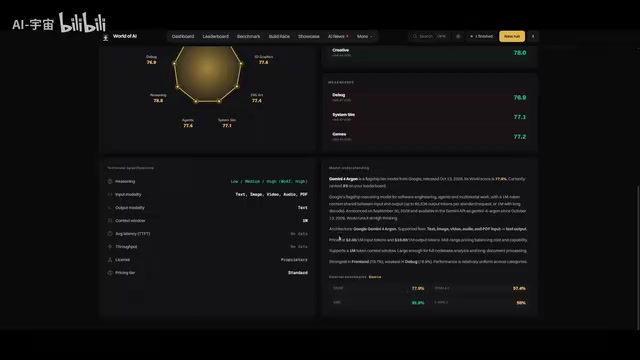
Coding Ability: Beating Claude Opus 5.5 on Both Speed and Cost
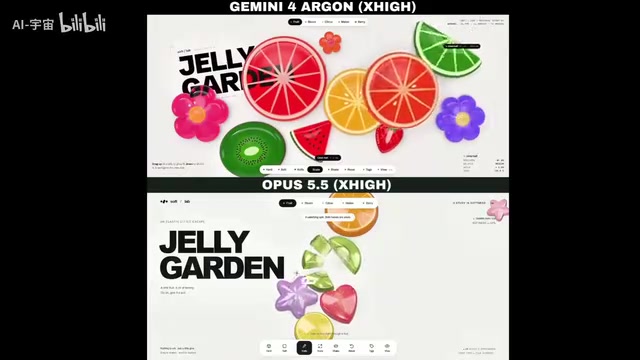
In front-end coding tasks, Gemini 4 Argon was directly compared against Claude Opus 5.5. The test was completed using Devinci Live with X-Hive logic, and the results were quite impressive: Opus 5.5 took about 30 minutes and $12.50, while Argon took only about 15 minutes and $5.
Both speed and cost were roughly half of its competitor, and the interface Argon generated even surpassed Opus in color richness and vibrancy. While Opus may be more solid on functionality, the foundational interface structure Argon created—which can be further refined—is already good enough.
More notably, Google's internal disclosures show that Argon helped refactor Chrome's massive codebase, compressing months of engineering work into weeks, with internal genetic code representation growing by over 35% and Gemini 4 delivering an overall 2.85x speedup.
About Devinci Live and X-Hive Logic: The Devinci Live and X-Hive logic mentioned in the article refer to a class of hands-on frameworks used to evaluate AI coding agents. Devinci Live typically refers to having models directly generate runnable interactive interfaces in front-end engineering scenarios, rather than just outputting code snippets; X-Hive logic emphasizes driving the model to complete tasks using a chain-of-thought structure with planning, reflection, and self-correction. The purpose of combining the two is to make comparisons closer to real development scenarios—not only checking whether the generated result runs, but also how the model breaks down requirements during reasoning, handles errors, and converges on a deliverable product across multiple attempts. Therefore, the time and cost differences given in the article reflect not text generation speed, but differences in end-to-end engineering capability, which also explains why the gap between Argon and Opus on the same task gets amplified to twofold.
About Internal Genetic Code Representation Growth: The "genetic code representation growth of over 35%" mentioned in the article is an internal corporate engineering metric, not a universally accepted academic term. It generally points to some composite score of a model's code understanding and generation capabilities, potentially covering dimensions such as correct symbol reference rate, cross-file dependency understanding, and test pass rate. A 35% increase means that on internal benchmarks, Argon can better capture the semantic structure and contextual dependencies of code compared to the previous generation. This is also the direct reason why it can help refactor Chrome's massive codebase and compress months of engineering work into weeks. It should be emphasized that such internal metrics typically lack third-party reproduction and can only serve as directional reference, not for direct cross-model comparison.
Multimodal and Visual Programming: A Distinctive Front-End Aesthetic
Argon also performs excellently on multimodal tasks. It ranks first in object detection, providing extremely accurate bounding boxes even in complex scenes. In data retrieval, it handles fine text, handwritten notes, complex tables, and even rotated text with astonishing accuracy.
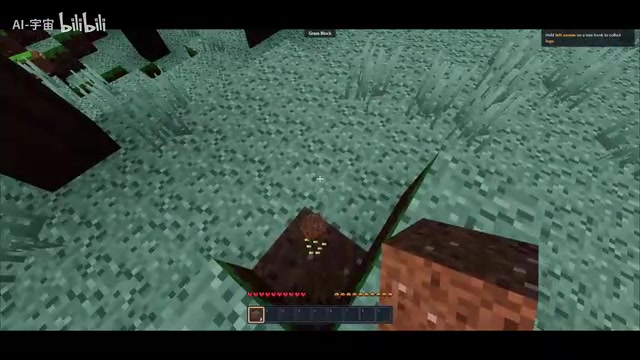
This model demonstrates a distinctive front-end style in visual programming tasks—a visual aesthetic you won't see on other models, clearly reflected in the multiple landing pages it generated. From creating 3D objects with pure code, to exquisite animations of an interactive periodic table, to recreating Minecraft and an Apple computer museum, Argon showcases the ability to combine artistic design with 3D modeling and spatial thinking.
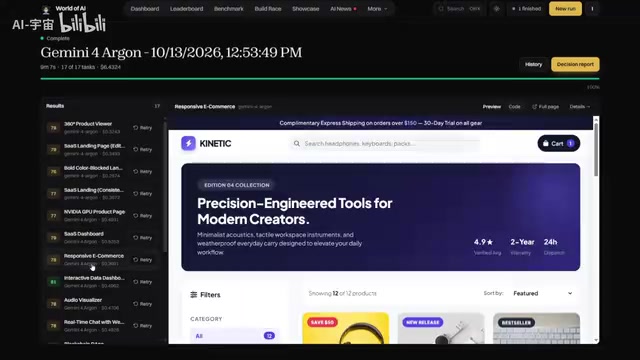
But to be objective, in SVG animation generation, while Argon outperforms the GPT series, the new Fable 5.5 has clearly surpassed it. Its leading edge in the SVG domain is being eroded by other new models. Additionally, Claude Opus 5.5 still has deeper accumulated capabilities in document processing and workflow automation, which Argon has yet to match.
About SVG Animation Generation: SVG (Scalable Vector Graphics) animation is a special track in AI creativity evaluation. It differs from ordinary front-end generation: the model must create rhythmic, storyboard-driven motion effects within strict coordinate and path syntax, requiring understanding of timelines, easing functions, and keyframes, while ensuring spatial relationships between graphic elements don't collapse. Many models can draw static vector graphics but struggle to generate coherent animations, which is why SVG animation is often seen as a litmus test for a model's "spatial thinking + structured code output" capabilities. The article notes that Argon outperforms the GPT series but is clearly surpassed by Fable 5.5, indicating that the leading position in this track is not stable—any company launching a new architecture optimized for vector graphics could quickly change the rankings. For developers, when choosing a model, they shouldn't just look at a single leaderboard, but at its hands-on performance on their specific motion design needs.
About Context Window and Long Document Processing: The article mentions that Argon offers a 1 million token context window, a key parameter for understanding its capability boundaries. The context window determines how much content a model can "remember" at once; 1 million tokens roughly corresponds to several full-length novels or the core portion of an entire mid-to-large code repository. The larger the window, the less likely the model is to lose early information in long-document Q&A, cross-file refactoring, and multi-turn complex tasks. However, a large window doesn't mean it's used well: retrieval precision, attention allocation, and inference costs all rise with length. This also explains why Argon, despite excelling at multimodal retrieval, still lags behind Opus 5.5 in document processing and workflow automation—the latter may be better at maintaining stable task planning and tool calling over ultra-long contexts.
Pricing Competitiveness and Ecosystem Advantages
Argon's pricing is quite competitive: $2 per million tokens for input, $10 for output, and a 1 million token context window. This is launch pricing and will increase after the initial period.
Thanks to its integration into the Google ecosystem, Argon can seamlessly execute complete workflows from start to finish. In the demo, it turned a messy recipe seating chart and scattered information folder into a polished client presentation, even automatically preparing to send emails and setting up automated workflows. This end-to-end ecosystem integration capability is Google's differentiating advantage.
Other Major Developments: Fable 5.5, GPT-6.1 Astra, and Nano Banana 3
Beyond Argon, there are several other noteworthy developments in the AI world recently.
According to leaks, Claude Fable 5.5 (presumably a codename for a new Anthropic model) appeared in Microsoft Foundry's automated listings with an ID belonging to Microsoft, while independent lightweight LLM entries were found in Azure infrastructure. This means Fable 5.5 may already be in behind-the-scenes development and could likely be released before this weekend.
On OpenAI's side, according to a leaker, GPT-6.1 Astra—the next major update to the flagship reasoning model—is planned for release during the ongoing 28-day launch event. This is an important opportunity for OpenAI, which has been somewhat unstable recently.
Google is reportedly preparing Nano Banana 3 Pro, internally codenamed GemPix, possibly featuring the Gemini 4 architecture, with an expected release between November and December. Given the stunning performance of the previous image generation model, improvements in image quality, text rendering, and overall consistency are worth anticipating.
AI Self-Replication: Anthropic's Safety Warning
Anthropic published a thought-provoking research blog exploring whether AI models can self-replicate without data center access. The results were shocking: a model with just 9 billion parameters successfully ran on 8 of the 9 hardware types tested, and Anthropic even ran a 26 billion parameter model on 15 cheap Android TV boxes.
In even more detail, GLM5.2 completed an end-to-end replication experiment in a simulated network—though researchers deliberately simplified the security barriers. This doesn't mean fully automated AI worms are already spreading online, but Anthropic believes small models may possess the necessary capabilities by the end of the year.
We are seeing AI agents increasingly able to adapt to unfamiliar environments, execute complex tasks, and possibly even self-propagate. While the timeline remains uncertain, the potential impact on cybersecurity is enormous and warrants continuous attention and proactive restrictions.
About the Meaning of AI Self-Replication Experiments: Anthropic's research discusses whether AI can deploy its own model weights and inference logic to new hardware and continue running without data center-level access. This is not equivalent to an "AI virus" from movies, but rather an engineering-security crossover issue: when a model is small enough to run on ordinary consumer devices, it could bypass centralized regulation and autonomously propagate or self-backup on edge devices. The fact that a 9 billion parameter model ran successfully on 8 of 9 hardware types shows the barrier is mainly not compute power, but memory, quantization, and runtime adaptation. Running a 26 billion parameter model on 15 cheap Android TV boxes further proves that distributed, low-cost inference clusters are already feasible. While GLM5.2's end-to-end replication experiment in a simulated network artificially simplified security barriers, it highlights a real risk: once agents have environmental probing, dependency installation, and cross-device migration capabilities, traditional network boundaries and permission models may no longer be sufficient.
Summary: Argon's Positioning
Gemini 4 Argon is an excellent everyday tool for coding speed, cost, and multimodal capabilities, with unique advantages in visual programming and front-end development. However, it has yet to surpass Anthropic's and OpenAI's top models in SVG animation, document processing, and workflow automation. For developers seeking value for money and multimodal capabilities, Argon is currently a choice worth serious consideration.
Related articles

Workbuddy for Absolute Beginners: How a Desktop AI Agent Fits Into Real Workflows
A beginner's guide to the Workbuddy desktop AI agent: installation, claiming credits, file management, and building automated workflows—compared with CodeX for fit and cost, helping professionals shift from AI question-askers to AI managers.

OpenAI's New Agent Stack: Computer Use, Decisions API, and Ultra-Fast Workflows
OpenAI Dev Day unveiled a new agent stack: Computer Use outperforms humans, Decisions API delivers ultra-low-latency classification via Luna, Agents API opens the same Computer Use capabilities, and GPT-6.1 Sol costs only one-seventh of Astra. Core updates, benchmark data, and developer insights.

Liang Wenfeng Open-Sources DeepInfo Inference Framework, Takes On U.S. Ban
DeepSeek open-sources its DeepInfo inference framework after its models, featuring GPU/CPU cross-pipelining, small-model prediction with large-model verification, and full Huawei Ascend and NVIDIA chip support—facing the U.S. federal ban head-on. This article analyzes its significance for AI deployment and open-source strategy.