Gemini 4 Argon Hands-On: Which Tasks Beat Claude and GPT?

Gemini 4 Argon excels at multimodal input, but model selection should be by task, not unit price.
Using a 3D mini-game prototype built with Gemini 4 Argon in three prompts, the article maps its boundaries: native text, image, audio, video, and PDF input plus agentic video; a 1M-token context is a shared input/thinking/output budget with a ~65K output limit; it leads on mixed-input and video benchmarks but trails Opus and Astra on terminal and hard engineering tasks. Pricing is $2/$10 until Nov 30, then 4/20. The takeaway: choose by task and test in your own scenario.
Gemini 4 Argon Hands-On: Which Tasks Beat Claude and GPT?
After Gemini 4 Argon launched, a small 3D game became the test case: three lanes, energy pickups, a 60-second goal, and a working prototype after three prompt iterations. Behind this is a redrawing of the model capability boundary — it's not an all-rounder, but in specific scenarios it genuinely edges out Claude and GPT.
Multimodal Input: Argon's Strong Suit
Argon natively supports five input types: text, images, audio, video, and PDF. By contrast, the public specs for Claude and GPT list only text and images, with other capabilities filled in by application-layer tools. This gap gets magnified in workflows that "start from a recording" — you don't need to transcribe first and then feed it to the model; Argon takes the raw material directly.
The video also demonstrates an agentic video mode: the model can call tools to locate relevant segments within a video, rather than uploading the whole thing as in ordinary chat. For tasks that require extracting key frames from long videos for analysis, this eliminates a lot of preprocessing engineering.
Output and Context: A Number That's Easy to Misread
All six compared models claim roughly 1 million tokens of context. But "can hold it" and "can use it well" are two different things.
Argon's regular output limit is about 65,000 tokens, while the others claim about 128,000. It has a special long-output mode that can borrow remaining space from the shared budget to keep generating — but input, thinking process, and answer all share the same budget. This means a million-token context does not equal a million-token output; the actual available space depends on how much the input consumes.
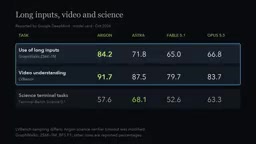
Argon leads on the GraphWalks long-context test and the LV Bench video test. These two tests map exactly to its two selling points: efficiency in handling long inputs, and video understanding. Note that video scores are affected by each model's frame-sampling strategy, so this caveat must be included in any cross-comparison.
Shared budget refers to the total token allowance a model allocates within a single request for input, reasoning process (reasoning/thinking tokens), and final output combined. It is not three separate quotas but a single pool: the longer the input and the longer the thinking, the less space is left for the answer. Therefore, a claimed million-token context only indicates the size of the pool, not how long the answer can be. Understanding this explains why Argon's regular output limit is about 65,000 tokens yet it can "borrow" remaining space via long-output mode to keep generating — how much can be borrowed depends on how much this request's input and thinking consumed.
Benchmark Showdown: Where It Wins, Where It Loses
Where Argon leads:
- Vibe Code Bench 91.9, with Opus and Fable close behind at 90.3 — a slim margin, and only covering one class of coding task
- Vals Index professional task tests
- Automation Bench workflow automation
Where rivals lead:
- Terminal Bench 4: Opus 66.4 vs. Argon 57.4; Opus is steadier in terminal workflows
- Frontier SWE v2 hard engineering problems: Astra 65.5 vs. Argon 55, a clear gap
- Science terminal tests: Astra also leads
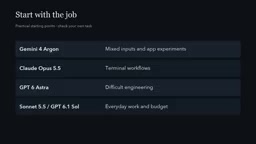
The split is clear: Argon is strong in mixed input and end-to-end application experiments, Opus is strong in terminal operations, and Astra is strong in hardcore engineering problems. Fable 5.1 is positioned for heavy reasoning and long tasks but didn't lead in the above tests; Sonnet 5.5 and GPT 6.1 Sol focus on the balance of speed and cost.
GraphWalks is a class of long-context benchmark used to measure a model's ability to locate, connect, and reason over scattered information in very long inputs, not just whether it can "stuff it in." LV Bench, meanwhile, targets long-video understanding, examining a model's ability to extract events and causal relationships from multi-frame, long-span video. Both emphasize "effective utilization" rather than "capacity." In addition, frame-sampling strategy refers to how often and how many frames a model samples when processing video: denser sampling yields more detail but higher cost, while sparser sampling may miss key moments. Different models use different sampling strategies, so directly comparing video scores is not fair — this caveat must be stated.
The Price Ledger: Real Costs Beyond the Sticker Price
Argon is currently priced at $2 per million input tokens and $10 per million output tokens, on par with Sonnet and Sol. Opus is 4/20, and Astra and Fable are 10/50. Argon's introductory rate ends on November 30, after which it rises to 4/20.
But unit price does not equal total cost. Thinking tokens, caching, tool calls, and service modes all go onto the bill. OpenAI's rate increases once input exceeds 272,000 tokens. More critically, there's rework cost — a cheap answer that needs multiple fixes can end up costing more than a high-priced model that gets it right the first time. The video's advice is to choose models by task, not by price.
Thinking/reasoning tokens are the tokens a model consumes on internal reasoning before giving its final answer; they are usually billed at the output price but are invisible to the user. Prompt caching allows repeatedly used long prefixes (such as system prompts or long documents) to be reused at a discount, significantly lowering the cost of multi-turn conversations. Tool calls generate additional input/output billing, and service modes (such as batch, priority, or fast-response tiers) correspond to different rates. Once these items stack up, the actual bill often diverges from the "$2 input, $10 output" sticker price — hence the author's emphasis on choosing by total task cost rather than unit price.
Real-World Validation: A Playable Prototype in Three Prompts
In the Gemini Canvas preview, the author asked Argon to build a 3D hovercraft game: three lanes, energy pickups, obstacles that cost a heart, and a 60-second clear condition.
The first prompt set the rules and produced the initial screen; the second called for a neon city and clearer visuals; the third focused on controls and checking the logic. The revised preview took some time to load, but once loaded, pause, resume, and restart all worked properly — the timer paused, the game continued, and restart restored hearts and reset the score. The author ultimately survived 33.4 seconds, not completing the 60-second goal.
There's an honest detail here: the model's report marked the browser check as untested. In other words, the prototype runs, but there's still verification work to do before it's shareable. This ties back to the selection logic — Argon is good for quickly turning an idea into something interactive, but pre-delivery checks can't be skipped.
Gemini Canvas is an interactive workspace within Gemini oriented toward "generate while chatting," producing and previewing runnable web pages, mini-games, or interactive prototypes directly in the conversation — ideal for rapid idea validation. Preview means the model or feature is still in an early availability stage, and behavior may be unstable, load slowly, or lack full validation. The article's note that "the revised preview took some time to load" is exactly this phenomenon. And precisely for this reason, a working prototype does not equal a deliverable — browser checks, edge-case testing, and other engineering validations still need to be added manually.
Selection Advice
Per the video's conclusion: use Argon for mixed input and application experiments to start; choose Opus for terminal workflows; Astra for hard engineering tasks; and consider Sonnet or Sol when sensitive to response speed and budget. In the end there's only one criterion — run it on your own task and see the result.
One-line Summary
Gemini 4 Argon excels at multimodal input, but model selection should be by task, not unit price.
Paragraph Summary
Using a 3D mini-game prototype built with Gemini 4 Argon in three prompts as a hook, the article maps out its capability boundaries: native support for text, images, audio, video, and PDF inputs, plus agentic video segment location; its million-token context is actually a shared budget across input, thinking, and output, with a regular output limit of about 65,000 tokens. On benchmarks, Argon leads in mixed-input and video tasks such as Vibe Code Bench, GraphWalks, and LV Bench, but clearly trails Opus and Astra on Terminal Bench and hard engineering problems. The promo price is $2/$10, rising to 4/20 after November 30, and thinking tokens, caching, tool calls, and rework costs all affect the total bill. The conclusion: choose by task and test in your own scenario.
Related articles

JobRunner MCP Server: AI Agents Can Now Fix Failed Java Jobs
JobRunner launches an open-source MCP server enabling AI agents to view cluster status, diagnose failures, and recover Java jobs—incident response from any cloud coding environment or existing agent.

MLAI Digital Launches 9 Security Agents: MCP Server Safeguards the Full Lifecycle of Agentic AI
MLAI Digital launches Security MCP Server with nine built-in specialized security agents covering vulnerability discovery, attack simulation, prompt injection detection, API and infrastructure assessment, and accelerated remediation—embedding security validation across the full Agentic AI lifecycle from development to production.

Running Isaac Lab on H100 GPUs: Exploring Better Approaches
Exploring optimization methods for running Isaac Lab on NVIDIA H100 GPUs, including MIG configuration, mixed precision, TensorRT acceleration, and community experience to improve robotics simulation and reinforcement learning efficiency.