Gemini 4 Argon Launches: A New Frontier Model Built for Complex Workflows

Google's Gemini 4 Argon targets coding, enterprise knowledge work, and cybersecurity via a controlled trusted-tester rollout.
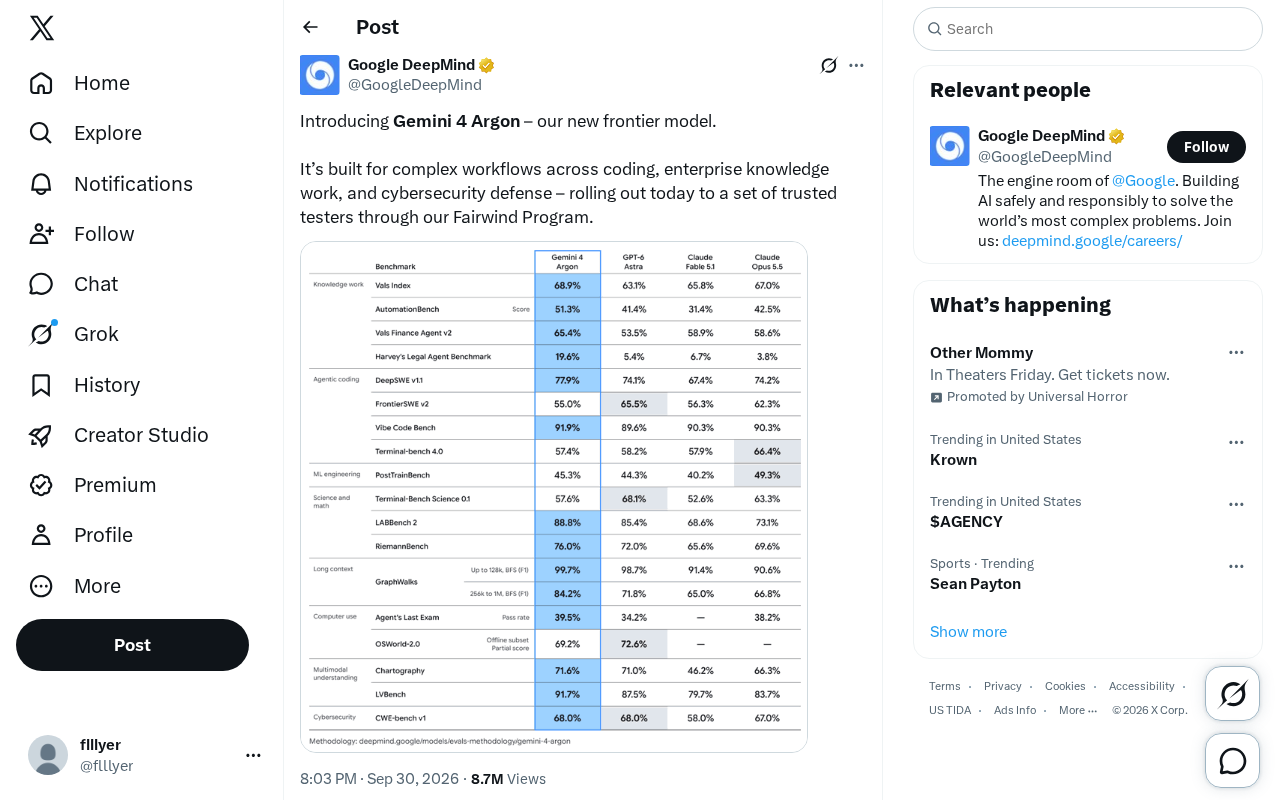
Google has launched Gemini 4 Argon, a new frontier model explicitly positioned for three high-complexity professional domains: coding, enterprise knowledge work, and cybersecurity defense. Rather than a general consumer release, it's being distributed through the Fairwind Program to a select group of trusted testers — consistent with industry norms for controlled rollouts of high-risk capabilities. The launch signals a broader shift in frontier AI competition, moving away from chasing general-purpose scale toward scenario-specific productivity value. Key details including parameter count, benchmarks, pricing, and general availability timelines have not yet been disclosed.
Google has introduced a new frontier model called Gemini 4 Argon, rolling it out to a set of trusted testers through the Fairwind Program. Based on what's been officially disclosed, this is not a general consumer release — it's a targeted launch aimed at high-complexity professional use cases.
Positioning: Three Core Complex Workflows
In official communications, Gemini 4 Argon is explicitly described as a "frontier model built for complex workflows," covering three core areas:
- Coding: Code generation, debugging, and large-scale engineering tasks
- Enterprise knowledge work: Internal documents, business processes, and knowledge-intensive tasks
- Cybersecurity defense: Threat identification and defensive security operations
What these three areas share is a demand for long-chain reasoning, sustained context retention, and highly reliable outputs. Compared to earlier models that emphasized "all-around conversation," Argon shifts the focus squarely onto professional productivity — a signal that competition in frontier AI is moving from general capability toward deep vertical specialization.
Frontier models refer to the most capable and comprehensive large language models at the current edge of technology — typically characterized by massive parameter counts, complex reasoning, and multi-step task execution. The term was first coined by AI safety researchers and has since been adopted by regulators (such as the EU AI Act) as a category requiring special scrutiny. Unlike general consumer models, frontier models tend to carry high deployment costs and inference latency, so vendors typically route them to professional users who can justify premium pricing and demand peak performance. Google's previous frontier model lineup (including Gemini Ultra) has followed the same targeted distribution logic.
Fairwind Program: A Controlled, Trusted Testing Channel
One notable aspect of this launch is how it's being distributed. Gemini 4 Argon is not open to all users — it's being gradually rolled out to a set of trusted testers through the Fairwind Program.
This kind of controlled release strategy is becoming increasingly common for frontier model deployments. On one hand, for sensitive applications like cybersecurity defense, the dual-use nature of model capabilities demands more cautious access controls. On the other hand, enterprise and security scenarios require far higher standards of stability and compliance than consumer products — a limited gray-area rollout helps gather real-world feedback and mitigate risk before broader availability.
As for the name itself: "Argon" — a stable, inert noble gas — may hint at design priorities around stability and controllability, though Google has offered no official explanation for the naming choice.
Controlled rollouts and staged testing are standard risk-reduction practices across the tech industry, and they're especially critical in AI. OpenAI used a similar API waitlist mechanism when launching GPT-4; Anthropic ran closed testing to collect early feedback on Claude. For security-focused models, the case for controlled release is even stronger — a model capable of vulnerability analysis and penetration testing could cause serious harm if misused by bad actors. This connects directly to the dual-use problem in large language models: the same capabilities that enable defense can also enable attack. As a result, some government agencies and security research organizations now require vendors to submit safety evaluation reports before releasing such models.
Industry Signal: The Professionalization of Frontier Models
Viewed against the broader industry backdrop, Argon sends several signals worth paying attention to.
First, capabilities are being tied to specific scenarios. Past model launches leaned heavily on parameter counts and benchmark leaderboards. This time, Google leads with three concrete workflow categories — coding, enterprise knowledge, and security defense — suggesting vendors are increasingly choosing to define model value through real productivity outcomes rather than abstract general intelligence metrics.
Second, cybersecurity is emerging as a major battleground for large models. Listing cybersecurity defense as a core use case means large models are being positioned to play an active defensive role — which raises the bar significantly for reliability and explainability.
Third, staged, trust-gated deployment is becoming the norm. Programs like Fairwind — built around trusted testers — represent an ongoing effort to balance expanding capability with meaningful risk control.
Key Information Still Missing
Official details remain limited. Specifics on parameter size, context window, benchmark performance, pricing, and the timeline for general availability to developers and enterprise customers have not been disclosed. The entry criteria and tester scope for the Fairwind Program have also not been made public.
For developers and enterprise users hoping to evaluate Argon's real-world capabilities, these gaps mean the current moment is still largely about expectation management. Actual performance will need to be verified through subsequent testing feedback and independent evaluations.
Takeaway
The launch of Gemini 4 Argon marks another move by Google on the frontier model chessboard, with a clear value proposition targeting three high-complexity domains: coding, enterprise knowledge work, and cybersecurity defense. By rolling it out through the Fairwind Program, Google has opted for a measured rather than aggressive release cadence. Until more technical details are available, this looks more like a directional signal than a fully formed product announcement — one that points toward where frontier AI competition is heading: deeper specialization, vertical focus, and trust-gated deployment.
Related articles

Chain of Thought Isn't Just for AI: How Humans Can Use CoT to Improve Thinking Quality
Chain of Thought isn't just a prompt trick for large models. Starting from a Hacker News discussion, this article analyzes why CoT works for human thinking too, breaks down actionable ways to transfer it, and highlights the key differences between human CoT and machine CoT.
Cloudflare Teams Up with OpenAI: Closi…
Cloudflare Teams Up with OpenAI: Closing the Loop from Vulnerability Discovery to Defense with AI
Cloudflare uses OpenAI Daybreak to investigate security vulnerabilities and generate reviewable remediation plans, while developers use Codex to boost coding efficiency and quality.

Orca Multi-Agent Orchestration in Practice: A Guide to Parallel Collaboration with Claude and Codex
Orca is Stable AI's free open-source agent workbench supporting 34 agents like Claude Code and Codex in parallel. Learn its Git worktree isolation, multi-model orchestration, and mobile management.