Gemini 4 Argon Leak: Analyzing Rumors of Google's Next-Gen LLM
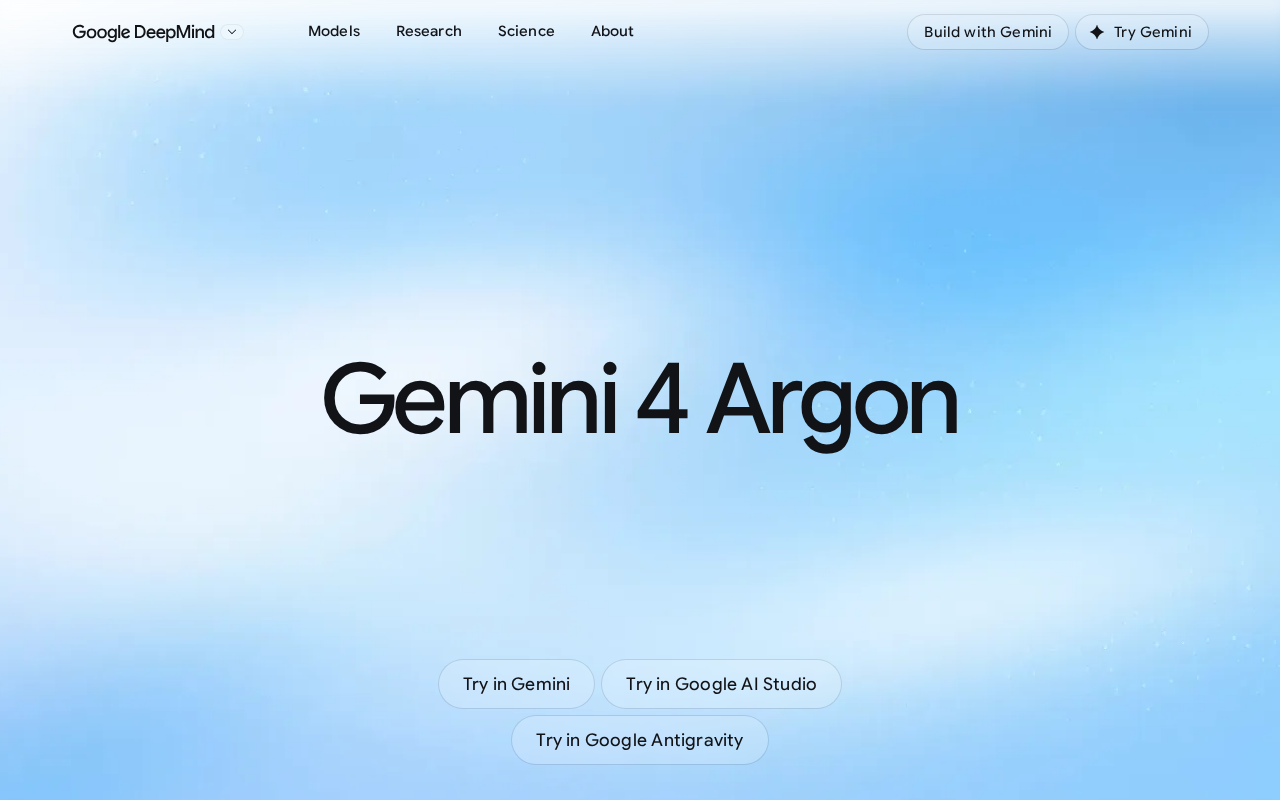
The 'Gemini 4 Argon' entry appeared in Hacker News RSS, sparking speculation about Google's next-gen LLM.
The article centers on the 'Gemini 4 Argon' entry that appeared in Hacker News' RSS feed, outlining developer community speculation about Google's next-generation large model. The author notes that the chemical element naming 'Argon' may hint at an internal codename system adjustment, and speculates the model may focus on three directions: context window expansion, native multimodal deepening, and reasoning capability improvement. In the competitive landscape, Google holds unique advantages through full-stack integration from TPUs to cloud services, but whether this translates into leadership depends on the model's own performance. The article also reminds readers that the entry lacks official confirmation, with discussion mainly speculative, and that developers and enterprises should base technology choices on verified capabilities rather than betting on unreleased versions.
Rumors about Google's next-generation large model, Gemini 4, are fermenting in the developer community. An entry titled "Gemini 4 Argon" appeared in Hacker News' RSS aggregation feed, quickly sparking speculation and discussion about Google's AI roadmap.
Why Gemini 4 Argon Is Drawing Attention
The naming choice of "Argon" itself is worth pondering. Google's previous models mostly followed the pattern of Gemini plus a number or suffix, and introducing a chemical element name may hint at an internal codename system adjustment. Argon is a noble gas with extremely low chemical reactivity — whether this metaphorizes the model's design orientation toward safety or stability remains undetermined.
Judging by the discussion heat on Hacker News, the developer community is especially sensitive to the iteration cadence of the Gemini series. The release gap between Gemini 1.5 and Gemini 2.0 previously sparked debates about whether Google's AI strategy was aggressive enough, and the speculation that "Gemini 4" skips directly over the number 3 has further heated up the discussion.
How Hacker News and RSS Aggregation Feeds Work
Hacker News (HN) is a tech community operated by Y Combinator, and its content aggregation relies heavily on user voting and submission mechanisms. HN provides official RSS (Really Simple Syndication) feeds, which third-party tools and aggregators periodically crawl. So-called "appearing in an RSS feed" usually means that a certain title or entry was submitted to HN's submission queue, or forwarded through some aggregation service. This means the entry could come from an ordinary user submission, an automated crawl, or even a mislabeling — rather than any official release. For this reason, inferring a product roadmap solely from an entry appearing in RSS carries significant risk — it could be an accidental leak of internal test content, or simply a fabricated or predictive headline by a community member. Understanding HN's information generation chain helps readers assess the credibility of such "leaks."
The Product Logic Behind the Naming Pattern
Looking back at the version evolution of Google's Gemini series, from the original Gemini 1.0 to 1.5, and then to subsequent multimodal-enhanced versions, each version number jump has been accompanied by substantive architectural changes. If "Gemini 4 Argon" indeed points to a major version iteration, then it may signify technological breakthroughs in the following directions:
Further expansion of the context window. Gemini 1.5 once stunned the industry with a million-level token context window. If Gemini 4 wants to continue leading in this dimension, it may need to handle contexts of tens of millions or even longer, posing entirely new requirements for attention mechanisms and inference efficiency.
Deepening of native multimodal capabilities. Google has consistently emphasized Gemini's "native multimodal" positioning, from unified processing of text, images, audio, and video. The next-generation model may add more modal input and output capabilities on this basis.
Systematic improvement in reasoning capabilities. Facing competition from OpenAI's o series and Anthropic's Claude on complex reasoning tasks, Gemini 4 needs to show clear progress in dimensions such as mathematics, code, and logical reasoning.
Context Windows and Attention Mechanisms
The context window refers to the total number of tokens a model can "see" simultaneously in a single inference, determining how long a document, codebase, or conversation history the model can handle. Gemini 1.5 was regarded as a milestone because it pushed the window to the million-token level — equivalent to reading several long novels or tens of thousands of lines of code in one go. However, bigger isn't always better: the attention computation complexity of a standard Transformer grows quadratically with sequence length, meaning doubling the length increases compute and memory overhead by roughly four times. To maintain usable efficiency at tens-of-millions-level context, optimizations such as sparse attention, chunked retrieval, state space models, or hybrid architectures are typically needed. This is precisely the engineering challenge behind the speculation of "continued context expansion," and a key observation point for judging whether a new-generation model truly has an architectural breakthrough.
The Difference Between Native Multimodal and "Concatenated Multimodal"
Early multimodal approaches mostly adopted a "concatenation" strategy: using a vision encoder to convert images into vectors, then feeding them to a language model. This approach often shows limited performance on cross-modal reasoning. "Native multimodal" means the model is jointly trained on mixed data including text, images, audio, and video from the pre-training stage, with all modalities sharing the same set of representations and attention mechanisms, making tasks like image-text reasoning and video understanding more natural. Google has consistently used this feature of Gemini as a differentiating selling point. If the next-generation model continues to deepen this route, possible signals include: stronger real-time audio-video input and output, cross-modal generation (such as generating structured text from video), and unified handling of more sensory channels within a single model, rather than deploying separate models for each modality.
The Time Window Under the Competitive Landscape
The current competitive landscape of the large model race determines that Google cannot slow down its iteration pace. OpenAI's GPT series continues to update, Anthropic's Claude has built a reputation in coding and enterprise scenarios, and the open-source camp's Llama and Mistral are also catching up rapidly.
Google's advantage lies in vertical integration capability — from TPU chips to data centers, from search distribution to cloud services, this full-stack layout gives Gemini unique advantages in deployment cost and application scenarios. But whether the advantage can translate into product leadership depends on the model's own performance.
"Gemini 4 Argon" is currently just an entry appearing in an RSS feed, lacking official confirmation. Discussions on Hacker News are also mainly speculation and anticipation, with no substantive technical details leaked yet.
Implications for Developers and Enterprise Users
For teams evaluating AI technology stacks, every iteration of the Gemini series is worth attention, but there's no need to over-bet on unreleased versions. Currently available Gemini models have already demonstrated practical value in multimodal processing and long-context scenarios. Enterprise selection should be based on verified capabilities rather than rumored specifications.
At the same time, Google's AI product naming and versioning strategy is becoming more complex. From Gemini to Gemma (the open-source model series), and to the possible Argon codename, developers need to build a clearer understanding of the product line to avoid confusion in actual projects.
If Gemini 4 is indeed in preparation, Google may choose to officially unveil it at a major developer conference or a dedicated product launch event. Until then, all discussion is just one piece of the puzzle.
Summary
Although the "Gemini 4 Argon" leak contains limited information, it reflects the developer community's high attention to Google's AI progress. The chemical element metaphor of "Argon" in the name, the possible version jump, and the benchmarking relationship with competitors are all clues worth continuously tracking. Before official news lands, staying attentive but not over-interpreting may be the best posture when facing such rumors.
Background Supplement
Competitor Comparison: o Series, Claude, and the Open-Source Camp
The several competitors mentioned in the article each have their own focus, and understanding them helps grasp the positioning pressure on Gemini 4. OpenAI's o series focuses on "inference-time compute" — trading longer reasoning chains for higher accuracy on tasks like mathematics and competitive programming; Anthropic's Claude has built a reputation in long-document processing, code engineering, and enterprise compliance scenarios; on the open-source side, Llama and Mistral attract teams sensitive to data sovereignty with self-hostability, fine-tunability, and controllable costs. Google's relative advantage is full-stack integration: in-house TPUs, proprietary data centers, and ready-made distribution channels through search and cloud, giving it structural advantages in per-unit inference cost and deployment scenarios. But integration advantages can only be realized when model performance isn't clearly outpaced — which is also the fundamental reason the community closely watches Gemini's iteration pace.
Related articles

Gmod TTT: Boba's Winning Streak and Game Design Insights
An in-depth analysis of Gmod TTT's role system, creative items, and social gameplay mechanics, exploring the relationship between randomness design and game balance through Boba's winning streak phenomenon.

FlexBudget: Fair Comparison of KV Cache Eviction Strategies Under a Unified Compute Budget
AMD engineer proposes FlexBudget at PyTorch Conference: a training-free fair comparison method for KV cache eviction rules using fixed kernels and memory budgets, all in core PyTorch.
