Gemini 4 Argon Optimizes 200,000 Lines of Code Overnight, Tops Three Benchmarks

Google's Gemini 4 Argon optimizes 200,000 lines of code overnight, leads three benchmarks, and opens globally.
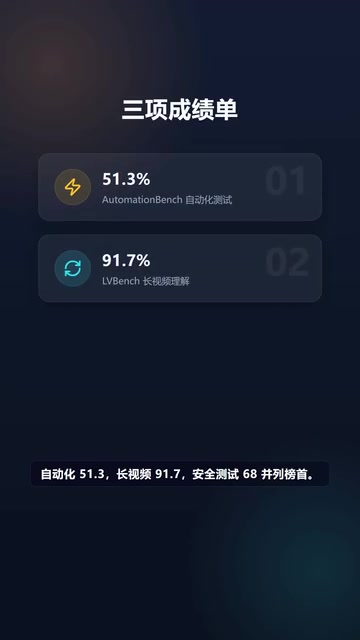
Google released Gemini 4 Argon, drawing attention for optimizing 200,000 lines of code overnight rather than benchmark scores alone. It scored 51.3 in automation, 91.7 in long video understanding, and 68 in safety tests (tied for first), covering Agent execution, multimodal video comprehension, and AI safety. Three entry points opened globally with pricing announced, signaling an aggressive distribution strategy targeting developers and enterprises.
Google has released its next-generation large model, Gemini 4 Argon. What's most striking isn't the usual benchmark improvements, but a concrete, almost extreme real-world data point: 200,000 lines of code optimized overnight. This news was first covered by a Bilibili AI daily news creator and quickly sparked widespread discussion in developer communities.

Three Hard Metrics: Automation, Long Video, and Safety Testing
According to benchmark data compiled by the creator, Gemini 4 Argon delivered impressive results across three key dimensions:
- Automation task score: 51.3
- Long video understanding score: 91.7
- Safety test score: 68, tied for first place
These three numbers correspond to the three most fiercely contested battlegrounds in current large model competition. The automation task score reflects the model's execution capability in Agent scenarios—not just answering questions, but whether it can autonomously complete multi-step operations. A score of 51.3 places it in the top tier among current models in its class, indicating that Google has made substantial progress in getting models to "do the work themselves."
The 91.7 in long video understanding is even more noteworthy. Video understanding has always been a challenge for multimodal models, especially coherent understanding and key information extraction from long-duration content. A score above 90 means the model can achieve near-human-level comprehension accuracy when processing long videos, which has direct application value for content moderation, video summarization, and educational scenarios.
The safety test score of 68, tied for first place, responds to external expectations for Google's investment in AI safety. This score itself isn't particularly high, but "tied for first" shows that the entire industry still has significant room for improvement in this dimension.

About Agent scenarios: The term "Agent" refers to a system form where a large model doesn't just passively answer questions, but can autonomously plan, call tools, execute multi-step tasks, and continue adjusting after observing results. The automation task score measures the model's execution success rate in such scenarios, typically examining whether it can correctly decompose tasks, select appropriate tools, handle intermediate errors, and ultimately complete the task loop. This dimension has become a competitive focus because it directly determines whether large models can transform from "chatbots" into "digital employees you can entrust work to."
200,000 Lines of Code Completed Overnight: Real-World Performance Is the True Watershed
More convincing than benchmarks is real-world performance. According to the original material, Gemini 4 Argon completed optimization work on 200,000 lines of code in a single night.
The impact of this data lies in its scale. For any medium-to-large engineering project, 200,000 lines of code represents a magnitude of refactoring that would take a team weeks or even months to complete. If Gemini 4 Argon can indeed handle code optimization at this scale in a single task, then what it represents isn't just an upgrade to a "programming assistant," but a qualitative leap in automated software engineering.

Of course, this number needs to be viewed rationally. The specific meaning of "optimization," the quality baseline of the code, and the actual results after optimization—these details weren't elaborated in the original material. But even with a discount, the scale of handling 200,000 lines is enough to demonstrate that Gemini 4 Argon has achieved generational improvements in context window and code reasoning capabilities.
About context windows and code reasoning: How much code a large model can process at once depends on its context window capacity (typically measured in tokens), while whether it can truly understand and correctly modify that code depends on code reasoning ability. 200,000 lines of code far exceeds the tens-of-thousands token window limits of early models, meaning the model needs to maintain consistent understanding of cross-file dependencies, function call chains, and type definitions within long contexts. This often requires combining retrieval augmentation, structured code indexing, or hierarchical summarization techniques—simply stacking window length isn't enough to guarantee optimization quality.
Three Entry Points Open Globally: Google's Distribution Strategy Has Changed
One piece of information repeatedly emphasized in the original material is "three entry points open globally." Though brief, this statement reveals a clear strategic signal: Google didn't choose phased rollout or regional restrictions this time, but instead launched simultaneously across multiple entry points.
This differs from Google's relatively cautious pace when releasing large models in the past. The specific forms of the three entry points (possibly the Gemini app, API interface, and the enterprise-facing Vertex AI platform) mean that from ordinary users to developers to enterprise customers, everyone can access this model from day one. Pricing information was also announced, indicating that Google has adopted a more aggressive commercialization posture with this release.
From a competitive landscape perspective, this move is highly targeted. Competition in the large model market has shifted from "whose benchmarks are higher" to "who can be adopted faster," and open entry points with transparent pricing are the most direct means of winning developer mindshare.
About Vertex AI: Vertex AI is Google Cloud's machine learning platform for enterprise customers, offering one-stop capabilities including model training, deployment, tuning, and API calls. Launching new models simultaneously on Vertex AI means enterprises can directly integrate Gemini 4 Argon into their production systems without building their own inference infrastructure. For Google, this is also a more stable commercialization path with higher per-customer value than consumer applications, which is why the enterprise entry point among the "three entry points" is often regarded as the strategic center of gravity.
What It Means for Developers
The true value of Gemini 4 Argon isn't how much better it is than its predecessor, but that it pushes the capability boundary of large models from "assisted programming" to "batch automated engineering." If a model can handle optimization tasks on 200,000 lines of code overnight, then software team collaboration methods, code review processes, and even project scheduling logic all need to be rethought.
In the short term, the most direct beneficiaries may be teams maintaining large legacy codebases. In the long term, when the marginal cost of code optimization approaches zero, the bottleneck in software development will shift from "writing code" to "defining problems" and "verifying results." This is both an opportunity and a change that needs to be adapted to in advance.
One-line Summary
Google's Gemini 4 Argon optimizes 200,000 lines of code overnight, leads three benchmarks, and opens three entry points globally.
Paragraph Summary
Google released its next-generation large model Gemini 4 Argon, and what drew the most attention wasn't the usual benchmarks but the real-world data point of "200,000 lines of code optimized overnight." Benchmarks show automation task score of 51.3, long video understanding of 91.7, and safety test of 68 tied for first place, corresponding to three competitive fronts: Agent execution capability, multimodal long video understanding, and AI safety. More critically, the release strategy: three entry points opened globally with pricing announced, showing Google's shift from cautious phased rollout to aggressive distribution targeting the developer and enterprise ecosystem. The article argues that if the scale of 200,000 lines of code optimization is accurate, the capability boundary of large models will shift from assisted programming to batch automated engineering, and software team collaboration, code review, and project scheduling logic all need rethinking.
Related articles

JobRunner MCP Server: AI Agents Can Now Fix Failed Java Jobs
JobRunner launches an open-source MCP server enabling AI agents to view cluster status, diagnose failures, and recover Java jobs—incident response from any cloud coding environment or existing agent.

MLAI Digital Launches 9 Security Agents: MCP Server Safeguards the Full Lifecycle of Agentic AI
MLAI Digital launches Security MCP Server with nine built-in specialized security agents covering vulnerability discovery, attack simulation, prompt injection detection, API and infrastructure assessment, and accelerated remediation—embedding security validation across the full Agentic AI lifecycle from development to production.

Running Isaac Lab on H100 GPUs: Exploring Better Approaches
Exploring optimization methods for running Isaac Lab on NVIDIA H100 GPUs, including MIG configuration, mixed precision, TensorRT acceleration, and community experience to improve robotics simulation and reinforcement learning efficiency.